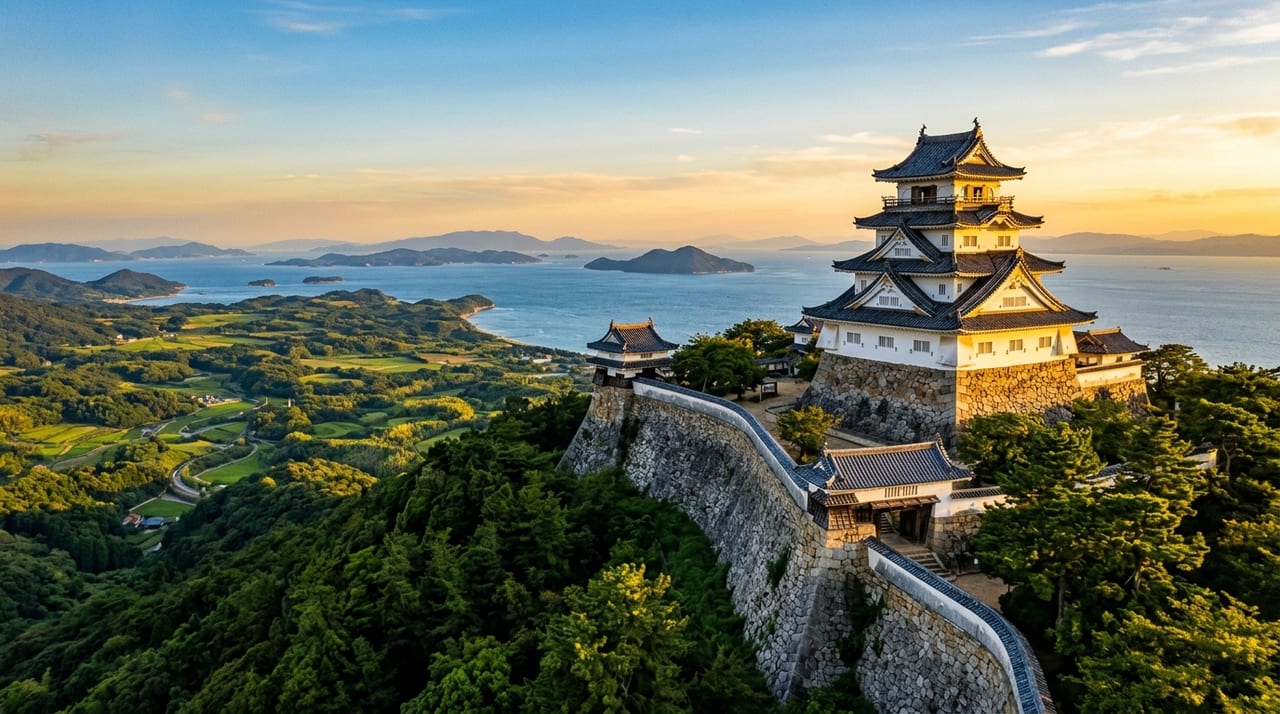
 * Image is for illustrative purposes only.
Sumoto Castle
洲本城
Sumoto Castle is a historic castle in the Kansai region (Built in Daiei 6 (1526); major reconstruction by Wakisaka Yasuharu from Tenshō 13 (1585) onward). Its lord was Atagi Fuyuyasu / Wakisaka Yasuharu.
Overview
Mountain Castle on Mount Mikuma
Sumoto Castle is a mountain castle built on the summit of Mount Mikuma, 133 meters above sea level, in the central part of Awaji Island, Hyogo Prefecture. Its grand location, overlooking the beautiful scenery of the Seto Inland Sea and Awaji Island below, is a defining feature. Most of the surviving stone walls date from the major reconstruction by Wakisaka Yasuharu, who became castle lord in Tenshō 13 (1585). The climbing stone walls (nobori-ishigaki), which drew on his experience at the wajō (Japanese castles built in Korea), preserve the technical standards of early-modern castle architecture to this day. From the donjon platform, views spread out over the city of Sumoto and Ōhama Beach below, and the site has become a popular tourist destination.
The Age of Miyoshi and Atagi
Sumoto Castle was built in Daiei 6 (1526) by Atagi Haruoki, a senior retainer of the Miyoshi clan, and was later inherited by Atagi Fuyuyasu. Atagi Fuyuyasu was the younger brother of Miyoshi Nagayoshi and a powerful figure who commanded the naval forces of Awaji and the Kii Channel. The geographic position of Awaji Island was a key point in determining control of the Seto Inland Sea, and Sumoto Castle functioned as its military stronghold. During the Tenshō era (1573–92), control of the castle changed hands as the Miyoshi clan declined. After Hashiba Hideyoshi conquered Awaji, warlords affiliated with the Toyotomi were appointed as castle lords.
Wakisaka Yasuharu and Sekigahara
In Tenshō 13 (1585), Wakisaka Yasuharu became lord of Sumoto Castle. Wakisaka Yasuharu is known as one of the Seven Spears of Shizugatake under Toyotomi Hideyoshi, and he was active as a naval commander in the Bunroku and Keichō campaigns (the Korean invasions). At the Battle of Sekigahara in Keichō 5 (1600), he initially sided with the Western Army (Ishida Mitsunari's faction) but is known for switching to the Eastern Army (Tokugawa Ieyasu's faction) after observing how the battle was going. After Sekigahara, he continued to rule Awaji as lord of Sumoto Castle and carried out a major renovation of the castle's stone walls to the scale seen today. The Wakisaka family was subsequently transferred to Ōzu Domain in Iyo, and Sumoto Castle was placed under the jurisdiction of the Hachisuka family of Awa Tokushima Domain.
The Stone Walls of the Castle Ruins and "Japan's Oldest Mock Donjon"
The stone walls of Sumoto Castle remain in good condition today and are designated as a National Historic Site. The donjon standing on the mountain is a mock donjon built in the early Shōwa period (1928), and it draws distinctive interest among castle researchers as "Japan's oldest mock donjon (reinforced concrete construction)." At the foot of the mountain, remains of the early-modern Sumoto Castle (its flatland section) also survive, preserving traces of the castle town to this day.
Connection to Swords
Wakisaka Yasuharu
Wakisaka Yasuharu was counted among the Seven Spears of Shizugatake and, as a commander of the naval forces of the Toyotomi regime, took part in the Bunroku and Keichō campaigns (1592–98), experiencing both naval and land battles on the Korean Peninsula. When he became lord of Sumoto Castle in Tenshō 13 (1585), he carried out a major renovation of the castle, built a donjon, and installed climbing stone walls (nobori-ishigaki) drawing on his experience at the wajō (Japanese castles built in Korea).
Seto Inland Sea Naval Forces and Awaji Island
Awaji Island, where Sumoto Castle is located, was a base of naval forces contending for control of the Seto Inland Sea during the Sengoku period, and warlords who led naval forces, such as the Atagi and Wakisaka clans, served as castle lords.
Korean Invasions
The Bunroku and Keichō campaigns, in which Wakisaka Yasuharu took part, were large-scale overseas wars in which Japanese warlords fought the armies of Korea and Ming.
Highlights
- Summit stone walls (National Historic Site) — well-preserved Keichō-era coursed masonry
- Japan's oldest reinforced-concrete mock donjon (built 1928) — a unique curiosity in castle history
- Panoramic Seto Inland Sea views from the summit — islands and straits in every direction
- Wakisaka Yasuharu heritage — one of Hideyoshi's 'Seven Spears of Shizugatake,' who as lord rebuilt the stone walls and added climbing stone walls (nobori-ishigaki)
- Sumoto castle town — vestiges of the Edo-period lowland castle and historic streetscape
* Opening hours and admission fees are subject to change. Please check the official website before visiting.