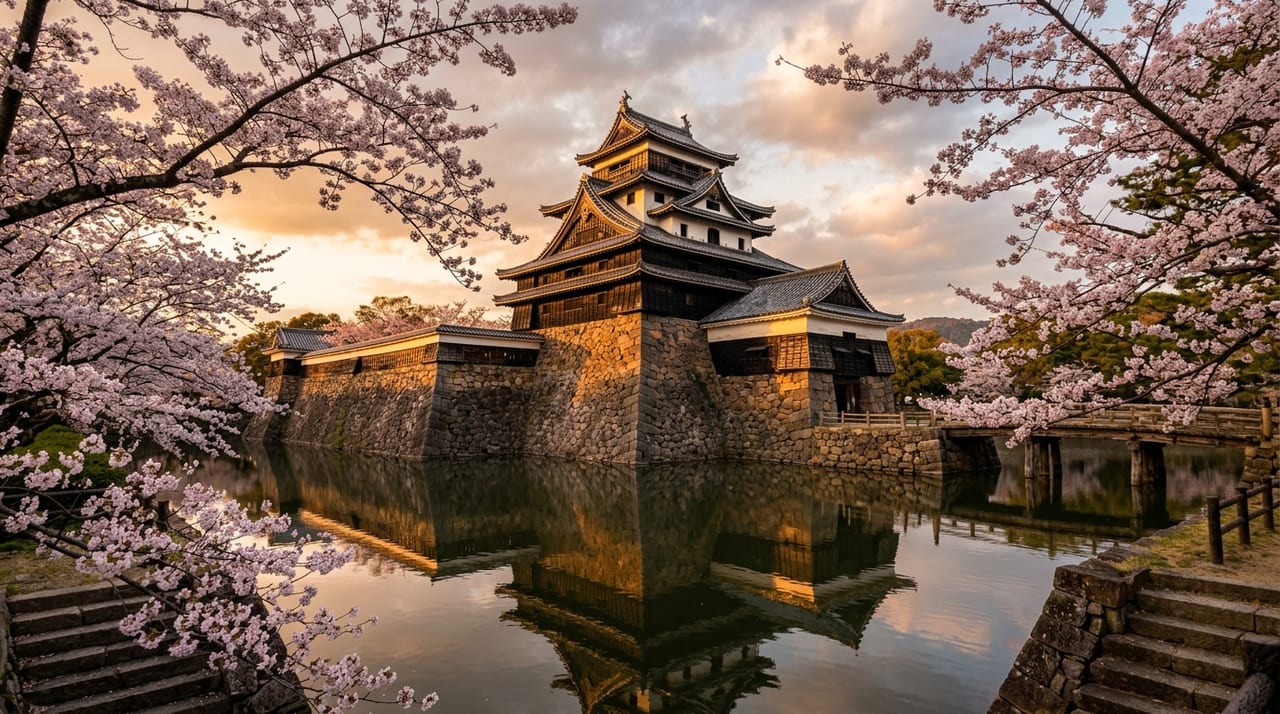
 * Image is for illustrative purposes only.
Uda Matsuyama Castle
宇陀松山城
Uda Matsuyama Castle is a historic castle in the Kansai region (Northern and Southern Courts period to early Edo period). Its lord was Akiyama clan, Taga clan, Fukushima Takaharu.
Overview
Overview
Uda Matsuyama Castle is a mountain castle located in Ō-Uda District, Uda City, Nara Prefecture, built on a summit at an elevation of 473 meters. It is designated as a National Historic Site (Uda Matsuyama Castle Ruins) and has also been selected as one of the Continued Japan 100 Castles (No. 166). The castle town has been selected as an Important Preservation District for Groups of Traditional Buildings, making it a rare example in which the castle and its castle town remain together as cultural properties.
History
It began as the castle of the Akiyama clan, one of the Three Generals of Uda (the Akiyama, Yoshino, and Sawa clans). The date of construction is unknown, but it is thought to have been in place by the Nanboku-chō period. After the Akiyama clan withdrew in Tenshō 13 (1585) in connection with Toyotomi Hidenaga's move into Yamato-Kōriyama, the castle became the seat of Itō Yoshiyuki, Katō Mitsuyasu, Haneda Masachika, and Taga Hidetane, and it was remodeled into an early modern castle. Under the Toyotomi regime, it was positioned, together with Yamato-Kōriyama Castle and Takatori Castle, as a key base for controlling Yamato Province. After the Battle of Sekigahara (1600), Fukushima Takaharu, younger brother of Fukushima Masanori, was granted a fief of 30,000 koku at Uda Matsuyama and entered the castle. Takaharu carried out further large-scale remodeling, but in the Summer Campaign of Osaka in the 1st year of Genna (1615) he was dismissed from his domain on suspicion of having colluded with the Toyotomi side. The castle was then dismantled and abandoned by Kobori Enshū and others.
Structure and Features of the Castle
On the summit, enclosures such as the tenshudai (tenshu base), the main enclosure (shukaku), and the ni-no-maru are laid out, and stone wall remains survive in good condition. The all-stone walls (sō-ishigaki) introduced in the remodeling by Fukushima Takaharu demonstrate techniques from the transition to early modern castles. Remains have also confirmed the existence of a tenshukaku (main keep), and the castle functioned as a powerful stronghold in the mountains of Yamato Province.
Relationship with the Castle Town
The townscape of Uda Matsuyama that formed beneath the castle still retains the atmosphere of the Edo period and is designated as an Important Preservation District for Groups of Traditional Buildings. The castle ruins and the castle town are preserved and maintained as a single whole, and the completeness of the historical landscape is high.
Connection to Swords
The castle lord, Fukushima Takaharu, belonged to the Eastern Army together with his elder brother Fukushima Masanori at the Battle of Sekigahara, and attacked Kuwana Castle, which was held by the Western Army's Ujiie Yukihiro.
Access and Current Condition
From Haibara Station on the Kintetsu Osaka Line, take a Nara Kotsu bus and get off at Ō-Uda; the trailhead is about a 20-minute walk. The castle site is currently maintained and managed by the Uda City Board of Education. Admission to view the site is free.
Connection to Swords
The castle lord, Fukushima Takaharu, was a warlord who belonged to the Eastern Army at the Battle of Sekigahara.
Highlights
- Stone-walled mountain castle summit at 473m elevation
- Castle town designated as Important Preservation District for Historic Buildings
- National Historic Site and Continued Japan 100 Fine Castles No.166
- Well-preserved keep platform and stone wall ruins
* Opening hours and admission fees are subject to change. Please check the official website before visiting.