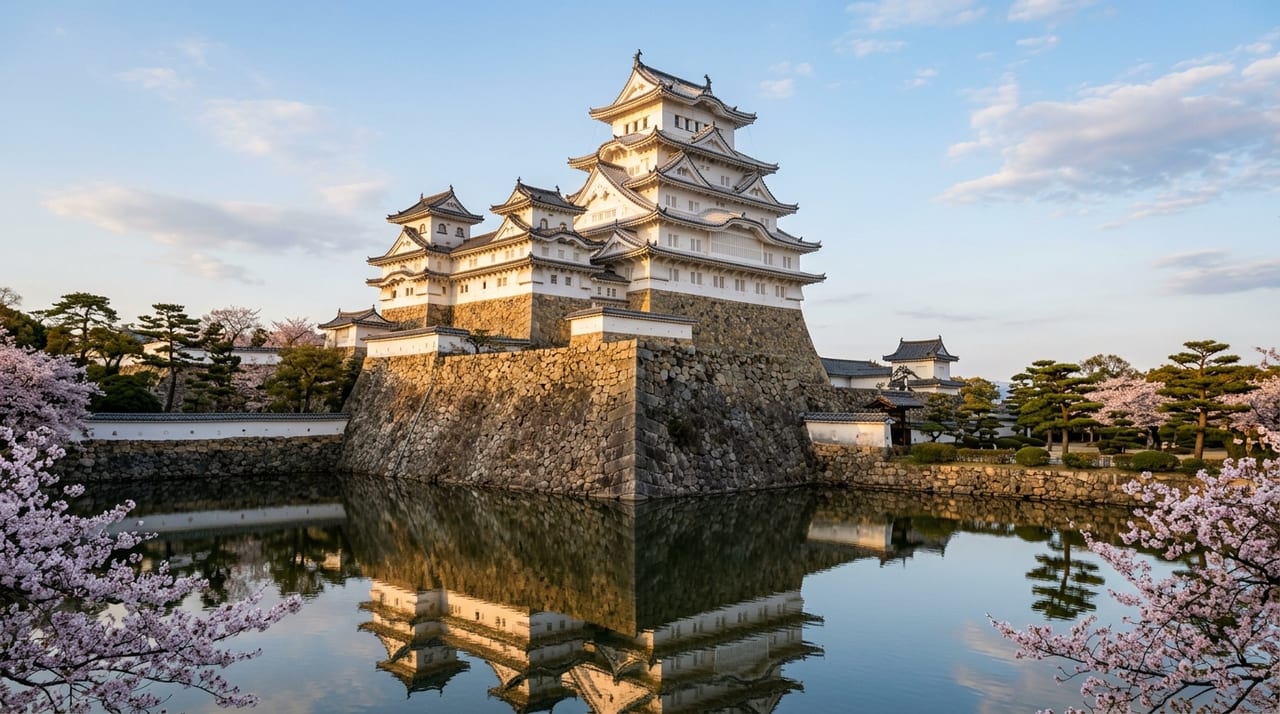
 * Image is for illustrative purposes only.
Himeji Castle
姫路城
Himeji Castle is a historic castle in the Kansai region (Major reconstruction 1601-09 (Keichō 6-14)). Its lord was Ikeda Terumasa / Sakai clan.
Overview
About the Castle
Himeji Castle is the pinnacle of Japanese castle architecture, known by the elegant name “Hakuro-jō” (White Egret Castle). It holds the unparalleled distinction of being a National Treasure and Japan's first UNESCO World Heritage Site (inscribed in 1993). Its walls, covered in a white plaster overall coating (shikkui sō-nurigome), shine with pure white beauty in the sunlight. The complex of interconnected keeps is the ultimate fusion of art and military technology that Japanese castle architecture could achieve: a main keep of five stories, six levels, and one basement level, joined by watari-yagura (bridge turrets) to three smaller keeps to the east, west, and northwest (Inui). Its history goes back to Genkō 3 (1333), when Akamatsu Norimura built a fort there. Its magnificent present form, however, is the result of a major renovation by Ikeda Terumasa, who received 520,000 koku of Harima after the Battle of Sekigahara. The renovation began in Keichō 6 (1601) and took eight years.
History of Construction
Terumasa married Toku-hime, the second daughter of Ieyasu, and built a famous castle of the realm worthy of its heavy responsibility as a guard of the west. The castle's layout is an ingenious design known as the “spiral layout” (rasen-shiki nawabari). The path from Hishi no Mon to the keep bends many times, with dead-end traps set throughout. Attacking enemy soldiers lose their sense of direction and are exposed to a crossfire of arrows and gunfire from loopholes (sama). This defensive philosophy represents the peak of Japanese castle design. Himeji Castle has Keshō-yagura, associated with Senhime, in Nishi no Maru. It also carries a woman's story, as the place where Senhime, daughter of Tokugawa Hidetada, lived after marrying Honda Tadatoki.
Architecture and Structure
During the air raids of the Pacific War, an incendiary bomb struck the keep but failed to detonate. This miraculous stroke of luck allowed the wooden structure, with more than 400 years of history, to survive intact into the present day. During the Heisei Great Restoration (2009–2015), the roof tiles and plaster were fully repaired, and the keep, restored to its former whiteness, became a topic of conversation as “Shirosugi-jō” (too-white castle). Himeji Castle is a true treasure that stands at the pinnacle of Japanese castles in architecture, history, defense, and beauty. Climbing the keep is an experience in itself. The steep stairs and dim interior spaces revive the tension of the Sengoku period, and the sense of release and the exceptional view upon reaching the top floor are extraordinary.
Sightseeing and Experiences
In spring, Somei-yoshino cherry trees envelop the castle in pale pink, and in autumn, the foliage sets off the white walls. Whatever season you visit, Himeji Castle does not disappoint its visitors. Himeji Castle welcomes many visitors from Japan and abroad and is a presence that defines the image of Japanese castles for foreign tourists as well. Within the castle grounds, there are also sites from ghost stories, such as the “Okiku Well” (Banshū Sarayashiki legend), where history and legend are layered together. The Harima region also retains ironmaking sites dating back to ancient times, centered on the Chikusa River basin.
Culture and Crafts
As a World Heritage Site, Himeji Castle welcomes many visitors from Japan and abroad, and it is recognized around the world as the finest ambassador of Japanese culture.
Connection to Swords
Ikeda Terumasa, one of the castle's lords, was originally born as the second son of Ikeda Tsuneoki. He went through the harsh experience of losing his father and elder brother at the Battle of Komaki–Nagakute, and became a warlord who knew the realities of the battlefield thoroughly. Terumasa was a powerful figure also called the Saigoku Shōgun. From Kan'en 2 (1749) onward, the Sakai family, which had moved from Maebashi, governed Himeji Domain. The Sakai family was a prestigious house, the legitimate main line of the Utanokami Sakai family, with deep ties to the shogunal family. Himeji Castle sits at a key point on the Sanyō Road, and Bizen Osafune, the largest production center of Japanese swords, is about one and a half hours away even by today's transportation. A route from Himeji through Okayama (Bizen Osafune Sword Museum) and on to Bitchū Matsuyama Castle is strongly recommended to sword enthusiasts as the ultimate journey for experiencing the history of Japanese swords. Iron has been produced in the Harima region since ancient times, and remains of tatara iron smelting have been confirmed, centered on the Chikusa River basin. Himeji Castle is also a castle standing within that iron culture sphere.
Highlights
- National Treasure and World Heritage main keep and interconnected keep complex — the pinnacle of Japanese castle architecture, the snow-white keep of five stories, six levels, and one basement level
- White plaster overall-coated walls — pure white beauty gleaming in the sunlight, a splendor worthy of the name “Hakuro-jō”
- Nishi no Maru and Keshō-yagura — the space where Senhime lived; the view of the keep from Hyakken Rōka is breathtaking
- Spiral layout, loopholes, and stone-drop openings — experience Japan's supreme defensive design by walking through it
- Kōko-en — a strolling pond garden adjacent to Himeji Castle, with nine gardens of distinct character
- Starting point of the pilgrimage to Bizen Osafune — follow the Sanyō Road to the sacred land of Japanese swords
* Opening hours and admission fees are subject to change. Please check the official website before visiting.