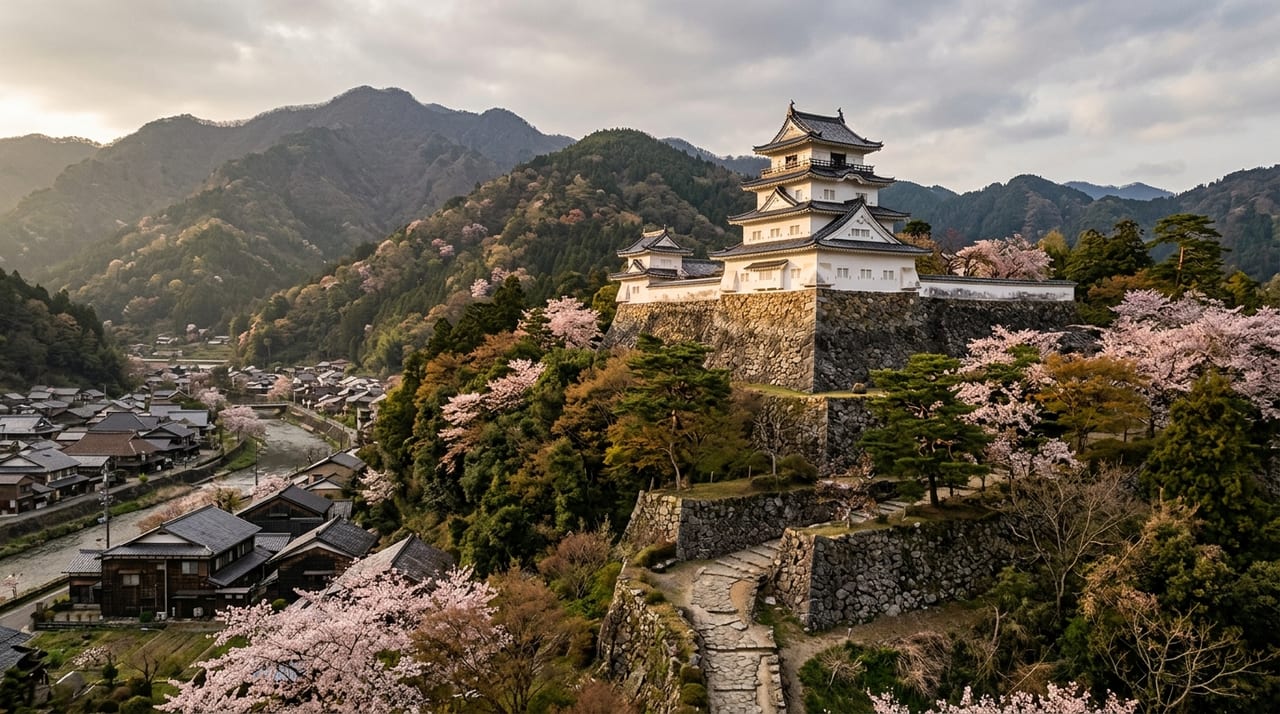
 * Image is for illustrative purposes only.
Izushi Castle (Ariko-yama Castle)
出石城(有子山城)
Izushi Castle (Ariko-yama Castle) is a historic castle in the Kansai region (In Keichō 9 (1604), Koide Yoshihide built Izushi Castle at the foot of the mountain as an early-modern castle. The medieval mountain castle Ariko-yama Castle behind it was abandoned). Its lord was Yamana Suketoyo (built Ariko-yama Castle) → Hashiba Hidenaga (after the pacification of Tajima) → Koide Yoshimasa → Matsudaira clan → Sengoku clan (until the Bakumatsu period).
Overview
Izushi Castle is an early-modern castle located in Izushi-cho, Toyooka City, Hyogo Prefecture. Together with the medieval mountain castle Ariko-yama Castle, which remains on the summit of Ariko-yama (elevation 321 m) behind it, it is a castle site that embodies the history of "Izushi, Tajima Province." The mountaintop Ariko-yama Castle ruins, together with the Konosumiyama Castle ruins, are designated as a National Historic Site under the name "Yamana Clan Castle Sites," while the Izushi Castle ruins at the foot of the mountain are designated as a historic site by Toyooka City. The castle town is called the "Little Kyoto of Tajima."
Izushi was the stronghold of the Yamana clan, who ruled Tajima from the medieval period. From the Nanboku-chō period through the Muromachi period, the Yamana clan was so powerful that they were called "Rokubun-no-ichi-dono" (lord of one-sixth of Japan), and there was a period when they controlled eleven of Japan's 66 provinces. Yamana Sōzen, who was also a principal cause of the Ōnin War (1467–77), embodied the peak of this clan. The Tajima Yamana clan ruled Tajima from Konosumiyama Castle and later from Ariko-yama Castle.
In the late Sengoku period, Hashiba Hidenaga, the younger brother of Hashiba Hideyoshi, invaded Tajima in Tenshō 8 (1580). Ariko-yama Castle fell, and the Yamana clan's rule of Tajima came to an end. After the Battle of Sekigahara, in Keichō 9 (1604), Koide Yoshihide built the early-modern Izushi Castle at the foot of the mountain as the center of political and administrative affairs. Ariko-yama Castle on the mountaintop was abandoned.
In the Edo period, a distinctive castle-town culture took shape. It included a clan internal dispute called the Sengoku Disturbance in the late Edo period, and the history of "Izushi sara-soba," said to have been brought by the Sengoku clan. The Sengoku clan was transferred from Ueda in Shinshu and brought soba culture with them. Today, the Izushi castle town still retains its Edo-period town layout. It is a tourist destination and, alongside Toyooka and Kinosaki Onsen, forms the core of Tajima's cultural tourism.
Connection to Swords
The connection between Izushi Castle and Japanese swords is rooted in the history of the Yamana clan, a powerful medieval warrior family called "Rokubun-no-ichi-dono."
The Yamana clan stands out in medieval Japanese history as one of the principal players in the Ōnin War. Their warrior culture overlapped with the golden age of sword culture in the Nanbokuchō and Muromachi periods.
Ikuno in the same Tajima Province (Asago City, Hyogo Prefecture) is a mining area famous as the "Ikuno Silver Mine." Yamana Suketoyo began full-scale mining there in Tenbun 11 (1542), and it later came under the control of Oda Nobunaga.
Highlights
- Izushi Castle ruins (Toyooka City Historic Site) — torii gate approach to the Inari enclosure, corner turrets, and stone walls overlooking the castle town known as the 'Little Kyoto of Tajima'
- Ariko-yama Castle ruins (medieval mountain castle) — Yamana clan hilltop fortress behind Izushi Castle, with vertical moats, bailey terraces, and stone walls
- Izushi sara-soba — Izushi's signature small-plate soba noodles, a culinary tradition traced to the Sengoku clan's transfer from Shinshu
- Izushi Eirakukan — kabuki playhouse built in 1901, the oldest playhouse in the Kinki region
- Ikuno Silver Mine (Asago City) — silver mine opened by the Yamana in the Sengoku period and later brought under Oda control, open as a historical mining site
- Takeda Castle ruins (Asago City) — the famous 'castle in the sky' stone-wall mountain castle associated with the Yamana
* Opening hours and admission fees are subject to change. Please check the official website before visiting.