 * Image is for illustrative purposes only.
Chihaya Castle
千早城
Chihaya Castle is a historic castle in the Kansai region (Built 1332 by Kusunoki Masashige to support Emperor Go-Daigo's campaign to overthrow the Kamakura shogunate; besieged in 1333). Its lord was Kusunoki Masashige.
Overview
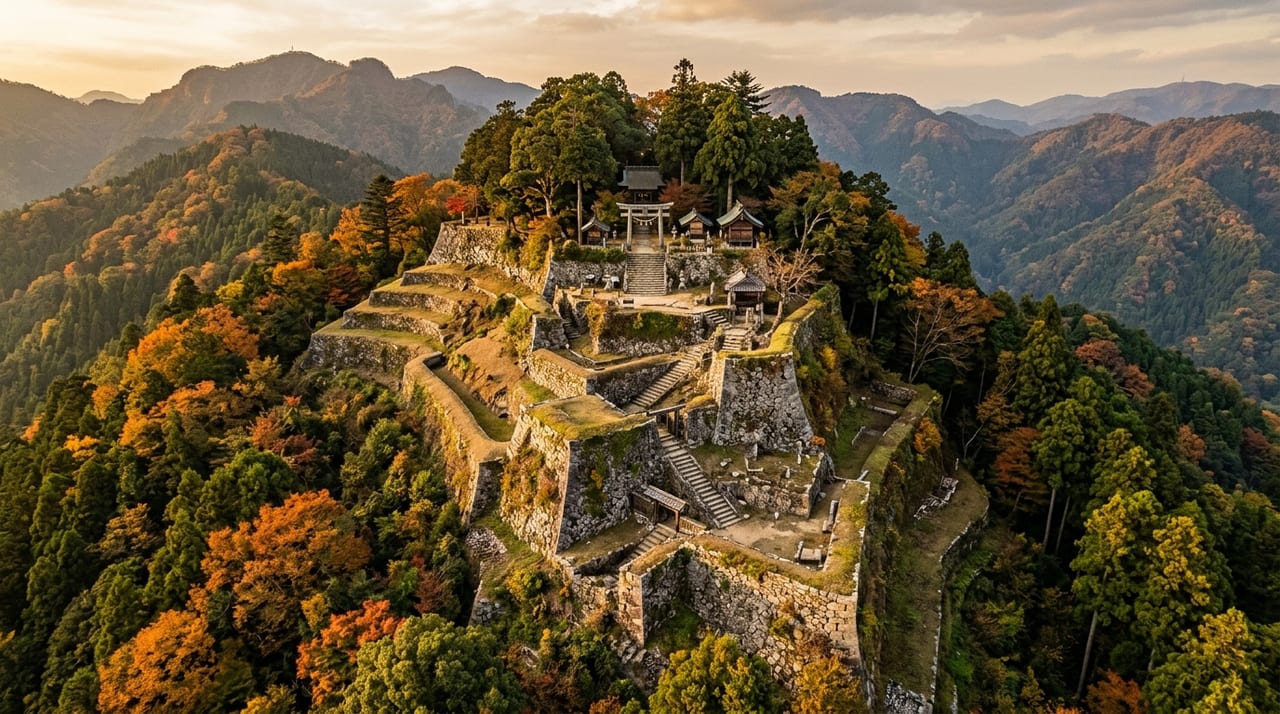
Chihaya Castle on the slopes of Mt. Kongō in Osaka Prefecture is one of Japan's most celebrated mountain fortress sites — the stage for Kusunoki Masashige's legendary defense against the Kamakura shogunate that helped topple Japan's warrior government in 1333 and remains the supreme example of asymmetric castle warfare in Japanese history.
Kusunoki Masashige was a warrior from Kawachi Province (southeastern Osaka) who responded to Emperor Go-Daigo's call to overthrow the Kamakura shogunate in 1331. He first raised his forces at Shimo-Akasaka Castle in 1331 (Genkō 1); after holding off the shogunate's great army, he set the castle on fire and vanished, then in 1332 (Genkō 2) he retook Akasaka and built Chihaya Castle on a spur of Mt. Kongō as its fallback stronghold. The resulting siege became legendary: against a shogunate force numbered in the tens of thousands, Masashige's garrison of fewer than a thousand defenders held out for months using an extraordinary range of improvisational tactics — stones hurled from the towers, straw dummies used as decoys, and oil poured onto the enemy's siege bridge to burn it down.
The time bought by Chihaya's resistance allowed anti-shogunate forces across Japan to coordinate, and in the 5th month of Genkō 3 (1333) the combined attacks of Ashikaga Takauji and Nitta Yoshisada finally brought down the Kamakura government. Masashige's role in making this possible elevated him to the status of Japan's archetypal loyal warrior — a reputation that reached its peak in the Meiji period, when he was enshrined as a model of imperial loyalty and devotion.
In 1336, defeated by Ashikaga Takauji's army at the Battle of Minatogawa, Masashige took his own life together with his younger brother Masasue. According to the Taiheiki, the brothers vowed to be reborn seven times as men to destroy the enemies of the court; in the modern era these words were recast as "Shichisei Hōkoku" (Seven Lives for the Nation).
The castle site today is a National Historic Site on the Mt. Kongō hiking trail, with earthwork remains of the main to fourth baileys and Chihaya Shrine on the site of the second bailey.
Connection to Swords
The relationship between Chihaya Castle and the Japanese sword stems from the convergence of Kusunoki Masashige's era and the Nanbokuchō period—the most critical turning point in Japanese sword history.
Kusunoki Masashige's active years during the Genkou and Kenmu periods (1331–36) correspond to the "late Kamakura through Nanbokuchō" era in sword history, marking the apex of the ōdachi and nodachi. Nanbokuchō warfare was dominated by large-scale infantry engagements and chaotic mass combat; the elongated ōdachi and nodachi were used on the battlefield. At the siege of Chihaya Castle under Masashige's command, swords and blades were deployed on the defensive side alongside bows, stones, and timber—the sword culture of this era is reflected in the actual practice of castle warfare.
From the end of the Kamakura period through the Nanbokuchō period (14th century), Bizen Osafune smiths such as Kagemitsu, Kanemitsu and Nagayoshi were active, and many blades now designated National Treasures or Important Cultural Properties were forged.
In later times, Kusunoki Masashige was exalted by the Meiji government as the embodiment of "loyalty and righteousness," enshrined as the Dainanko. Places associated with Masashige include Minatogawa Shrine (Kobe, Hyogo Prefecture) and Kanshinji temple (Kawachi-Nagano, Osaka Prefecture), and the tachi "Koryū Kagemitsu" (National Treasure), traditionally said to have been his sword, is held by the Tokyo National Museum.
Highlights
- Chihaya Shrine (second bailey) — Kusunoki Masashige's enshrining, center of the National Historic Site
- Stone stairway ascent — steep stone steps to the summit, conveying the mountain castle's natural defenses
- Mt. Kongō hiking — the castle site lies along the Kongō-san trail, highest peak near Osaka (1,125m)
- Kanshinji temple (Masashige's grave) — the Kusunoki family temple with Masashige's head mound
- Chihayaakasaka Village Local History Museum — Kusunoki clan artifacts and armor reproductions
- Shimo-Akasaka and Kami-Akasaka castle ruins — the Akasaka castles Masashige held alongside Chihaya
* Opening hours and admission fees are subject to change. Please check the official website before visiting.