New Arrivals — Browse our catalog for the latest authentic Japanese sword arrivals. Browse →
2nd–5th month, 1333 CE (Genkō 3)
Chihaya Castle, Mount Kongō, Kawachi Province (present-day Chihayaakasaka Village, Minamikawachi District, Osaka Prefecture)
Forces
Kusunoki Masashige's Forces (Garrison)
Kamakura Shogunate Forces (Besieging Army)
About 12 min read
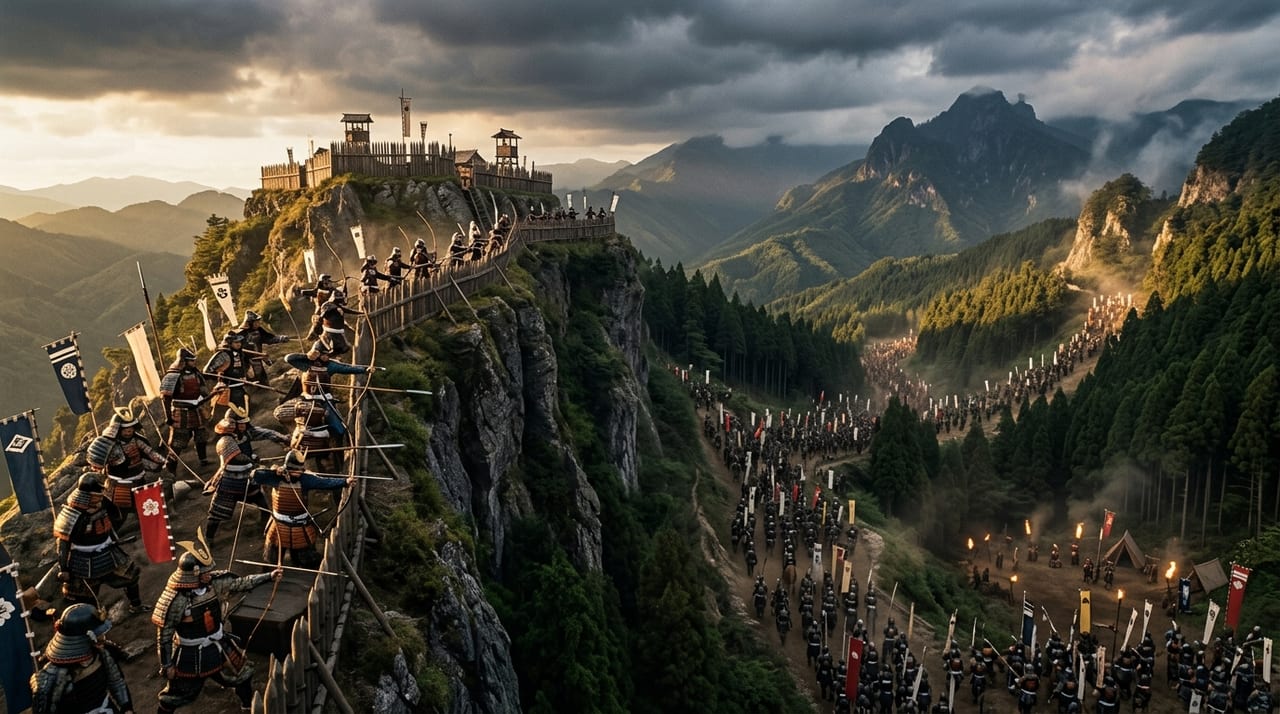
From the 2nd month of Genkō 3 (1333) to the 5th month, Kusunoki Masashige held out at Chihaya Castle, built on Mount Kongō in Kawachi Province (present-day Chihayaakasaka Village, Minamikawachi District, Osaka Prefecture). For about three and a half months, he repelled the tens of thousands of troops of the Kamakura shogunate with only several hundred to fewer than a thousand soldiers. The Battle of Chihaya Castle is passed down in Japanese history as the most dramatic siege in which a small force outmaneuvered a much larger one. While this determined defense held the shogunate's army in place, Nitta Yoshisada captured Kamakura and brought down the Kamakura shogunate. It was the moment when Masashige's tactics and resolve decisively changed the course of Japanese history.
Kusunoki Masashige was a warrior based in Kawachi Province (present-day southern Osaka Prefecture) who, in response to Emperor Go-Daigo's movement to overthrow the shogunate, had been resisting the shogunate since the Genkō War (beginning in 1331). Within the Kamakura shogunate's system, Masashige was called an "akutō." This did not mean a criminal. It was a medieval term for "extra-systemic military power," referring to armed groups that led independent forces outside the manorial system and the shugo-jitō system.
Masashige's tactics are characterized by avoiding head-on clashes and by combining clever stratagems, terrain, and traps into "irregular warfare." From the first battle at Akasaka Castle (1331) onward, Masashige had used castle-building ingenuity, surprise attacks, and feints to bewilder the overwhelming shogunate forces. Chihaya Castle is the stage on which this reached its culmination.
As a sword said to have been worn by Masashige, the tachi "Koryū Kagemitsu" (National Treasure, held by the Tokyo National Museum), made by Bizen Osafune Kagemitsu, is well known, and it is also called "Nankō Kagemitsu." However, there is no reliable historical record confirming that it was Masashige's worn sword.
Chihaya Castle was a mountain castle built on the steep ridge of Mount Kongō (elevation approximately 1,125 meters), and its natural strength was unmatched. The only access to the castle was by steep mountain paths, and there was almost no flat ground on which a large army could deploy. It was terrain where, if attacked head-on, a single defender could do the work of ten.
Masashige made the fullest use of this terrain. The specific defensive tactics recorded in the Taiheiki are:
• Dropping large rocks and logs (physical attacks using the slope) • Diversion with straw dummies (a ruse of luring the attacking force with straw dummies dressed in armor) • Burning down long ladders with torches and oil (fire attacks on a bridge built across a valley) • Night counterattacks (active sorties rather than purely defensive posture)
Even discounting the literary exaggeration of the "Taiheiki," these tactics were studied by later military commanders as a textbook of irregular warfare.
The shogunate's army that attacked Chihaya Castle was led by Hōjō clan generals including Aso Harutoki, Osaragi Ietoki, Osaragi Sadanao, and Nagoe Munenori, and Nagasaki Takasada had joined as army magistrate (ikusa bugyō). According to the Taiheiki, the Nagoe forces, who were trying to cut off the water supply, were attacked at night by the Kusunoki forces and had their banners and curtains seized.
The shogunate afterward dispatched a new force to the capital (Kyoto) under Nagoe Takaie and Ashikaga Takauji as its commanders. Takaie was killed in action at the Battle of Koganawate on the 27th day of the 4th month. Takauji defected to Emperor Go-Daigo's side and, on the 7th day of the 5th month, attacked and captured Rokuhara Tandai in Kyoto. Takauji later went on to establish the Muromachi shogunate.
The prolonged struggle over Chihaya Castle pinned down the shogunate's large army and resulted in prompting anti-shogunate forces across the country to rise up.
The true significance of Chihaya Castle lies not in the outcome of individual battles but in the securing of time, since it tied down the shogunate's large army for an extended period. In the 5th month of Genkō 3 (1333), Nitta Yoshisada raised an army in Kōzuke Province (present-day Gunma Prefecture) and marched toward Kamakura. Because the shogunate had many of its troops pinned down at Chihaya Castle, Kamakura's defenses were thin. Nitta Yoshisada's army broke into Kamakura from Inamuragasaki (the Miracle of Inamuragasaki), and Hōjō Takatoki and other senior shogunate officials committed suicide, and the Kamakura shogunate fell.
Kusunoki Masashige changed the course of history by "holding Chihaya Castle to the end." This was not a direct victory won by force of arms; it is a fine historical example of strategic depth, showing how "not losing" led to ultimate victory. The concept of "defense" in the world of Japanese swords — that a weapon is a tool not only for attack but, through defense, a tool that "creates time" — is historically embodied in this Battle of Chihaya Castle.
Kusunoki Masashige, who gained Emperor Go-Daigo's trust through the success of the siege of Chihaya Castle, distinguished himself with many military achievements during the Kenmu Restoration. After the collapse of the Kenmu Restoration, however, he fought valiantly as a standard-bearer of Emperor Go-Daigo's side in opposition to Takauji, and in the Battle of Minatogawa (present-day Kobe, Hyogo Prefecture) in Engen 1 (1336), he engaged in a decisive battle with the forces of Ashikaga Takauji. Knowing it was a fight without any chance of winning, Masashige obeyed the emperor's order and met a fierce death at Minatogawa.
Masashige's death at Minatogawa is passed down through the ages as "the pinnacle of loyalty." The final moments, in which he and his younger brother Masasue stabbed each other and died by their own hands, are vividly depicted in the war chronicle "Taiheiki." Kusunoki Masashige's short sword and long sword remained in people's memory for a long time as symbols of his "loyalty and death." In the Edo period, Kusunoki Masashige was once again honored as a "mirror of loyal retainers," and had a profound influence on the samurai spirit and sword culture of that era.
The Battle of Chihaya Castle lives on today in the hearts of those who love swords, as a historical example of the tactical ideal, symbolized by the Japanese sword, of "a small elite force repelling a great army."
Kusunoki Masashige
Kusunoki Masashige — the tactical genius who held Chihaya Castle and changed the course of Japanese history
Kusunoki Masatsura
Kusunoki Masatsura — Masashige's heir who continued fighting for the Southern Court in his father's spirit
Nitta Yoshisada
Nitta Yoshisada — Masashige's ally who destroyed Kamakura while Chihaya held the shogunate in place
Ashikaga Takauji
Ashikaga Takauji — commanded part of the shogunate's siege force before his famous defection to the imperial cause