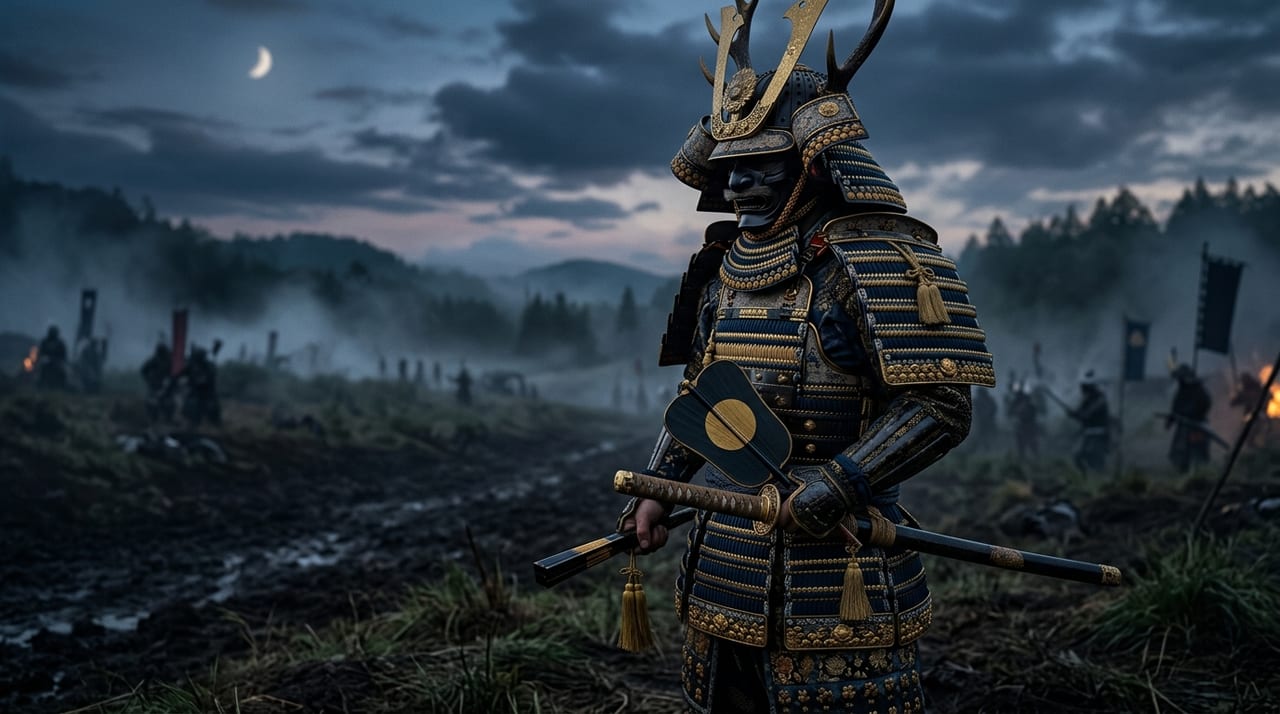
 * Image is for illustrative purposes only.
Kusunoki Masatsura
楠木正行
The Young Nankō — Loyal Son of the Southern Court Who Fell at Shijōnawate
Description
Birth of Shō-Nankō and His Father's Teachings
Born around Karyaku 1 (1326) as the eldest son of Kusunoki Masashige, Kusunoki Masatsura is a loyal retainer of the Southern Court, remembered in later ages as “Shō-Nankō.” His father, Masashige, is renowned as “Dai-Nankō” for his devotion to Emperor Go-Daigo and was a core military commander who supported the Kenmu Restoration. Masatsura came to engrave his father's teachings into his very bones through the words Masashige spoke to his son at the Parting at Sakurai, as depicted in the Taiheiki, when Masashige set out for the Battle of Minatogawa: “Do not cherish your life so much that you lose the heart of loyalty; you must not surrender to the enemy.” These words became the guiding principle of Masatsura's life and never wavered until his death at Shijōnawate.
Carrying On His Father's Will
In Shōhei 2 (1347), Kusunoki Masatsura raised troops under Emperor Go-Murakami as the main force of the Southern Court army. As tensions with the Northern Court forces of the Muromachi shogunate rose, Masatsura launched aggressive offensives against Northern Court troops across the provinces of Settsu, Kawachi and Izumi, winning one victory after another. These included repelling the forces of Hosokawa Akiuji at the Battle of Fujiidera and those of Yamana Tokiuji at the battles of Sumiyoshi and Tennōji. Masatsura's exploits in this period were reminiscent of his father Masashige's tactics, in which he met the numerically superior Northern Court forces with bold stratagems and mobility.
Farewell at Nyoirin-dō: Death Poem and Vow
In Shōhei 3 (1348), when it became clear that a large army led by Kō no Moronao would launch a final offensive against the Southern Court, Masatsura refused to withdraw, even though he knew the disparity in forces was overwhelming. Before setting out, Masatsura visited the Nyoirin-dō (Nyoirin-ji) in Yoshino together with his kinsmen and retainers, and carved a death poem into its door. The poem reads: Kaeraji to kanete omoeba azusayumi naki kazu ni iru na o zo todomuru (Resolved never to return, I set out to war. As if drawing a bow, even if I join the ranks of the dead, I will leave my name behind.) This single poem, which condenses Masatsura's depth of resolve and his longing for his father, has continued to move people some seven hundred years later as a celebrated verse.
The Fierce Battle at Shijōnawate and His Heroic End
On the 5th day of the 1st month of Shōhei 3 (1348), the Southern Court army led by Masatsura and the Northern Court army of Kō no Moronao clashed at Shijōnawate (present-day Shijōnawate City, Ōsaka Prefecture). Facing a Northern Court force several times his own in number, Masatsura charged head-on. In the fierce fighting, many of his kinsmen fell one after another, and Masatsura himself was seriously wounded. When his strength was spent, he took his own life on the spot, by mutual stabbing with his younger brother Masatoki. Although there are various theories about his year of birth, his death came at a young age. This heroic end has been praised in later ages as the ultimate expression of loyalty, and for the men of the Meiji Restoration, the self-sacrifice of the Kusunoki father and son became a spiritual pillar.
Favored Sword and Martial Arts
Masatsura's martial prowess was cultivated through his father Masashige's teachings, and he is said to have excelled in horsemanship, archery and swordsmanship alike. Few swords that Masatsura is clearly known to have owned have been transmitted to the present. In the Taiheiki, Masatsura is depicted as receiving the Kikusui sword from his father Masashige at the Parting at Sakurai, and swords in the Kusunoki family have been handed down as symbols of martial pride and loyalty.
Legacy of a Loyal Retainer and Its Influence on Later Generations
The life of Kusunoki Masatsura, who upheld righteousness even while knowing the battle was hopeless, became a model for samurai throughout the Edo period and a textbook example of bushidō. In the Mito school and in sonnō (reverence for the emperor) thought, the Kusunoki father and son were deified as embodiments of “taigi meibun” (the righteous cause and proper order). After the Meiji period, they were enshrined as national heroes at Minatogawa Shrine and Shijōnawate Shrine. Masatsura's death poem was quoted and imitated by many samurai and patriots, and his spirit lived on at the core of the Japanese samurai spirit, from the sonnō jōi movement of the bakumatsu period through to the final stage of the Pacific War.
Notable Swords
- The Kikusui sword — a sword described in the Taiheiki as given to Masatsura by his father Masashige at the Parting at Sakurai. In the Tenshō-bon manuscript it is called “Kikusaku no Katana.”