New Arrivals — Browse our catalog for the latest authentic Japanese sword arrivals. Browse →
June 20 – July 4, 1333 (8th–22nd day, 5th month, Genkō 3)
Kamakura, Sagami Province (present-day Kamakura City, Kanagawa Prefecture)
Forces
Nitta Yoshisada's Forces (anti-shogunate army)
Kamakura Shogunate Forces (Hōjō clan)
About 10 min read
In the 5th month of Genkō 3 (1333), the army of Nitta Yoshisada, which aimed to topple the bakufu, attacked Kamakura, the stronghold of the Kamakura bakufu, in Kamakura, Sagami Province (present-day Kamakura City, Kanagawa Prefecture), and destroyed the bakufu forces centered on the Hōjō clan. Known as the “Siege of Kamakura” or “the end of the Genkō Incident,” this battle marked the end of the warrior government that had ruled Japan for about 140 years, since the establishment of the Kamakura bakufu by Minamoto no Yoritomo in 1185 (Bunji 1), or since his formal appointment in 1192.
The mass suicide of the Hōjō clan, with more than 870 men dying in a fierce last stand at Tōshōji, has been passed down to later generations as the ultimate expression of the warrior's “purity” and the “aesthetics of destruction.” And Nitta Yoshisada's “miracle of the receding tide” at Inamuragasaki gave this battle a mythic brilliance.
Emperor Go-Daigo was dissatisfied with the arbitrary rule of the Kamakura bakufu (the Hōjō regency) and pushed forward plans to topple it. In the Genkō Incident of 1331 (Genkō 1), his attempt to restore direct imperial rule failed, and Go-Daigo was exiled to the Oki Islands.
However, in 1333 Go-Daigo escaped from the Oki Islands. Ashikaga Takauji (whose name was then still written with a different first character) defected to the imperial side and destroyed the Rokuhara Tandai (the bakufu's organ for governing Kyoto), while Nitta Yoshisada raised an army in Kōzuke Province (present-day Gunma Prefecture). The bakufu came under pressure from both east and west and quickly faced the danger of collapse.
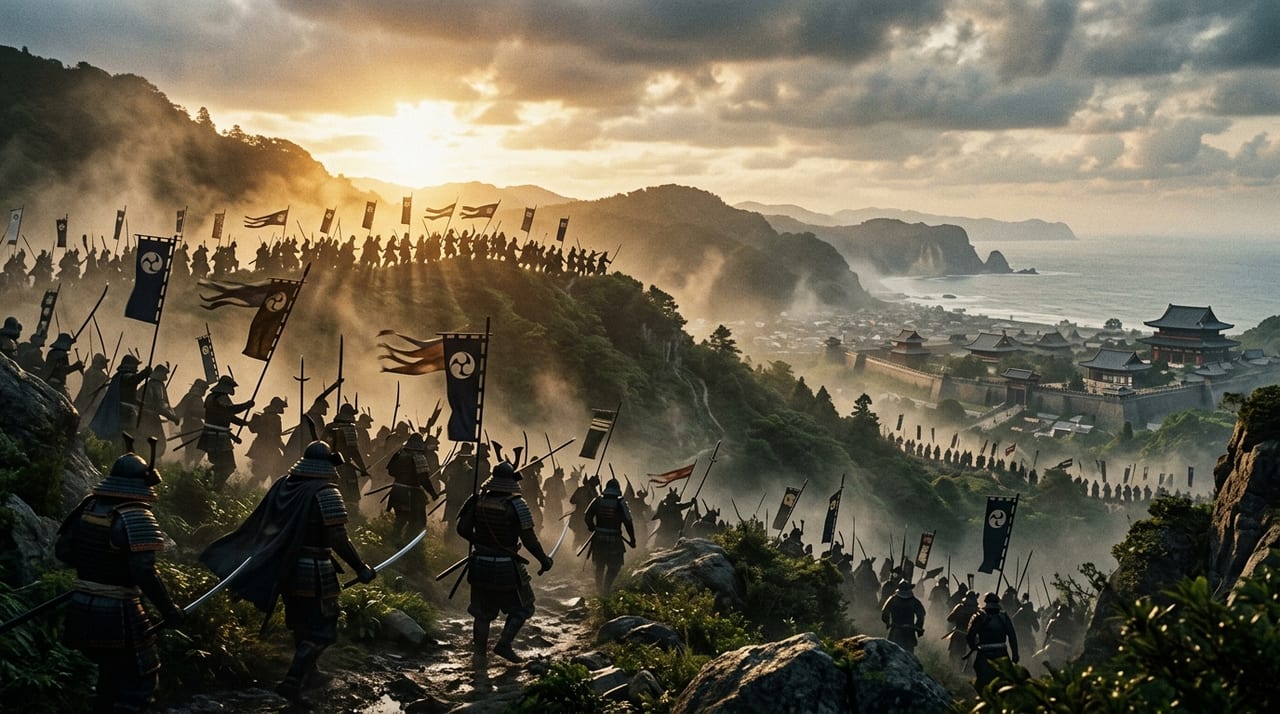
Nitta Yoshisada's uprising is accompanied by a well-known episode. According to the “Taiheiki,” on the 8th day of the 5th month of Genkō 3, Yoshisada gathered with the Nitta clan at the shrine precincts of Ikushina Myōjin (present-day Ikushina Shrine in Ichinoi-chō, Nitta, Ōta City, Gunma Prefecture) and raised the banner with only 150 riders.
Kamakura is surrounded by mountains on three sides and faces the sea to the south, and the road along the western coast was blocked by the cliffs of Inamuragasaki (a headland in the southwest of Kamakura City). The bakufu forces skillfully repelled attacks from every direction, but Yoshisada decided to take the city by detouring along the sea from Inamuragasaki.
According to the “Taiheiki,” Yoshisada threw a sword (a gold sword, kintachi) into the sea on the shore at Inamuragasaki and prayed to the dragon god (the sea god). The tide immediately receded, and his army was able to pass over the exposed tidal flats and detour to the flank of Kamakura's urban area.
This “miracle at Inamuragasaki” functions less as a recorded historical fact than as a mythic explanation that “heaven took Yoshisada's side.” The prevailing interpretation is that a natural receding tide during the spring tide of the 5th month was given mythic meaning by the “Taiheiki.” However, the act of “throwing a sword into the sea and praying to the gods” cannot be overlooked, as it shows how sacred the sword was to warriors.
After the Nitta army broke into Kamakura, the Hōjō clan centered on Hōjō Takatoki, along with the remnants of the bakufu, gathered at Tōshōji in Kasaigaya and committed mass suicide. According to the “Taiheiki,” the number was more than 870. Hōjō Takatoki, the former shikken (regent) and tokusō (head of the main Hōjō line), also took his own life here.
This scene, in which clan members and retainers one after another ended their lives by the sword, embodies the warrior aesthetic of the “way of dying” (shinizama), the archetype of bushidō of “dying cleanly” and “taking one's own life by the sword.” It had a great influence on later literature and theater.
Direct sources are scarce regarding the sword Hōjō Takatoki held last, but the Hōjō clan collected and held many famous swords throughout the Kamakura period. The sword Onimaru Kunitsuna is known as a celebrated blade that was handed down in the Hōjō family and later passed to the Ashikaga shogunal house and the imperial family.
The fall of the Kamakura bakufu marked the first change of warrior government in Japanese political history. And the fact that this fall was achieved by force, with 140 years of rule overthrown by Nitta Yoshisada's swords and spears, is also the prototype of the Sengoku period logic that “force is the ultimate arbiter of politics.”
Moreover, the fall of the bakufu in the form of the mass suicide at Tōshōji had a great influence later as a precedent for the bushidō spirit of “dying in loyalty to one's lord” and “dying for honor.” This lineage continues through the actions of Ōishi Kuranosuke and others in the Akō Incident (Chūshingura) of the Edo period, down to the militarist ideology of “gyokusai” after the Meiji period.
Yoshisada's gold sword cast into the sea at Inamuragasaki, a sword imbued with prayer to the dragon god, forms an important page in the cultural history of the Japanese sword. It is a typical example of how the Japanese sword functioned as a “sacred implement” and “medium of prayer” beyond being a mere “weapon.”
Ashikaga Takauji
Simultaneously destroyed the Rokuhara Tandai; shared credit for the shogunate's fall
Nitta Yoshisada
Commander of the Kamakura attack; the hero who destroyed the shogunate at Inamuragasaki
Hōjō Yoshitoki
Hōjō Yoshitoki — the regent who established the shogunate; ancestor of the Hōjō who were destroyed here
Kusunoki Masashige
Southern warrior who collaborated with Yoshisada to overthrow the shogunate