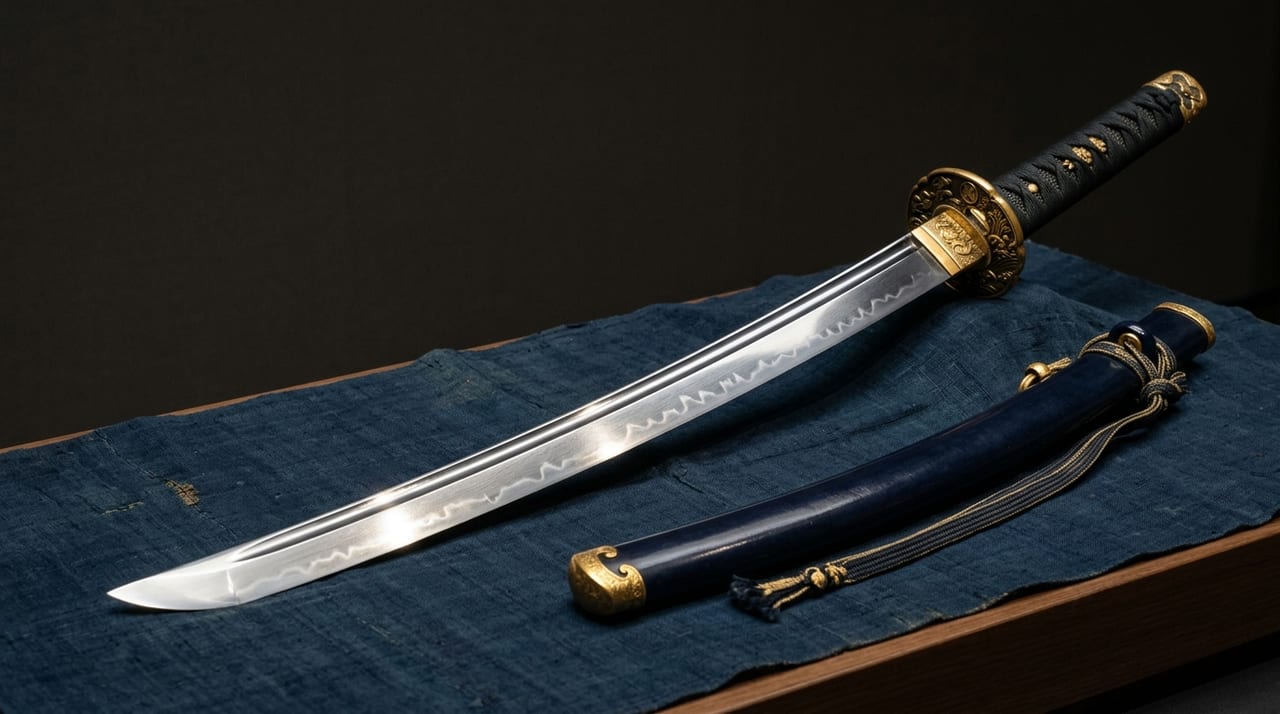
 * Image is for illustrative purposes only.
Onimaru Kunitsuna
鬼丸国綱
Also known as: Onimaru — the Tachi That Slays Demons of Its Own Will
Description
Overview of the Blade
One of the Five Greatest Swords (Tenka Goken), a tachi that embodied the very authority of the Hōjō Tokusō house as the guardian blade of the Kamakura shogunate. Its blade length is traditionally recorded as 2 shaku 5 sun 8 bu (approximately 78.2 cm), and it has pronounced curvature (sori) and a sturdy fumbari (the robust base of the blade).
The Swordsmith
The smith Awataguchi Kunitsuna was a mid-Kamakura period swordsmith who lived in Awataguchi, Yamashiro Province. He is known as the youngest of the six Awataguchi brothers, and is traditionally said to have moved to Kamakura at the invitation of Hōjō Tokiyori.
Forging Method and Characteristics
The Awataguchi school was a representative group of Yamashiro-den smiths, unmatched by others in the refinement of its jigane and the nobility of its quality. Kunitsuna's style is especially vigorous among the brothers, and it is notable for combining the refinement of Yamashiro-den with the robust strength favored by the warrior class. The jigane of Onimaru Kunitsuna is ko-itame with ko-mokume mixed in, its surface finely consolidated, with ji-nie and chikei mixed in. The hamon is ko-notare mixed with gunome and ko-midare, with ashi running into it; the nioiguchi tends toward subdued, with fine nie, and koshiba is quenched on both faces. According to the Taiheiki, when Hōjō Tokimasa, the first shikken (regent) of the Kamakura shogunate, was troubled by a small demon appearing in his dreams, this tachi fell over of its own accord and cut away a demon figure cast into the leg of a brazier. From this story it took the name 'Onimaru.' Thereafter, as the guardian blade of the Hōjō Tokusō house, it symbolized the authority of the Kamakura shogunate. After the shogunate's fall it is said to have passed through the hands of Nitta Yoshisada, the Ashikaga shogunal house, and Toyotomi Hideyoshi. From Hideyoshi's era through the Edo period it was entrusted to the Hon'ami family of Kyoto.
Provenance
Few swords in the history of Japanese swordcraft are said to have passed through the hands of so many masters of the realm.
Current Ownership
After the Meiji Restoration it was presented to the Imperial House, and it is now managed by the Imperial Household Agency as a gyobutsu (Imperial treasure). Gyobutsu are not eligible for National Treasure designation, and opportunities for public viewing are extremely limited, so the chance to see the actual blade is very rare. That it is the only tachi among the Five Greatest Swords still held by the Imperial House attests to its exalted status. It shows that Onimaru Kunitsuna retains, even today, a position beyond that of a mere famous sword, as a 'guardian blade of the nation.'
Legends & Stories
Legend and Lore
The legend of Onimaru Kunitsuna is one of the most dramatic tales of the spiritual power said to dwell in a Japanese sword. Hōjō Tokimasa, the first shikken of the Kamakura shogunate, came to be tormented by nightmares almost every night from a certain point. In his dreams a small demon appeared and tormented him. One night an old man appeared in the dream and said that he was the spirit of this tachi. He was rusted and could not slip out of his scabbard, so he could not subdue the demon that tormented his master, and he asked to be purified. On waking, Tokimasa at once removed the rust from the blade, maintained it, and stood it beside his bedchamber. The tachi then fell of its own accord, as if it had a will of its own, and cut away the demon figure cast into the leg of a brazier that stood close by. From that night the nightmares that had plagued Tokimasa stopped completely, and the tachi came to be called 'Onimaru,' as recorded in the Taiheiki. A sword that slays demons of its own will: this extraordinary legend commanded deep reverence among Kamakura warriors, and Onimaru Kunitsuna came to be regarded as sacred, the guardian blade of the Hōjō Tokusō house. After the fall of the Kamakura shogunate, the Taiheiki states that Nitta Yoshisada obtained Onimaru, which had been found among the Hōjō side's suicides. The guardian blade of the Hōjō house thus followed an ironic course, passing into the hands of the commander who destroyed the Hōjō family. The Taiheiki states that after Yoshisada's death in battle, Onimaru passed to Shiba Takatsune, who had defeated Yoshisada. According to Hon'ami family tradition, Takatsune's descendants presented it to Ashikaga Yoshimasa, and it was transmitted to the Muromachi shogunal house. In the Azuchi-Momoyama period it passed to Toyotomi Hideyoshi, who entrusted it to the Hon'ami family of Kyoto. After the Battle of Sekigahara, Hon'ami Kōtoku presented it to Tokugawa Ieyasu. Ieyasu is said to have returned it, saying, 'It came from that family originally, so return it there,' and Onimaru remained entrusted to the Hon'ami family throughout the Edo period. Since it was delivered from the Hon'ami family to the Kunaishō (Imperial Household Ministry) in the Meiji period, it has remained an Imperial treasure to the present day. Onimaru Kunitsuna is spoken of as the most 'willful' of the Five Greatest Swords. Its mysterious provenance, as if it slays demons of its own accord and chooses the masters of the realm of its own accord, embodies in its purest form the ancient Japanese belief that spirits dwell in Japanese swords.