New Arrivals — Browse our catalog for the latest authentic Japanese sword arrivals. Browse →
5th month, Jishō 4 (1180) – 3rd month, Juei 4 (1185)
Throughout Japan — Kantō, Tōhoku, Hokuriku, Kinai, Shikoku, Kyushu, culminating at Dan-no-ura
Forces
Minamoto Forces
Taira Forces
About 14 min read
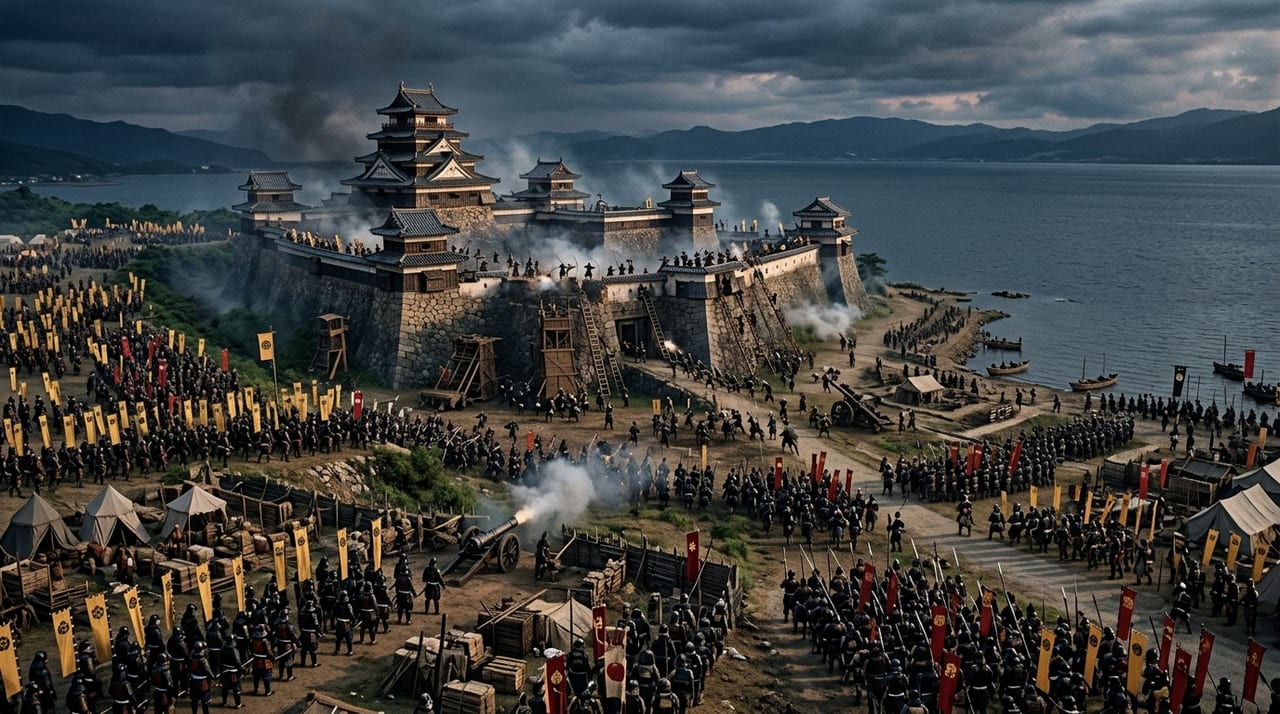
The “Jishō–Juei War” is the collective name for the roughly five-year civil war that began in Jishō 4 (1180), when Prince Mochihito issued a prince's mandate (ryōji) calling for the destruction of the Taira, and ended in Juei 4 (1185), when the Taira clan was annihilated at Dan-no-ura. It is commonly called the “Genpei War” or the “Genpei Battles,” but it cannot be reduced to a simple opposition between the Minamoto and the Taira. It was a great war of total mobilization, in which the complex interests of the Fujiwara, the Northern Fujiwara, Kiso Yoshinaka, Retired Emperor Go-Shirakawa, and others intersected.
The Taira regime centered on Taira no Kiyomori (1118–1181) was an unprecedented political order in which a warrior group that had risen from serving as guards in the insei (rule by retired emperors) came to stand at the apex of court society. Taira warriors wore tachi at their waist when serving at court. Swords were both symbols of military power and refined works of art shaped by aristocratic aesthetic sensibility.
In this era, the schools later classified as Ko-Bizen, Ko-Aoe, and Ko-Hōki flourished, and swords were produced that combined the elegant line of koshizori (curvature near the hilt) with the functional beauty of shinogi-zukuri. Bizen Province (present-day Okayama Prefecture) prospered especially as a center of sword production, and the master smiths of Ko-Bizen sent many tachi out into the world. Dōjigiri Yasutsuna, one of the Five Great Swords Under Heaven (Tenka Goken), conveys to the present day which famous blades the warriors of this era held as their ideal.
In the 4th month of Jishō 4 (1180), Prince Mochihito, the third son of Retired Emperor Go-Shirakawa, issued a prince's mandate calling for the overthrow of the Taira to warriors across the country, beginning with the Minamoto. Prince Mochihito himself was soon killed, but this prince's mandate became the fuse that sparked the uprisings of the warriors of the eastern provinces.
In the 8th month, Minamoto no Yoritomo, who was then living in exile, raised an army in Izu. Although he suffered a crushing defeat in the opening engagement, the Battle of Ishibashiyama, he escaped by sea to Awa (Chiba) and rapidly expanded his power by rallying the warrior bands of the Kantō region. The fact that Yoritomo established Kamakura as his base and firmly secured his position as leader of the eastern warriors became a direct foundation for the later establishment of the warrior government.
At the same time, Kiso Yoshinaka (Minamoto no Yoshinaka) raised an army in Shinano (Nagano) and repeatedly defeated Taira forces in the Hokuriku region. Yoshinaka's forces belonged to a different branch of the Minamoto from Yoritomo in Kamakura, and a serious rivalry would later arise between the two.
In the 7th month of Juei 2 (1183), Kiso Yoshinaka's forces entered Kyoto, and the Taira, carrying Emperor Antoku and the Three Sacred Treasures, fled to the western seas. However, Yoshinaka's violent conduct incurred the anger of the people of Kyoto, and Retired Emperor Go-Shirakawa ordered Yoritomo to subdue Yoshinaka. In the 1st month of Juei 3 (1184), the combined forces of Yoritomo's younger brother Minamoto no Yoshitsune and Minamoto no Noriyori defeated Yoshinaka (Battles of Uji River and Awazu), and Yoshinaka was killed in battle.
In the 2nd month of that same year, Yoshitsune carried out a daring stratagem against the Taira forces at the Battle of Ichi-no-Tani: the descent (sakaotoshi) at Hiyodorigoe. The Taira army collapsed in complete disarray under an unprecedented assault in which mounted warriors charged down a sheer cliff. The episode best known from this battle is the scene in which Kumagai Naozane grappled with the young Taira no Atsumori. Atsumori was known as a master of the flute. Naozane tried to save Atsumori, who was about the same age as his own son, but urged on by Atsumori, he took his head in tears. This anecdote has been repeatedly taken up in the Noh play Atsumori, the bunraku and kabuki play Ichinotani Futaba Gunki, and other works, becoming a story that symbolizes the compassion of the warrior and the sorrow of the sword.
In the 2nd month of Juei 4 (1185), Yoshitsune launched a surprise attack on the Taira stronghold at Yashima (Kagawa) in the Seto Inland Sea (the Battle of Yashima). The famous scene from this battle is “Nasu no Yoichi and the Fan Target,” an anecdote in which the mounted warrior Nasu no Yoichi shot with his bow a fan that had been raised on a Taira ship. Defeated at Yashima, the Taira retreated further west and were driven into Dan-no-ura (Shimonoseki, Yamaguchi Prefecture, Kanmon Strait), the site of the final decisive battle.
On the 24th day of the 3rd month of Juei 4 (1185), the final great battle between the Minamoto and the Taira was fought on the waters off Dan-no-ura. Through Yoshitsune's tactics, which exploited the shifting tides, the Taira navy collapsed. Emperor Antoku was held in the arms of Nii-no-Ama (Taira no Tokiko, Kiyomori's wife) as they plunged into the sea. Of the Three Sacred Treasures, the Yasakani no Magatama and the sacred mirror were recovered, but Ama-no-Murakumo-no-Tsurugi (Kusanagi no Tsurugi) sank beneath the sea and was lost forever.
The loss of this divine sword dealt a cultural and spiritual shock that went beyond the mere disappearance of a treasure. The interpretation that “the divine sword returned to the sea” and the political implication that “the Kusanagi no Tsurugi symbolizes the loss of royal sovereignty” continued to influence later debates over imperial succession and the theory of the regalia.
In battles of this era, the naginata, bow and arrow, and tachi were the principal weapons. In hand-to-hand combat after dismounting, the tachi played a decisive role. On horseback, the bow was mainly used, and when a fight came to grappling, warriors pinned down their opponent and took his head.
The tachi Nukemaru, which was handed down in the Taira family, was passed on through later generations as a famous sword associated with Taira no Tadamori and Taira no Yorimori. Such swords were not mere weapons but were revered as objects embodying the spirit and soul of the warrior.
The Tale of the Heike is a war chronicle depicting the Jishō–Juei War, and its opening passage, “The sound of the bell at Gion Shōja echoes the impermanence of all things,” is known as one of the most famous opening lines in Japanese literature. The tale was passed down by blind biwa hōshi (lute-playing monks), and its depictions of battle, warriors, and swords were deeply engraved in the Japanese view of war, view of life and death, and sense of beauty.
There are many performing arts works on the Genpei War, including the yōkyoku (Noh chanted pieces) “Atsumori,” “Tadanori,” and “Funa Benkei,” and the kabuki play Yoshitsune Senbon Zakura. Through these works, weapons such as swords, bows and arrows, and naginata became culturally established as attributes of the warrior's spirit.
After Dan-no-ura, Minamoto no Yoritomo effectively established the Kamakura shogunate as a warrior government (his formal appointment as shogun, Sei-i Taishōgun, came in 1192). The shogunate gained control over the warriors of the whole country through the gokenin (vassal) system.
During the Kamakura period, the craft of swordsmithing developed greatly. Smiths who gathered in Sōshū (Sagami Province, Kanagawa Prefecture) established a new school called Sōshū-den, and the era that produced master smiths led by Okazaki Masamune (Masamune) was a product of the warrior society that the Jishō–Juei War had opened up.
The Genpei War was the decisive historical stage on which the Japanese sword established its position as a comprehensive symbol of authority, loyalty, spirit, and art, beyond being a mere weapon. Through this war, the Japanese sword became inseparably bound to the concept of “the soul of the warrior,” and it would continue to occupy the core of Japanese culture for more than 700 years thereafter.
Dōjigiri Yasutsuna
Supreme tachi of the late Heian period — emblem of the sword tradition tested in the Genpei War
Onimaru Kunitsuna
One of the Five Great Swords of Japan — carried by warriors of the Genpei era
Nukemaru
Legendary sword associated with the Genpei War tradition
Iwatooshi
Legendary naginata associated with the Genpei War tradition