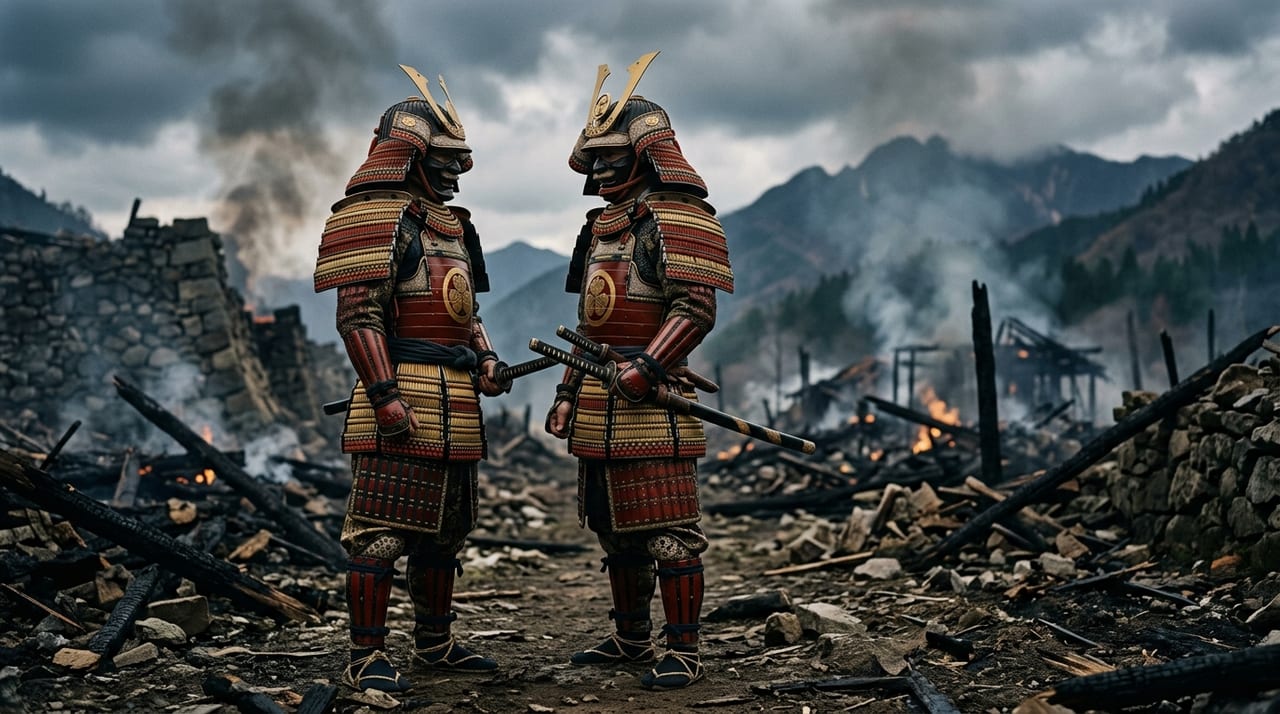
 * Image is for illustrative purposes only.
Minamoto no Yoshitsune
源義経
The Tragic Hero of the Genji
Description
Birth as Ushiwakamaru
Born in Heiji 1 (1159) as the ninth son of Minamoto no Yoshitomo, Minamoto no Yoshitsune (Ushiwakamaru) was a tragic hero who displayed brilliant strategic talent in the Genpei War and drove the Taira to ruin. His childhood name was Ushiwakamaru. After his father Yoshitomo was defeated and killed in the Heiji Rebellion, the young Yoshitsune was placed in the care of Kurama-dera. This childhood on Mount Kurama is said to have laid the foundations for Yoshitsune's later martial arts and swordsmanship.
Training at Kurama-dera
The legend that Yoshitsune was taught swordsmanship by a tengu during his training at Kurama-dera is widely known. The story that Sōjōbō, a great tengu said to dwell on Mount Kurama, passed on martial strategy and sword techniques to Yoshitsune is a legend meant to explain his superhuman valor, but it also conveys how far beyond ordinary people his swordsmanship was. The dagger said to have been given to Yoshitsune on this mountain is the Imanotsurugi. In the Gikeiki, it is described as having been given to him as a protective blade by the superintendent (bettō) of Kurama-dera, and as having been used in his final suicide as well.
Minamoto no Yoshitsune's Rise
In Jishō 4 (1180), Yoshitsune answered the uprising of his elder brother Yoritomo, hurried from Ōshū, and had a moving reunion with him at Kisegawa. From here, Yoshitsune's military genius was displayed to the full. In the Battle of Ichi-no-Tani in Juei 3 (1184), he carried out the unprecedented surprise tactic of the descent at Hiyodori-goe. This tactic, in which mounted warriors charged down a steep cliff to strike the Taira from behind, completely overturned conventional wisdom. At this time, Yoshitsune is said to have led the way down the cliff with his beloved sword in hand.
Exploits in the Genpei War
In the battle that followed at Yashima, he crossed the sea in a storm with only a few boats and launched a surprise attack on the Taira from behind. The anecdote of his retainer Nasu no Yoichi shooting through the fan target in this battle is famous, but Yoshitsune himself also swung his sword and scattered the Taira forces. Then, in the Battle of Dan-no-ura in Genryaku 2 (1185), he commanded the Minamoto navy and brought the Taira to complete ruin. At this time, he is said to have performed the hassō-tobi (the eight-boat leap), fighting while leaping from boat to boat, and his nimbleness and valor astonished friend and foe alike.
Swords and Legends
The most famous of Yoshitsune's swords is the Usumidori (Hizamaru). This blade is a renowned sword handed down through generations as a treasured sword of the Minamoto house, and is said to be the work of a smith of the Heian period. The name Hizamaru is said to derive from the fact that, when this sword was used to behead a criminal, its momentum cut through to the knee. It was later renamed Usumidori. This is said to have been changed to echo the spring mountains of Kumano when Yoshitsune received it as a gift from the Kumano bettō. That Yoshitsune possessed this sword, which the legitimate line of the Minamoto had worn for generations, was a sign of his standing as the rightful heir of the Minamoto.
Conflict with His Elder Brother Yoritomo
Yoshitsune's tragedy began after the Taira had been destroyed. His relationship with his elder brother Yoritomo deteriorated rapidly, and Yoshitsune came to be placed under a pursuit order from the imperial court. The cause of the rift with Yoritomo is said to be that Yoshitsune accepted court rank without Yoritomo's permission, but it was also a tragedy brought on by Yoshitsune's guileless nature, which left him unskilled at political maneuvering.
A Tragic Hero
Now a hunted man, Yoshitsune fled to the Ōshū Fujiwara together with loyal retainers including Musashibō Benkei. But through the betrayal of Fujiwara no Yasuhira, he was attacked at his residence at Koromogawa in Bunji 5 (1189). While Benkei stood firm like a Niō guardian to protect his lord, Yoshitsune shut himself in the jibutsu-dō, and after killing his beloved wife and children, he took his own life. He was 31 years old.
Yoshitsune's tragic end became the origin of the Japanese term hōgan-biiki (sympathy for the underdog). The deep sympathy of the Japanese people for Yoshitsune, who excelled in valor yet was defeated by politics and met an untimely death, has not faded even after a thousand years. The martial might of the Minamoto house, handed down through generations and symbolized by Yoshitsune's sword Usumidori, and the years of training at Kurama, symbolized by the Imanotsurugi: Yoshitsune's swords reflect both the glory and the sorrow of this tragic hero.
Notable Swords
- Usumidori / Hizamaru (a treasured sword of the Minamoto house handed down through generations. It received the name Hizamaru because, when used to cut down a criminal, it cut through to the knee. Yoshitsune received it as a gift from the Kumano bettō and is said to have renamed it Usumidori after the spring mountains of Kumano.)
- Imanotsurugi (a dagger said to have been given to him during his training at Kurama-dera. In the Gikeiki, it is described as having been used in his final suicide. A single blade that symbolizes Yoshitsune's boyhood.)