New Arrivals — Browse our catalog for the latest authentic Japanese sword arrivals. Browse →
17th day of the 10th month, Bunji 1 (1185)
Minamoto no Yoshitsune's residence at Rokujō-Horikawa, Kyoto (the Horikawa mansion)
Forces
Minamoto no Yoshitsune and his household retainers in Kyoto (the defenders)
The forces of Tosabō Shōshun (the attackers, acting under Yoritomo's orders)
About 17 min read
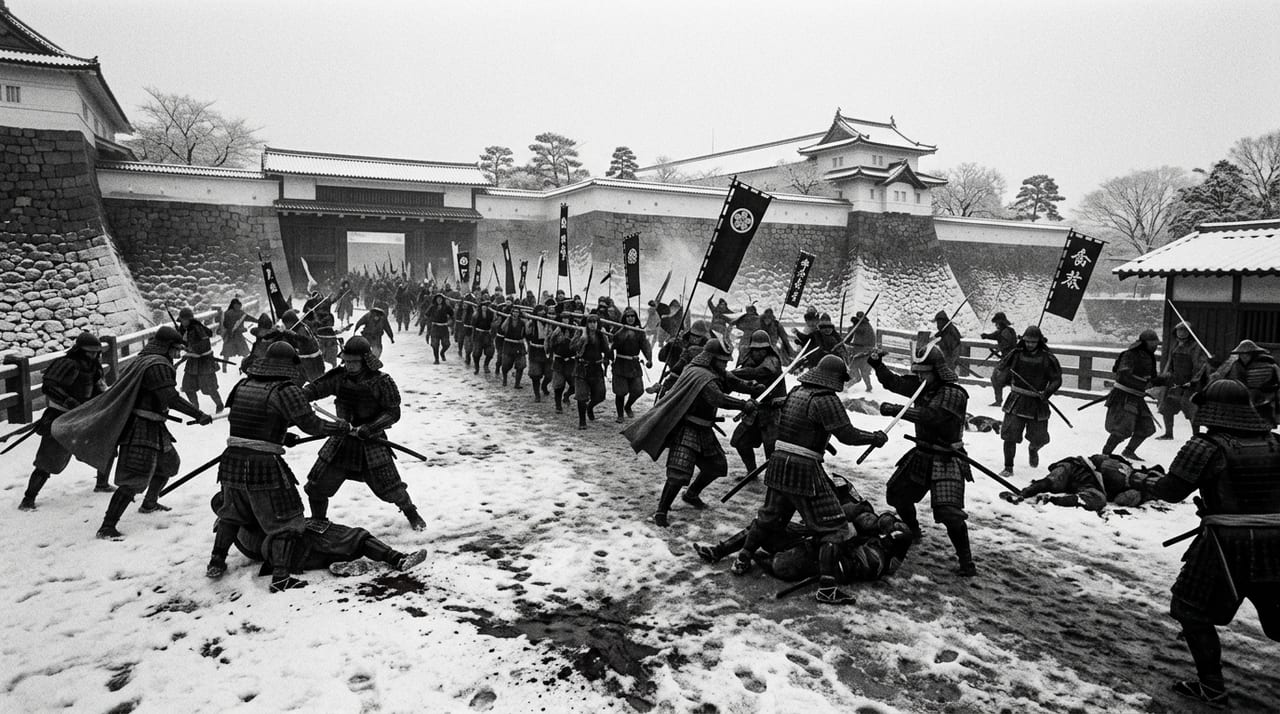
The Horikawa Night Attack (Horikawa yōchi) was an incident in which, on the night of the 17th day of the 10th month of Bunji 1 (1185), Tosabō Shōshun, acting on the orders of Minamoto no Yoritomo, attacked the Horikawa residence, Minamoto no Yoshitsune's mansion at Rokujō-Horikawa in Kyoto. Because this night attack failed and Yoshitsune then obtained an imperial decree (senji) for the pursuit of Yoritomo, the rift between the brothers Yoritomo and Yoshitsune reached a point of no return. It became a watershed that led directly to Yoshitsune's flight and his tragic end in the Battle of Koromogawa-no-tachi in Bunji 5 (1189).
In the Jishō–Juei War (Genpei War), Minamoto no Yoshitsune distinguished himself greatly at the battles of Ichi-no-Tani, Yashima, and Dan-no-ura, and he was one of the greatest contributors to driving the Taira to ruin. However, after the war, Yoshitsune received court rank from the imperial court without first obtaining the permission of his older brother Yoritomo, and he proceeded with postwar arrangements without Yoritomo's approval. For these reasons Yoritomo grew increasingly distrustful of Yoshitsune. In addition, slander from Yoritomo's close aides, who envied Yoshitsune's military achievements, compounded the problem, and relations between the two deteriorated rapidly.
Another trigger that sealed the rift was the affair at "Koshigoe" in the 5th month of Bunji 1 (1185). Yoshitsune was escorting Taira no Munemori and his son Kiyomune from Kyoto to Kamakura in triumph, but Yoritomo, out of distrust, did not allow him to enter Kamakura and kept him at Koshigoe on the outskirts of Kamakura. From there, Yoshitsune is said to have sent a letter to Ōe no Hiromoto, one of Yoritomo's close aides, expressing his feelings (the Koshigoe Letter). In the end, however, entry into Kamakura was not granted, and Yoshitsune had to deliver Munemori and his son to Kamakura alone and return to Kyoto. Although in recent research the view that the Koshigoe Letter itself is a later forgery has also gained strength, in any case, during this period Yoshitsune was recommended for the post of Governor of Iyo (Iyo no kami) as a reward for his campaign against the Taira, yet he also continued to hold his post as kebiishi. This was taken to flatly contradict the new warrior order that Yoritomo was establishing, and it is said that the rift between the two had reached a level that was difficult to repair.
In Bunji 1 (1185), Yoritomo ordered the gokenin of Kamakura to subjugate Yoshitsune, who was in Kyoto, but no one stepped forward. Among them, the one who voluntarily accepted the role of attacker was Tosabō Shōshun, a warrior of Kamakura. On the 9th day of the 10th month, Shōshun departed Kamakura with a force of 83 mounted warriors, including his younger brother Mikami Iesue, and on the 17th day of the 10th month he made a night attack on Yoshitsune's residence in Kyoto, the Horikawa residence at Rokujō-Horikawa.
On that day, most of Yoshitsune's retainers were out and absent. Yoshitsune himself opened the gate and fought back, fighting bravely together with a small number of retainers, including Satō Tadanobu, who had been left to guard the residence. Just as his uncle Minamoto no Yukiie arrived to reinforce them, Yoshitsune's side succeeded in repelling Shōshun's attack.
Defeated, Shōshun fled to Mount Kurama on the outskirts of Kyoto, but he was captured by Yoshitsune's retainers and beheaded at Rokujō-gawara on the 26th day of the 10th month.
On the 18th day of the 10th month, the day after the night attack, Yoshitsune received from Retired Emperor Go-Shirakawa an imperial decree for the pursuit of Yoritomo. Confronted with the fact that Yoritomo had ordered an attack on him, Yoshitsune judged that restoring relations with Yoritomo was now impossible, and it is said that he decided to raise an army himself to overthrow Yoritomo. However, few warriors responded to this uprising. Yoshitsune soon tried to flee to Kyushu, but his fleet was wrecked by a storm, and from then on he was forced into a life of flight away from the capital.
Meanwhile, Yoritomo used this incident as a pretext to make Retired Emperor Go-Shirakawa approve the establishment of shugo and jitō for the pursuit of Yoshitsune and Yukiie, and he used it as a stepping stone to establish the Kamakura shogunate's nationwide system of control. Ironically, this night attack, which failed to kill Yoshitsune, became the direct trigger for Yoritomo's establishment of a nationwide warrior rule.
After the Horikawa Night Attack ended his relationship with Yoritomo, Yoshitsune spent about four years in a life of flight and hiding, repeatedly leaving the capital and going into concealment. Eventually he fled to Hiraizumi in Ōshū, relying on Fujiwara no Hidehira, who had once given him protection. After Hidehira's death, however, his son Fujiwara no Yasuhira, yielding to Yoritomo's pressure, betrayed Yoshitsune, and in the intercalary 4th month of Bunji 5 (1189), Yoshitsune was driven to take his own life at Koromogawa-no-tachi. The Horikawa Night Attack can be said to be the first turning point that determined Yoshitsune's fate, leading to this tragic end. Minamoto no Yukiie, the uncle who had repelled the night attack together with Yoshitsune and had continued to act with him afterward, was likewise pursued by Yoritomo's side. In Bunji 2 (1186), the following year, he was captured in Izumi Province and beheaded. Many of those who parted ways with Yoritomo after the Horikawa Night Attack met violent deaths soon afterward.
The episode in which Yoshitsune himself took up a sword and fought at the gate during the Horikawa Night Attack has been repeatedly taken up in later war tales (gunki monogatari), Noh plays, and kabuki. Together with the loyalty of retainers such as Musashibō Benkei and Satō Tadanobu, it has been passed down as a scene symbolizing the bond between Yoshitsune and his followers. This battle, in which a small force held off a sudden night attack, is also regarded as an example showing that warriors from the late Heian period to the early Kamakura period always kept tachi and naginata close at hand and were prepared to respond immediately to any sudden attack. For this reason it occupies an important place in the history of the Japanese sword and warrior culture.
Tosabō Shōshun, who carried out the Horikawa Night Attack, is a figure for whom several theories about his origins have been transmitted. According to one theory, he was the same person as Konnōmaru (Shibuya Konnōmaru), a retainer of Minamoto no Yoshitomo, the father of Yoritomo. However, none of these theories has firm evidence, and the details of Shōshun's career remain unclear in the historical sources. His voluntary acceptance of the difficult task of subjugating Yoshitsune, which no one else had stepped forward to take, is noted especially in the Azuma Kagami as a sign of his deep loyalty to Yoritomo. As a result, however, this duty cost Shōshun his own life. Regarding the dates of Shōshun's departure from Kamakura and arrival in Kyoto, the Azuma Kagami records departure on the 9th day of the 10th month and the attack on the 17th day of the 10th month, while the Engyō-bon text of the Heike Monogatari transmits a differing account of departure on the 29th day of the 9th month and arrival in Kyoto on the 10th day of the 10th month. Thus, there are differences in the detailed descriptions among the historical sources of the time.
After the Horikawa Night Attack, Yoshitsune raised an army against Yoritomo, but few warriors responded. Lacking a military base in the capital, Yoshitsune sought to make a comeback in western Japan. In the 11th month of Bunji 1 (1185), Yoshitsune set sail from Daimotsu-ura in Settsu Province (present-day Amagasaki, Hyōgo Prefecture) with a fleet bound for Kyushu, together with Yukiie and close aides including Musashibō Benkei. The fleet was wrecked by a storm, and he lost many of his followers. Because of this "wreck at Daimotsu-ura," his escape to western Japan was thwarted. From then on, Yoshitsune lived in hiding, moving from place to place among Yoshino, Nara, and Mount Hiei.
Having failed to capture Yoshitsune, Yoritomo made the most of this incident. He strongly pressed Retired Emperor Go-Shirakawa to establish shugo and jitō under the pretext of pursuing and arresting Yoshitsune and Yukiie. In the 11th month of Bunji 1 (1185), the court gave imperial sanction to this, and the Kamakura side was granted the authority to place shugo in the provinces and jitō on the shōen and kōryō estates. The establishment of shugo and jitō became the institution that formed the foundation of the Kamakura shogunate's later nationwide system of control. It is often pointed out, as a historical irony, that the single incident of the Horikawa Night Attack thus became a turning point that greatly advanced the governing machinery of warrior government in Japan. The contrast between the Horikawa Night Attack, which was the starting point of tragedy for Yoshitsune personally, and its becoming for Yoritomo's warrior government an opportunity to legally justify nationwide control has often been taken up in Japanese medieval history research. It is an anecdote symbolizing the process by which, after the Jishō–Juei War, Japanese society came to establish a centralized warrior governing apparatus through internal conflict within the Minamoto house.