New Arrivals — Browse our catalog for the latest authentic Japanese sword arrivals. Browse →
30th day of the intercalary 4th month, Bunji 5 (1189)
Koromogawa no Tachi, Hiraizumi, Mutsu Province (present-day Hiraizumi, Iwate Prefecture)
Forces
Ōshū Fujiwara clan (Fujiwara no Yasuhira's forces)
Minamoto no Yoshitsune's retinue
About 11 min read
On the early morning of the 30th day of the intercalary 4th month of Bunji 5 (1189), flames rose at Koromogawa no Tachi in Hiraizumi, Mutsu Province. Among the flames fell Minamoto no Yoshitsune, the figure most beloved in Japanese history as a tragic hero. He was 31 (some accounts say 30). The commander who had destroyed the Taira at the Battle of Dan-no-ura and brought brilliant victory in the Genpei War ended his life pursued by his own elder brother, Kamakura-dono Minamoto no Yoritomo.
When Yoritomo raised his army in Jishō 4 (1180), Minamoto no Yoshitsune hurried to join him from the side of Fujiwara no Hidehira in Hiraizumi, Mutsu Province. He won remarkable military achievements in the campaign against Kiso Yoshinaka (1184), the Battle of Ichi-no-Tani (1184), the Battle of Yashima (the 2nd month of 1185), and the Battle of Dan-no-ura (the 3rd month of 1185). His stratagems, such as the sheer-cliff descent, and his battle command at sea, which bordered on the divine, gave rise to legends that he "studied strategy under Kiichi Hōgen" and that "tengu taught him swordsmanship." He won battle after battle.
However, Yoshitsune accepted the court ranks of kebiishi (capital police commissioner) and Saemon-no-shōjō without Yoritomo's permission. This provoked Yoritomo's fury, and the rift between the brothers became decisive. Immediately after the Battle of Dan-no-ura, Yoritomo refused to let Yoshitsune enter Kamakura. From Koshigoe, Yoshitsune sent a petition known as the Koshigoe Letter (Koshigoe-jō) to plead his innocence, but Yoritomo's heart did not move.
In the 10th month of Bunji 1 (1185), Yoshitsune obtained an imperial edict (senji) from Retired Emperor Go-Shirakawa ordering Yoritomo's pursuit, and he resisted. However, only a small force gathered, and he failed. He tried to set sail from Daimotsu-ura but was caught in a great storm. After wandering from place to place, he took refuge in Bunji 3 (1187) with Fujiwara no Hidehira, the third head of the Ōshū Fujiwara. Hidehira sheltered Yoshitsune, but he died in the 10th month of that same year. His successor, Fujiwara no Yasuhira, yielded to Yoritomo's pressure.
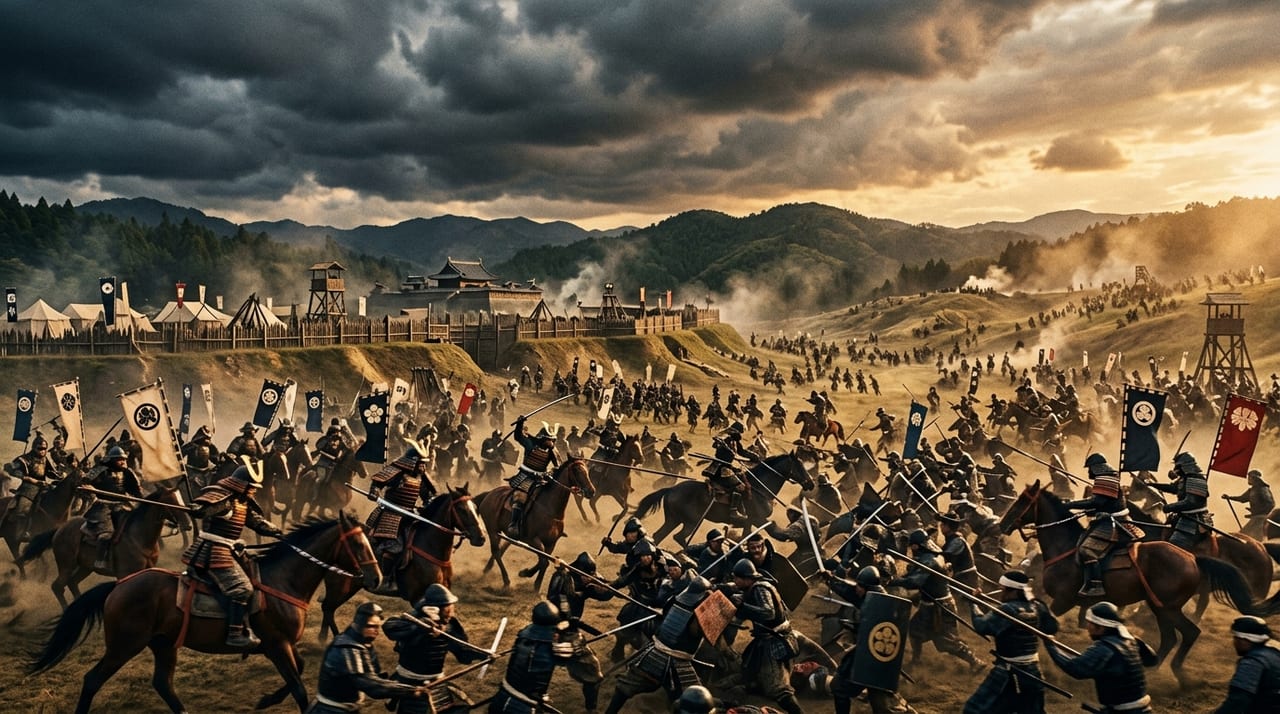
At dawn on the 30th day of the intercalary 4th month of Bunji 5 (1189), Fujiwara no Yasuhira sent several hundred troops against Koromogawa no Tachi. Yoshitsune's retainers numbered barely a dozen or so mounted warriors. Loyal warriors led by Musashibō Benkei fought bravely outside the residence and bought time.
The end of Benkei is especially famous. The tale of Benkei no tachi-ōjō (Benkei's standing death), in which he is said to have died still standing upright though struck by countless arrows, was repeatedly depicted in later war chronicles, kabuki, Noh, and other works. As a symbol of loyalty, a man who kept guarding his lord to the very end with a blade in hand, Benkei's image is inseparably linked with the swordsman and the spirit of bushidō.
As fire approached the residence, Yoshitsune shut himself in the jibutsudō (private Buddhist chapel). He first killed his wife, Sato Gozen, and their young daughter, and then took his own life. Yoshitsune's head was packed in sake and sent to Kamakura, where it was examined at Koshigoe on the 13th day of the 6th month.
After Yoshitsune's death, his legend expanded rapidly. The legend of Yoshitsune's flight north (Yoshitsune hokkō densetsu), the tradition that a double died at Koromogawa while Yoshitsune himself fled north and became Genghis Khan, was widely believed from the medieval to the early modern period and even spread to Mongolia.
In connection with the Japanese sword, blades said to be associated with Yoshitsune have been handed down in various places. "Usumidori" (also called Hizamaru) is a long sword said to have been favored by Yoshitsune, and it is still preserved at Daikaku-ji in Kyoto Prefecture. The "Tsurugi no Maki" (Book of Swords) of the Heike Monogatari describes it as a hereditary sword of the Minamoto clan, commissioned by Minamoto no Mitsunaka, which passed through the generations of Yorimitsu and Tameyoshi and was presented to Yoshitsune by the Kumano Bettō (superintendent of the Kumano shrines). "Imanotsurugi" is a tanto that, according to the Gikeiki, Yoshitsune received as a protective dagger at Kurama-dera in his childhood and also used for his final suicide. Many of these swords are difficult to verify in person, yet through the pull of the Yoshitsune legend, they are still passed down and discussed among sword enthusiasts today.
In the present day, the popular game Tōken Ranbu also depicts Imanotsurugi and Hizamaru as characters (tōken danshi). Through this, it serves as a medium that conveys to younger generations the connection between the Yoshitsune legend and the Japanese sword.
Yoshitsune's tragedy gave birth to the term hōgan-biiki (sympathy for the underdog). Derived from Yoshitsune's court title, Saemon-no-shōjō (hōgan), the term has taken root in Japanese as a word for sympathy and identification with the weak and the defeated. The story of a hero who, though pursued by overwhelming power, took pride in his martial merit and perished alone, resonated deeply with mono no aware, the aesthetic sensibility that the Japanese have held since ancient times.
From medieval sources such as the Heike Monogatari, the Gikeiki, and the Azuma Kagami, to the early-modern kabuki and jōruri work Yoshitsune Senbon Zakura, and on to modern manga, anime, and taiga dramas, Yoshitsune's story has been retold again and again. His life has taken deep root in Japanese culture as the ideal of the warrior and the ultimate in tragedy.
More than 800 years after Yoshitsune's death, visitors still continue to come to the site of Koromogawa no Tachi (Hiraizumi, Iwate Prefecture). Located on a hill about 500 meters east-southeast of the entrance to the main approach of Chūson-ji, the site quietly tells of the splendor of the Ōshū Fujiwara and the end of Minamoto no Yoshitsune. Hiraizumi was registered as a UNESCO World Heritage Site in 2011, and as a place connected with Yoshitsune, it attracts attention from around the world.