New Arrivals — Browse our catalog for the latest authentic Japanese sword arrivals. Browse →
March 4, 1184 (Juei 3/1/20)
The Uji River in Yamashiro Province (present-day Uji City, Kyoto Prefecture) and Awazu in Ōmi Province (present-day Otsu City, Shiga Prefecture)
Forces
Minamoto Yoritomo Forces (Yoshitsune & Noriyori)
Kiso Yoshinaka Forces
About 19 min read
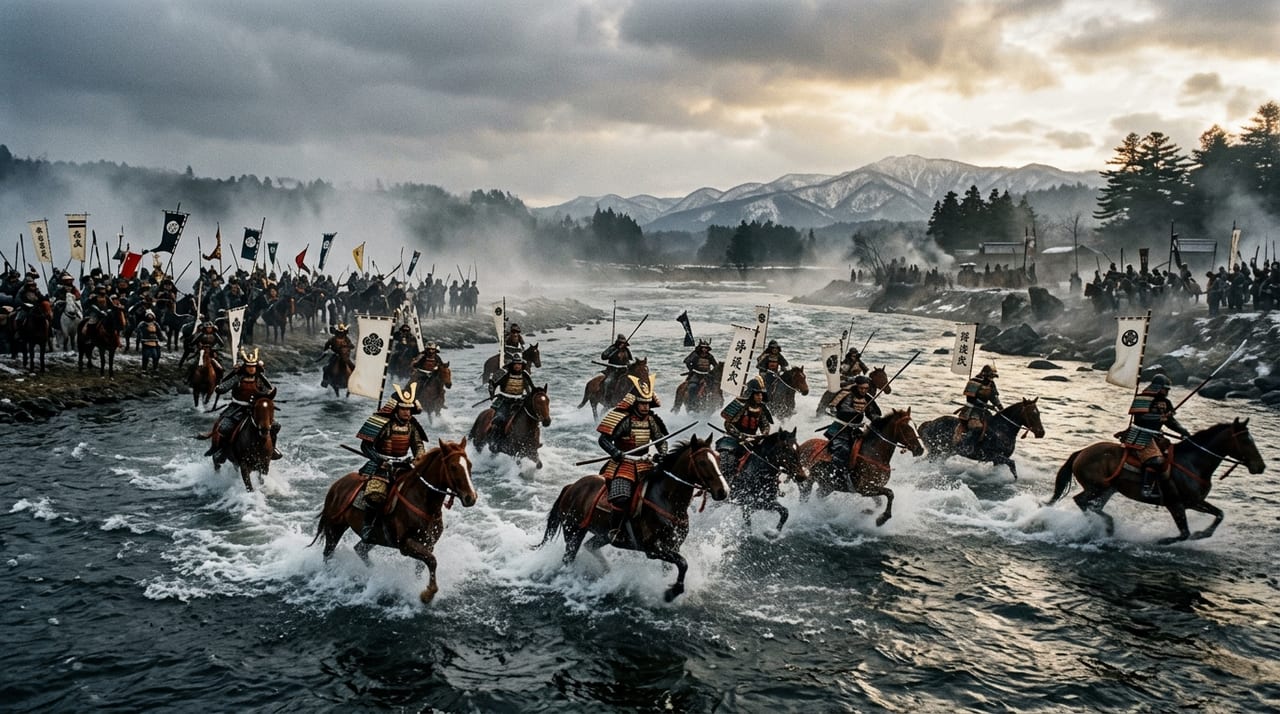
In the 1st month of Juei 3 (1184), on the banks of the Uji River, which flows south through Yamashiro Province (present-day Kyoto Prefecture), generals who shared the same Minamoto blood crossed swords. This battle was an internal strife that broke out during the Genpei War (the Jishō–Juei War). It was a clash between the armies of Minamoto no Yoshinaka (Kiso Yoshinaka), who had gone up to Kyoto and taken control of the court, and the forces of Yoritomo's younger brothers, Yoshitsune and Noriyori, whom Minamoto no Yoritomo of Kamakura had dispatched.
The Battle of the Uji River holds a special place in Japanese samurai culture and sword culture not so much because of the outcome of the battle itself, but because of the legend of the "senjin arasoi" (the race to be first across) born in it. This episode, in which Kajiwara Kagesue and Sasaki Takatsuna raced each other across the winter Uji River on horseback and by swimming, is passed down to later generations as the scene that most vividly embodies the core of bushidō: honor, loyalty, and a pride that transcends death.
In the Genpei conflict that began in Jishō 4 (1180), Kiso Yoshinaka (Minamoto no Yoshinaka), whose base was Shinano Province (present-day Nagano Prefecture), swept through Echigo, Kaga and Etchū and took control of the Hokurikudō with surging momentum. In the 5th month of Juei 2 (1183), Yoshinaka's Hokurikudō army annihilated the great Taira army at the Battle of Kurikara Pass, and in the 7th month of Juei 2 (1183) he entered the capital.
However, Yoshinaka's rule of the capital was turbulent. Looting connected with the procurement of food for his army terrified the court nobles and common people of the capital, and relations with the court gradually deteriorated. In the 11th month of Juei 2 (1183), he committed the reckless act of surrounding the palace of Retired Emperor Go-Shirakawa in the Battle of Hōjūji-dono Palace, and he came under suspicion of being a "traitor to the throne."
Seeing this situation as an opportunity, Minamoto no Yoritomo of Kamakura ordered his younger brother Minamoto no Yoshitsune to lead a large army westward, with Minamoto no Noriyori as commander-in-chief. The Yoritomo army, said in some accounts to number about 60,000 mounted warriors, had a strength that overwhelmed Yoshinaka's forces.
In the 1st month of Juei 3 (1184), cornered, Yoshinaka tried to block Yoritomo's forces' advance by using the Uji River south of Kyoto as a line of defense. The Uji River was in its winter high-water season and functioned as a natural moat, wide and swift-flowing. Yoshinaka stationed troops on the river's north bank (the Kyoto side) and removed the bridge planks to make crossing difficult.
Yoshinaka's camp included his loyal retainer Imai Kanehira and Tomoe Gozen, famed as a "female warrior." Tomoe Gozen is said to have been an extraordinarily beautiful woman who was also a combat master skilled with bow, arrow and sword, and she is passed down to later generations as the most famous female warrior of the Genpei and Kamakura periods.
What makes the Battle of the Uji River shine eternally is the dramatic scene passed down to later generations as the "senjin arasoi" (the race to be first across). This was not merely an episode of martial valor. It was an event that crystallized the foundations of Japanese bushidō, namely "death for honor," "death for one's lord," and "resolve shown through action rather than words," and it is recorded in detail in war chronicles including The Tale of the Heike.
Kajiwara Kagesue, a son of Kajiwara Kagetoki, requested the famous horse "Ikezuki" from Yoritomo but was not granted it; instead he received "Surusumi." However, Yoritomo gave Ikezuki to Sasaki Takatsuna, and the two came to compete for the lead across the Uji River.
The two reached the south bank of the Uji River and tried to cross the swift current together. The account in which Takatsuna called out to the leading Kagesue, "Your horse's girth looks loose, so tighten it," and then, while Kagesue retightened his girth, Takatsuna rode his own horse into the river first, is celebrated as a memorable scene that demonstrates a samurai's quick wit and courage.
Thus Takatsuna, riding Ikezuki, got ahead of Kagesue on Surusumi, reached the opposite bank (the Kyoto side) first, and loudly proclaimed his name: "Sasaki Shirō Takatsuna, the first across the Uji River!" This moment is depicted countless times in later literature, theater and painting as the scene in which the concept of samurai "honor" was shown in its purest form.
In the Edo period, the joruri and kabuki play Hirakana Seisuiki (first performed in 1739) included a scene called 'Senjin Mondō' that took the senjin arasoi as its subject. In this way, the senjin arasoi of the Uji River was widely loved through the theater as well.
The large Yoritomo army that broke through the Uji River overwhelmed Yoshinaka's forces, and Yoshinaka fled Kyoto and was routed to Awazu in Ōmi Province (present-day Shiga Prefecture). At this time, only a few dozen mounted warriors followed Yoshinaka.
At Awazu, Yoshinaka made a final attempt to resist, but he was surrounded by enemy troops. Imai Kanehira advised his lord Yoshinaka, "Lord Kiso, please take your own life," and in order to buy time for Yoshinaka to take his own life, he charged alone into the enemy ranks. While Yoshinaka was heading toward the pine grove of Awazu, the legs of his horse became stuck in a deep marsh, leaving him unable to move, and he was struck in the face by an arrow and killed. Imai Kanehira too followed his lord in death by suicide.
The bond between Imai Kanehira and Yoshinaka as lord and retainer, and Kanehira's act of "dying for one's lord," were praised in later generations as the ideal form of samurai loyalty. Yoshinaka closed his short life at the age of 31, but his bold way of living was passed down to later generations, and numerous works of literature, kabuki and other visual works featuring Yoshinaka as the protagonist were produced down to modern times.
According to The Tale of the Heike, at the final moment Tomoe Gozen was ordered by Yoshinaka to flee, with the words "You must not be said to have brought a woman to the last battle," and she is said to have left the battlefield after killing enemy commander Onda no Hachirō Moroshige. There are various theories about what became of Tomoe Gozen after she left the battlefield, but the samurai-style "regret" at not having died with Yoshinaka made her an even more poignant figure in later tales.
The Battle of the Uji River also holds an important place from the perspective of the Minamoto's tachi culture. The "tachi" that samurai wore at their sides from the late Heian period to the early Kamakura period embodied the pinnacle of the sword-making technology of the time.
The most famous swords corresponding to the era of the Battle of the Uji River are "Higekiri" and "Hizamaru." These two blades are famous swords said to have been commissioned by Minamoto no Mitsunaka and passed down as heirloom treasures to the main line of the Minamoto, including Minamoto no Yorimitsu. Higekiri is also said to have been worn by Yoritomo, and it is positioned as a symbolic sword of the founding of the Kamakura shogunate. There is also a legend that Hizamaru passed to Yoritomo's younger brother Yoshitsune and was renamed "Usumidori."
As Minamoto no Yoshinaka's weapons, the long naginata and the tachi come to mind. Yoshinaka's bold martial style was embodied in a fighting style that prized "power and speed" over delicate technique, which reflects the view of swords as weapons in the late Heian period.
Sasaki Takatsuna, who won the lead across the Uji River, is also said to have taken Buddhist vows after gaining martial renown and to have called himself "Ryōchi." Details of the tachi that Takatsuna wore have not been handed down.
The era in which the Battle of the Uji River took place, a period of transition from the Genpei conflict to the founding of the Kamakura shogunate, was also an important period of development in the shape and technology of the Japanese sword. The form of the "tachi," established in the mid-Heian period, moved toward more practical refinement through the battlefield experience of this age. After the founding of the Kamakura shogunate, the Sōshū tradition developed centered on Sagami Province (present-day Kanagawa Prefecture), preparing the way for the golden age of the Japanese sword.
The historical significance of the Battle of the Uji River is a weighty one that goes beyond the outcome of a mere battle.
First, this battle brought the power struggle within the Minamoto to a close and consolidated the foundation of Minamoto no Yoritomo's "unified rule." With the disappearance of Kiso Yoshinaka, "another Minamoto," Yoritomo became the head of the Minamoto both in name and in reality, and in the 3rd month of Genryaku 2 (1185), the following year, he went on to destroy the Taira at the Battle of Dan-no-ura.
Second, the Battle of the Uji River gave rise to a typical example of a bushidō-style competition, the "senjin arasoi." The sense of honor in "charging into the enemy's lines before anyone else" forms the core of the samurai's combat ethics, and this spirit was carried on through the Kamakura, Muromachi and Sengoku periods. The culture in which samurai bearing swords were judged by "how they fought" rather than by "how they died" begins here.
Third, the lord-and-retainer bond between Yoshinaka and Imai Kanehira and their heroic deaths set a model for later generations as the earliest example embodying the concept of "samurai loyalty." This concept of loyalty developed into the theory of bushidō in the Muromachi and Sengoku periods, and in the Edo period it was reproduced in its most extreme form as the "Akō Incident (Chūshingura)."
The Battle of the Uji River is one of the important starting points in the long history through which Japanese samurai culture and the sword rose from "instruments of war" to "symbols of honor and spirit." The scene of two famous horses racing across the Uji River is still carved into stone today as the Uji River Senjin Monument (Uji City), and it remains in the land of Uji as an eternal symbol of Japanese bushidō.
Minamoto no Yoshitsune
Yoritomo's field commander who led the Uji crossing — tactical genius of the Genpei War
Kiso Yoshinaka
Defender who held the Uji River line; died heroically at Awazu
Tomoe Gozen
Female warrior who fought for Yoshinaka and stayed at his side to the end
Minamoto no Yoritomo
Kamakura commander who dispatched the army; victory here secured Minamoto supremacy
Musashibō Benkei
Yoshitsune's loyal warrior-monk who fought throughout the Genpei campaigns