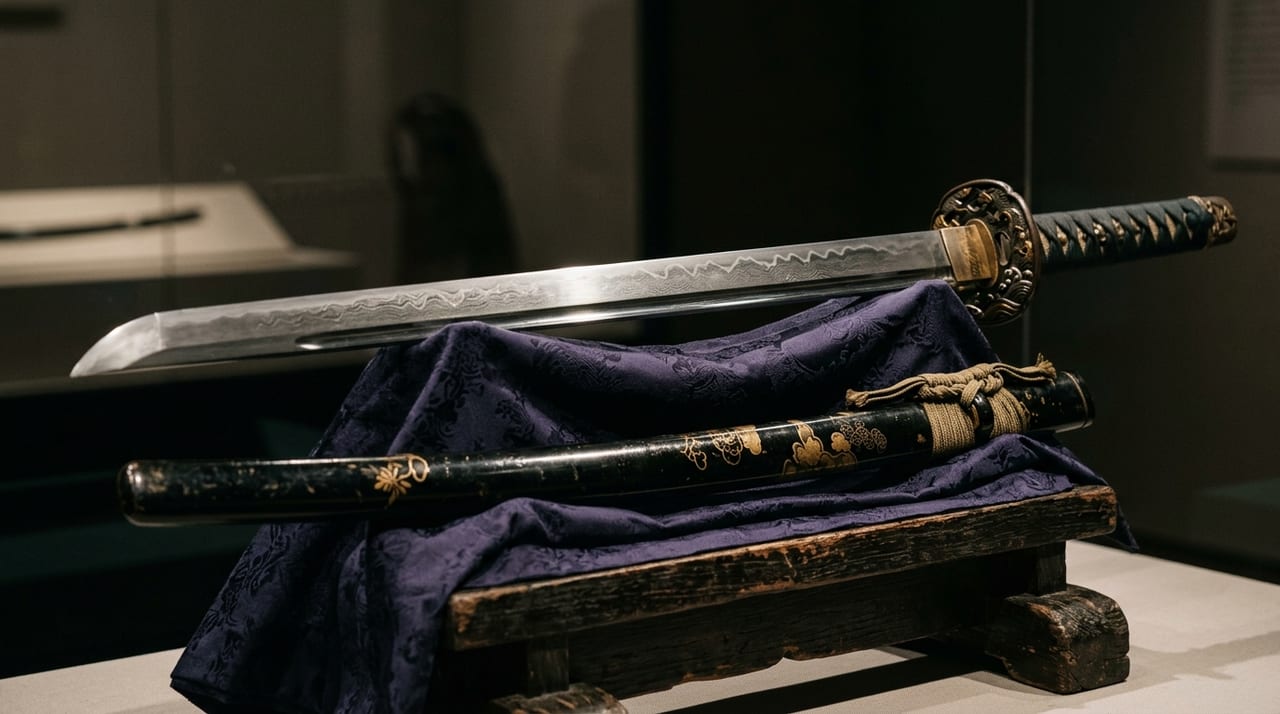
 * Image is for illustrative purposes only.
Higekiri
髭切
Also known as: Onikiri / Onikirimaru / Tomokiri
Description
Overview of the Sword
A legendary tachi (long sword) revered as a treasure of the Genji clan. As the "elder brother" of the paired swords with Hizamaru, it was honored as the supreme guardian blade that each Genji clan head passed down. Of the two tachi that Minamoto no Mitsunaka had forged, this one received the name "Higekiri" (Beard Cutter) because, in a test cut on a criminal, it sliced through the man's beard with ease. Like Hizamaru, Higekiri has also been called by other names over its history, including "Onikiri" (Demon Cutter) and "Tomokiri" (Friend Cutter). The name "Onikiri" in particular comes from Watanabe no Tsuna's feat of cutting off a demon's arm at Ichijō Modoribashi bridge, and it is widely known as Higekiri's most famous alternate name.
Swordsmith
The maker is unknown, and the sword is a legendary one in tradition. However, the tachi bearing the signature "Yasutsuna," known as Onikirimaru and held by Kitano Tenmangū Shrine in Kyoto, is identified with Higekiri and has been designated an Important Cultural Property. The Kitano Tenmangū tachi has the graceful form of the late Heian period. It shows the dignified bearing of a typical old tachi, with deep koshizori (curvature at the waist) and a sturdy, firm profile.
Construction and Characteristics
The hamon (temper line) is notare-midare, an undulating and irregular pattern. Like its paired sword Hizamaru, held by Daikaku-ji, it carries the refined elegance of an old tachi. Minamoto no Yoritomo is said to have valued Higekiri as a symbol of the Genji clan's revival, emphasizing the clan's legitimacy when he founded the Kamakura shogunate. As a guardian blade that only the head of the Genji clan was permitted to hold, Higekiri continued to embody the bloodline and authority of the Genji. The Kitano Tenmangū tachi was passed down through the Mogami family of Dewa Province. It left that family in 1868 (Meiji 1), and in 1880 (Meiji 13) volunteers from Kyoto, Osaka and Shiga Prefecture dedicated it to Kitano Tenmangū Shrine. In the game Tōken Ranbu, Higekiri appears alongside his younger brother Hizamaru as "the Genji brothers," and as the easygoing elder brother he has become very popular. Kitano Tenmangū and Daikaku-ji have held simultaneous public showings of Higekiri and Hizamaru, and museum exhibitions have displayed the two swords side by side. These events have drawn considerable attention from sword enthusiasts.
Legends & Stories
Higekiri's most famous legend involves the demon-slaying feat of Watanabe no Tsuna. One night, as Tsuna, a retainer of Minamoto no Raikō, was crossing the Ichijō Modoribashi bridge, a beautiful woman asked him for an escort. When he placed her on his horse, she transformed into a fearsome demon and tried to carry him away through the sky. Undaunted, Tsuna drew this tachi and severed the demon's arm. In the Tsurugi no Maki the demon is identified as the Hashihime of Uji, while later tales name it Ibaraki-dōji, a follower of Shuten-dōji. From then on, the blade was called 'Onimaru' (later tales say 'Onikiri', Demon Cutter). As the sword of the Genji clan leader, it symbolizes courage that fears not even demons. Together with Hizamaru, it forms the most famous brother-sword pair in Japanese history. In Touken Ranbu, Higekiri is depicted as the carefree elder brother, and his banter with his younger sibling Hizamaru has become hugely popular.