New Arrivals — Browse our catalog for the latest authentic Japanese sword arrivals. Browse →
March 20, 1184 (7th day, 2nd month, Juei 3)
Ichi-no-Tani, Settsu Province (present-day Suma-ku, Kobe, Hyōgo Prefecture)
Forces
Minamoto Forces
Taira Forces
About 10 min read
On the 7th day of the 2nd month of Juei 3 (20 March 1184), the Genji forces led by Minamoto no Yoshitsune and Minamoto no Noriyori launched a surprise attack on the Taira encampment at Ichi-no-Tani in Settsu Province (present-day Suma Ward, Kobe, Hyogo Prefecture). The Battle of Ichi-no-Tani is renowned as the engagement in the Genpei War in which Yoshitsune's tactical genius was displayed most brilliantly. It is also a battle in which the “compassion of the warrior” and the “aesthetics of life and death,” symbolized by the death of Taira no Atsumori, have been passed down through the ages.
Since Kiso Yoshinaka seized Kyoto in Juei 2 (1183), the Taira had fled to the western provinces. After Yoshinaka was killed by Yoshitsune and Noriyori, who were on the side of Minamoto no Yoritomo (the Battle of Uji River), Yoshitsune swiftly turned to pursuing the Taira. Ichi-no-Tani lay on the coast of Settsu Province (present-day Hyogo Prefecture). It was a natural stronghold, with the sea to the south and a mountain of sheer cliffs to the north. The Taira set up their encampment here and fortified their defenses.
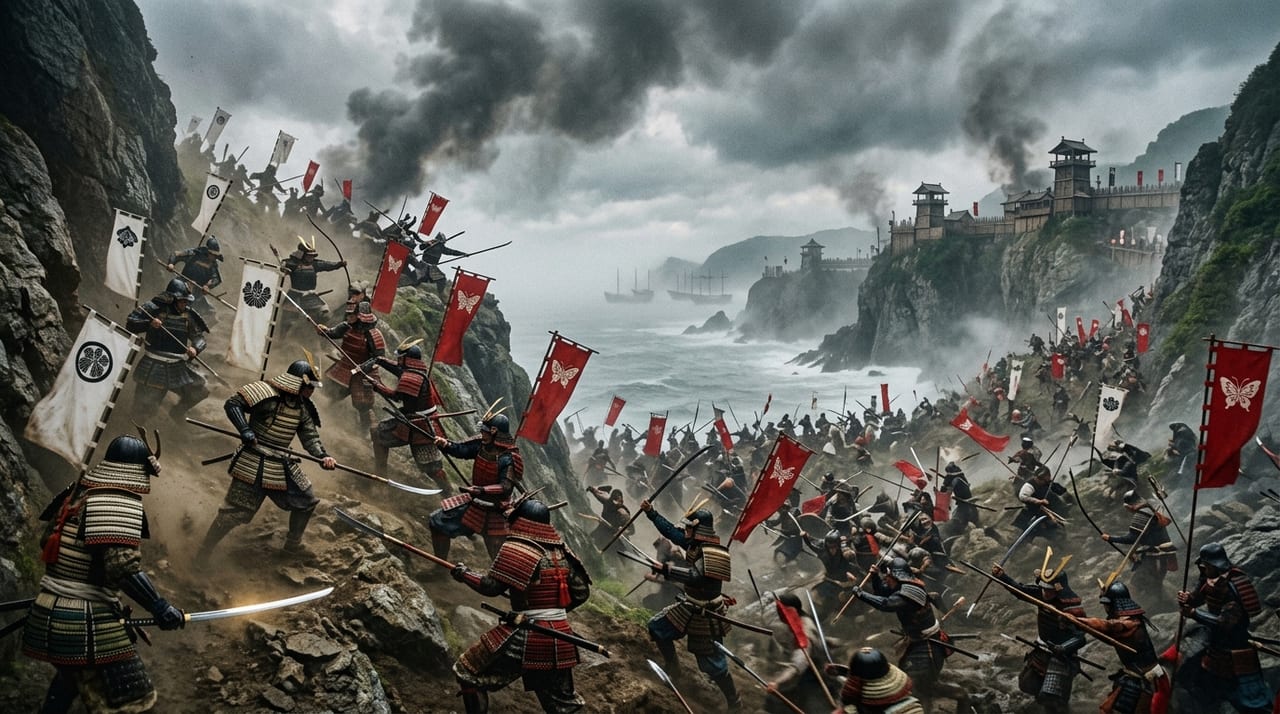
Judging that a frontal assault alone could not win, Minamoto no Yoshitsune entrusted Noriyori with the attack from the front (east side). He himself led a small elite force over the mountains to carry out a daring plan: a sudden descent down the northern cliffs at Hiyodorigoe. According to the Heike Monogatari and the Azuma Kagami, this charge, called “sakaotoshi” (reverse descent), went down a steep cliff that was said to be too steep for horses to charge down, and it struck the rear of the Taira encampment. However, the sakaotoshi does not appear in the contemporary diary Gyokuyō, and both its location and its historical accuracy are debated.
This stratagem of Yoshitsune has a deep connection with sword culture. The image of Yoshitsune handed down in the Heike Monogatari depicts him as a hero of outstanding skill in archery and horsemanship, linked to the legends of the Genji swords Higekiri and Hizamaru. Several theories exist about Yoshitsune's favorite sword. However, the Genji family treasures Higekiri and Hizamaru as symbols of the Genji's legitimate line, and they are deeply tied to the stories of Yoshitsune and his elder brother Yoritomo.
The episode most passed down through the ages from the Battle of Ichi-no-Tani is the single combat between Taira no Atsumori (aged 17) and Kumagai Naozane.
Kumagai Naozane, a warrior on the Genji side, called out to a young warrior fleeing by riding his horse into the sea. He made the youth turn back and pinned him down. When he removed the helmet, a beautiful young man appeared: Taira no Atsumori. Naozane hesitated for a moment, thinking, “Should I kill this young man?” But as his comrades came closing in, he swallowed his tears and took the head.
Upon seeing the flute tucked at Atsumori's waist, a flute named Saeda (Little Branch), Naozane is said to have wept aloud. Deeply moved, he thought, “Surely no one among our men would bring a flute to the battlefield. How refined the courtly nobles are.” Naozane later became a monk and a disciple of Hōnen.
This story is known as the highlight of the Heike Monogatari. As a scene embodying the “compassion of the warrior” and mono no aware (the pathos of things), it deeply influenced later views of bushidō and sword aesthetics. The value that a sword is at once an instrument that takes life and an embodiment of a warrior's sincerity and grief crystallized here.
At Ichi-no-Tani, Taira no Tadanori, a younger brother of Taira no Kiyomori, was also slain. Tadanori was known as a warrior accomplished in both the literary and martial arts, excelling in waka poetry. The Heike Monogatari describes an episode in which, at the time of the flight from the capital, he visited his waka teacher Fujiwara no Shunzei and left with him a collection of his own poems.
Tadanori was slain by Okabe Tadazumi of the Genji side. It is said that tied to his quiver (ebira) was a note bearing a single poem under the title “Flower at a Traveler's Lodging.” The image of the Taira aristocratic warrior, combining culture and military prowess, overlaps with the ideal of “bunbu ryōdō” (dual mastery of letters and arms) in later bushidō culture.
The swords worn by the warriors of the Genpei War were elegant tachi with deep curvature. The mainstream way of wearing them was at the waist, hanging the tachi from the left hip.
There are no historical records concerning the tachi said to have been worn by Taira no Atsumori. However, as a young lord of the Taira, he is thought to have worn a tachi with a courtly, luxurious mounting (koshirae). Tachi of the late Heian period, along with their splendid mountings, were also works of art embodying “the fusion of aristocratic and warrior culture.”
The Battle of Ichi-no-Tani was a place where the warrior's sword and poetry met. The sword takes life, the flute binds hearts, and the poem engraves eternity. As a scene condensing the multifaceted beauty of Japan's sword culture, this battle still lives on in people's hearts.
Minamoto no Yoshitsune
Minamoto commander who executed the famous cliff descent surprise attack
Taira no Tomomori
Senior Taira commander who fought at Ichi-no-Tani
Taira no Kiyomori
Taira clan leader who died the previous year; his legacy defined the conflict
Musashibō Benkei
Yoshitsune's legendary retainer who accompanied him throughout the Genpei War
Minamoto no Yoritomo
Minamoto supreme commander who ordered Yoshitsune to pursue the Taira
Kumagai Naozane
Minamoto Warrior Who Slew Taira no Atsumori