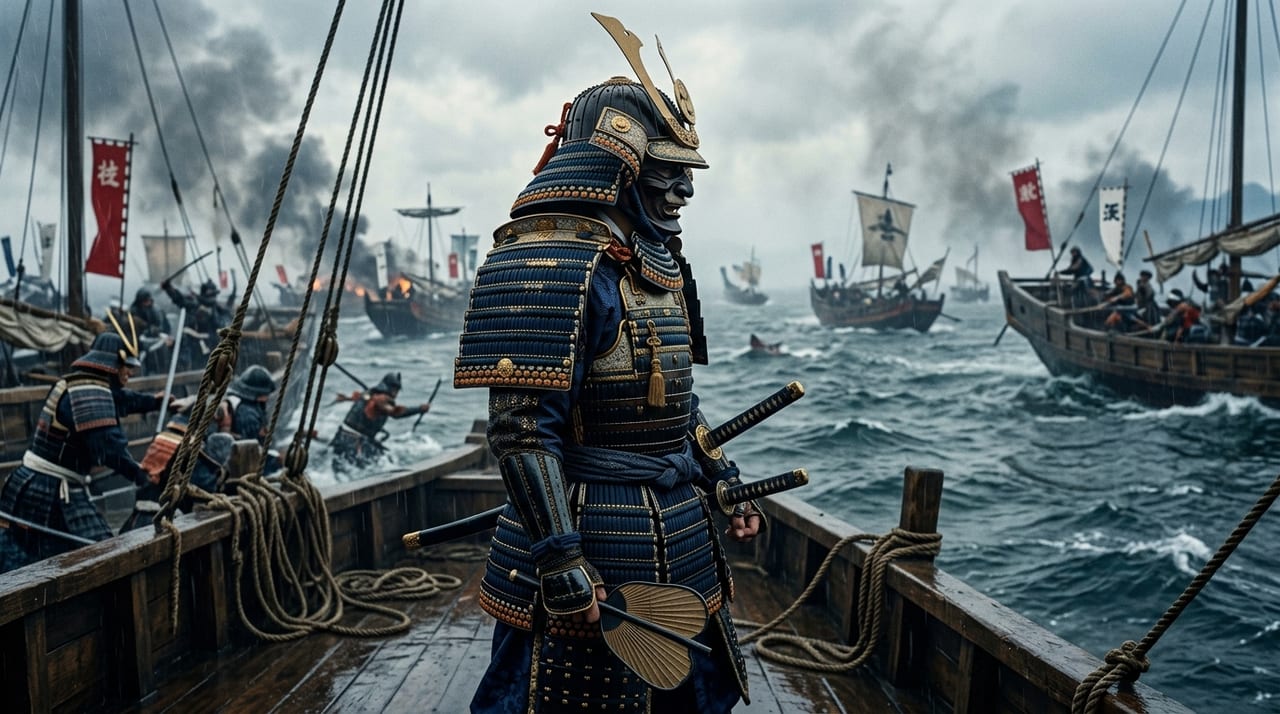
 * Image is for illustrative purposes only.
Taira no Tomoori
平知盛
Ikari Tomoori—The Valiant Taira General Who Sank at Dannoura, the Tragic Warrior Who Left Behind the Famous Words 'I Have Seen All That Was Worth Seeing'
Description
The Life of Taira no Tomoori, The Valiant Taira General
Born in 1152 as the fourth son of Taira no Kiyomori, Taira no Tomoori was renowned as an exceptional general of the Taira clan, combining outstanding martial prowess with strategic wisdom. In the Tale of the Heike, Tomoori is depicted with particular poignancy as a tragic hero who met a glorious end, and the legend of "Ikari Tomoori" is passed down to posterity as a tale symbolizing his spectacular death. Tomoori's life embodied a microcosm of the Taira clan's glory and decline, and he was an embodiment who took the samurai aesthetic of "the beauty of one's final moments" to its ultimate expression.
Taira no Tomoori's Role in the Genpei War
In the Genpei War (Jisho-Juei Uprising), Tomoori served as one of the most capable Taira generals, distinguishing himself on battlefields throughout the conflict. At the Battle of Ichinotani (1184), when Minamoto no Yoshitsune's surprise assault through the Hiyodori Pass dealt a devastating blow to the Taira forces, Tomoori still succeeded in commanding the surviving troops to retreat to the sea, preserving the Taira clan's lifeline. At the Battle of Yashima as well, Tomoori's naval command was outstanding, functioning as the strategic cornerstone of Taira maritime warfare. This military acumen made Tomoori a figure set apart even within the Taira clan.
The Final Battle at Dannoura
In March 1185, at Dannoura off Akama in Nagato Province (present-day Shimonoseki, Yamaguchi Prefecture), the final clash between the Genji and Heike took place. Initially, the Taira navy held the advantage through skillful use of the tides, but when the current reversed in the early afternoon, the advantage swung decisively to the Genji. As Taira oarsmen fell one after another to arrows and deserters fled, Tomoori moved from ship to ship, commanding the battlefield. According to legend, at this moment Tomoori declared: "I have seen all that was worth seeing. Now I shall take my own life," and embracing an anchor upon his armor, he cast himself into the sea. His final words and actions became the archetype of an honorable death in the face of defeat, profoundly influencing the death philosophy of later samurai society.
The Spirit of "I Have Seen All That Was Worth Seeing"
The words Tomoori left behind—"I have seen all that was worth seeing. Now I shall take my own life"—are among the most essential maxims in discussions of Japanese bushido. This phrase—meaning "I have witnessed all that was worthy (fulfilled all my duties), with nothing left to regret"—expresses the clear-minded state of one who has completely fulfilled his obligations as a general. The elegance and aesthetic of these words became a spiritual standard for later warriors, exerting profound influence in forming the concept of "a samurai's manner of death." Tomoori's greatness lay not merely in his martial prowess, but in the spiritual nobility he displayed at the moment of death.
The Taira Clan's Sword Culture
The Taira clan of the late Heian period, while serving as court officials, possessed both refined cultural sophistication and exceptional martial capability. The tachi of Tomoori's era represented a time when beautiful curvature (sori) and forging technique reached their zenith, with sword makers from Bizen Osafune and other regions competing to produce masterpieces. Numerous famous swords appear in the Tale of the Heike, revealing how deeply samurai held their tachi as sacred objects. Tomoori, as a general, certainly carried fine swords, and his tachi were symbols of the soul, embodying loyalty to his lord and the pride of the warrior. The Kusanagi no Tsurugi that sank at Dannoura (one of the Three Imperial Regalia lost with Emperor Antoku) became a symbolic embodiment of loss and tragedy in Japanese sword culture, intertwined with Tomoori's final moments.
Influence on Later Generations and the Spread of Legend
Tomoori's tragic end was depicted in many performing arts—including the Tale of the Heike, Noh, Kabuki, and puppet theater—and has held an important place in Japanese cultural history. The "Ikari Tomoori" scene in the Kabuki play "Yoshitsune and a Thousand Cherry Blossoms" is a prime example, continuing to convey to audiences the sublime aesthetic of a spectacular death. At Akama Shrine in Shimonoseki, the spirits of the Taira clan are enshrined, with Tomoori venerated as a central figure. The sea bottom of Dannoura is said to be inhabited by the spirits of the Heike, and the legend that the faces of Heike warriors reside on the shells of Heike crabs continues to be told in connection with Tomoori's spectacular death.
Notable Swords
- Taira-transmitted famous tachi—Tomoori carried tachi created by the master smiths of Bizen and Yamashiro at the height of the late Heian period. The tachi of Tomoori's era represented the pinnacle of Japanese sword beauty, symbolizing the warrior's soul and loyalty.
- The Kusanagi no Tsurugi that sank at Dannoura—One of the Three Imperial Regalia lost with Emperor Antoku at the bottom of Dannoura. Intertwined with Tomoori's final moment, it remains a symbol of the greatest loss and tragedy in Japanese sword culture.