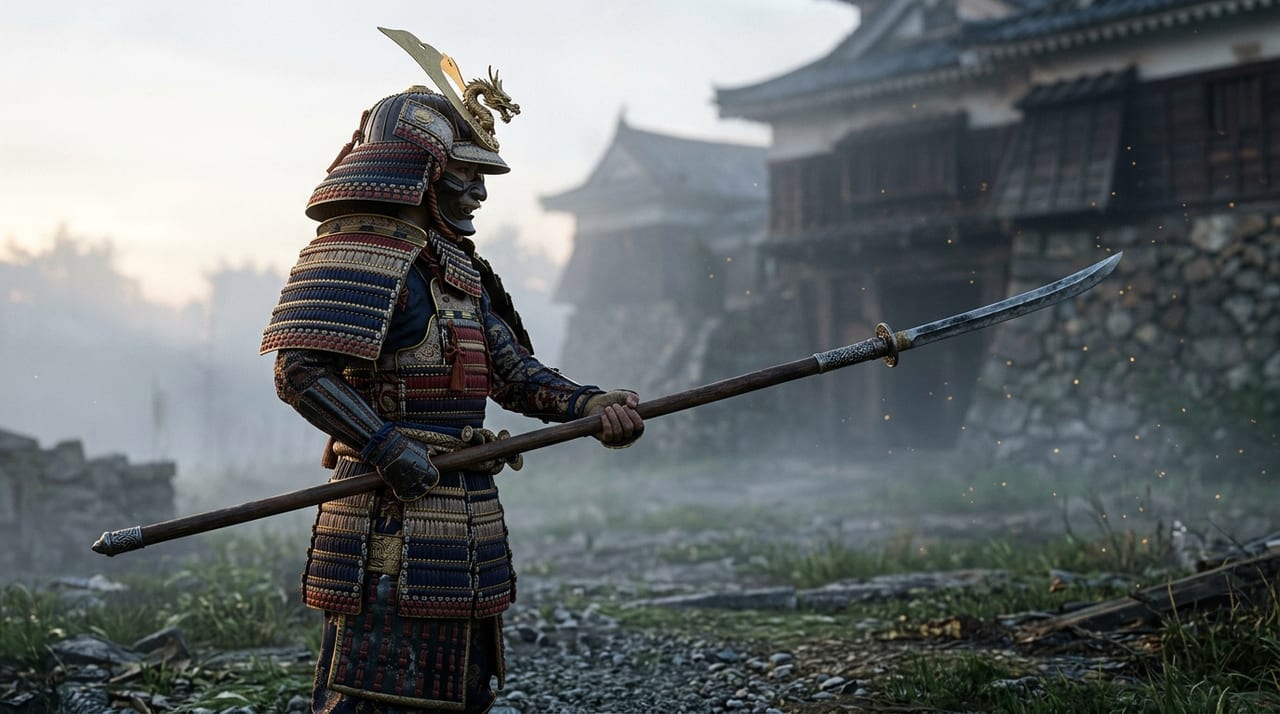
 * Image is for illustrative purposes only.
Tomoe Gozen
巴御前
The Paragon of Female Warriors — Japan's Most Celebrated Woman Warrior
Description
What Kind of Woman Was Tomoe Gozen?
Tomoe Gozen does not appear in contemporary historical records, and there are no documents that confirm her life. The image depicted in a passage from Book 9, “The Death of Kiso,” of the Heike Monogatari is the source of all later images of Tomoe Gozen. There it is written: “Tomoe was fair-skinned with long hair and of exceptionally fine looks. A rare archer with a strong bow and a superb warrior, on horseback or on foot, sword in hand she was ready to face demon or god — a warrior worth a thousand.” Depicted as a female warrior combining beauty and martial prowess, Tomoe Gozen, with her vivid image, has been deeply inscribed in Japanese culture and has continued for centuries to stimulate people’s imagination, from painting and literature to theater and modern popular culture.
Relationship with Yoshinaka
Tomoe Gozen is known as a favored concubine of Minamoto no Yoshinaka (Kiso Yoshinaka); other accounts hold that she was a binjo (female attendant) or a menotogo (foster-sibling, the child of a wet-nurse family). Yoshinaka is said to have been born in Musashi Province. He was a Minamoto warrior who grew up in the Kiso Valley in Shinano Province, and he raised arms under the banner of overthrowing the Taira regime. At the Battle of Kurikara Pass in Juei 2 (1183), he annihilated the great Taira army. This great victory allowed him to enter the capital, and he gained the title “Asahi Shōgun” (Rising-Sun General). Tomoe Gozen stayed constantly at Yoshinaka’s side during his rise as a military power and, even on the battlefield, served as his right arm. Regarding Tomoe Gozen’s origins, there are several theories: one holds that she was a daughter of Nakahara Kanetō, who raised Yoshinaka, and a sister of Imai Shirō Kanehira and Higuchi Kanemitsu (Genpei Jōsuiki); another holds that she was a daughter of Higuchi Kanemitsu (Genpei Tōjōroku). In any case, she is portrayed as one of Yoshinaka’s closest companions.
Exploits on the Battlefield
The highlight of Tomoe Gozen’s role in the Heike Monogatari is the Battle of Awazu in Juei 3 (1184), where Yoshinaka faced his final battle. After the Taira’s downfall, Yoshinaka entered the capital, but his political conflicts with Retired Emperor Go-Shirakawa and Minamoto no Yoritomo deepened, and he eventually came to be the target of a pursuit campaign. Yoshinaka’s forces were driven into a corner by the armies of Minamoto no Noriyori and Yoshitsune, and in the end had dwindled to just five riders, lord and retainers together. In this desperate situation, Yoshinaka ordered Tomoe Gozen: “Women, flee first.” But Tomoe Gozen did not withdraw. In a final valiant fight, she rode alongside Onda no Hachirō Moroshige, a man of great strength renowned in Musashi Province, grappled with him, pulled him down, pressed him against the front of her saddle, wrenched off his head, and threw it away. Afterward, Tomoe is said to have cast off her armor and helmet and fled toward the eastern provinces. This overwhelming depiction of martial valor was deeply imprinted on the minds of later generations and made Tomoe Gozen an immortal figure as a “model of female warriors.”
Master of the Naginata and Tachi
The weapons Tomoe Gozen is said to have wielded were both the naginata and the tachi. The naginata was a principal infantry weapon from the late Heian period through the Kamakura period, with a curved blade on the end of a long shaft. Wielding it required a distinctive technique using the shifting of the whole body’s weight and the rotation of the hips, and it was an effective weapon even against male warriors of greater physical stature. The reason female warriors in particular excelled with the naginata was that they could make up for differences in build through technique and distance, and this led to the later tradition of samurai women practicing the naginata. The tachi was the principal weapon of mounted warriors of the time, a long sword worn hung from the waist. The scene with Moroshige is a grappling fight in which she grabs an enemy on horseback and pulls him down, and she is depicted fighting on equal terms with a male warrior.
Yoshinaka’s Final Days and Tomoe’s Later Life
At the Battle of Awazu, Yoshinaka rode his horse into a deep paddy field covered with thin ice and became immobilized. He was struck in the face beneath his helmet visor by an arrow and killed. Tomoe Gozen, who had tried to stay by his side to the end, left the battlefield on Yoshinaka’s order. Regarding Tomoe Gozen’s later whereabouts, accounts vary widely. Various traditions remain: according to different texts of the Heike Monogatari, some say she took the tonsure and became a nun; others (Genpei Jōsuiki) say she was summoned by Minamoto no Yoritomo, became the wife of Wada Yoshimori, and bore Asahina Yoshihide. There is also a tradition that she moved to Etchū Province and spent her later years there, and Toyama Prefecture has several places associated with Tomoe Gozen. Her birth and death years are unknown, but according to one theory she lived to the age of ninety-one, and she is said to have spent a long remaining life carrying Yoshinaka’s final moments in her heart more deeply than anyone else.
Legends of the Female Warrior and Sword Culture
The legend of Tomoe Gozen also offers intriguing insight into the relationship between women and swords in Japan. The way the naginata came to be established in later times as a “weapon of women” can also be seen as a result of legends of female warriors like Tomoe Gozen taking root in the culture. Although Tomoe Gozen does not appear in contemporary records and her existence cannot be confirmed, her image as a “beautiful and strong female warrior” has lived on for more than eight hundred years as a powerful symbol of the potential and strength of women in Japanese culture. Her naginata and tachi show us the sublimity of pursuing the way of the warrior to its peak beyond gender and social status.
Notable Swords
- Naginata (the long-shafted weapon Tomoe Gozen carries in the Noh play 'Tomoe'; naginata with a broad blade and a deep curve are called 'Tomoe-gata' after Tomoe Gozen)
- Tachi (the principal weapon of mounted warriors of the time. The Heike Monogatari depicts Tomoe as 'with a sword in hand ready to face demon or god, a warrior worth a thousand')