New Arrivals — Browse our catalog for the latest authentic Japanese sword arrivals. Browse →
4 March 1184 (Juei 3/1/20)
Awazu, Ōmi Province (present-day Awazu-chō area, Ōtsu City, Shiga Prefecture)
Forces
Minamoto no Yoshinaka's Forces
Minamoto no Yoritomo's Forces (Noriyori / Yoshitsune)
About 14 min read
On 4 March 1184 (Juei 3/1/20), the final hour of Minamoto no Yoshinaka (Kiso Yoshinaka) came in the pine grove of Awazu in Ōmi Province (present-day Ōtsu City, Shiga Prefecture). In Juei 2 (1183), Yoshinaka had destroyed the Taira forces at the Battle of Kurikara Pass and became the first Minamoto commander to enter Kyoto as a hero. Afterward, however, the rough warriors of Shinano brought lawlessness to the capital, his feud with the Cloistered Emperor Go-Shirakawa deepened, and his conflict with his cousin Yoritomo became irreparable. In late Juei 2, a great army under Minamoto no Yoshitsune and Minamoto no Noriyori, acting on Yoritomo's orders, set out to subdue Yoshinaka.
In the Battle of the Uji River on the 20th day of the 1st month, Yoshinaka's army was routed, and he fled Kyoto with a small force. In the pine grove of Awazu, Yoshinaka turned to face his pursuers and entered his last battle. The war tale The Tale of the Heike describes this battle in detail and with great drama, and the "death of Yoshinaka," the "parting from Tomoe Gozen," and the "fierce death of Imai Kanehira" are known as famous scenes in the history of Japanese literature.
Minamoto no Yoshinaka (1154–1184) was born the son of Minamoto no Yoshikata, a warrior of the Kawachi Genji line. His father was assassinated when he was a child (Yoshikata was killed by Minamoto no Yoshihira when Yoshinaka was two years old), and he was raised in Kiso (present-day Kiso District, Nagano Prefecture) by Nakahara no Kanetō. For this reason he is known by the nickname "Kiso Yoshinaka."
Yoshinaka was a fierce warrior raised in the mountains of Shinano, and his military talent was outstanding. In Juei 2 (1183), at the height of Taira power, Yoshinaka subdued the Hokurikudō and aimed for Kyoto. At Kurikara Pass, on the border between Etchū and Kaga (now the boundary between Oyabe City, Toyama Prefecture, and Tsubata Town, Kahoku District, Ishikawa Prefecture), he clashed with the great Taira army under Taira no Koremori, said by some accounts to number seventy thousand. Yoshinaka's tactic was to tie torches to the horns of oxen at night and send them charging into the Taira camp (the "fire-ox stratagem" (kagyū no kei)), throwing the confused Taira army down into the valley. It has been handed down as a legendary ruse, though evidence that it actually happened is thin.
Following the great victory at Kurikara Pass, the Taira army was destroyed, and Yoshinaka entered Kyoto in the 7th month of Juei 2. However, governing the capital was not Yoshinaka's strength. The plundering and lawlessness of the mountain warriors of Shinano provoked resentment among the people of the capital, and political conflict with the Cloistered Emperor Go-Shirakawa deepened. Seeking to break his political isolation, Yoshinaka took the harsher step of confining the Cloistered Emperor Go-Shirakawa in the 11th month of Juei 2, but this proved a decisive blunder. Yoritomo decided to subdue Yoshinaka.
On the 20th day of the 1st month, the great armies of Minamoto no Noriyori and Yoshitsune attacked from Seta and Uji, and Yoshitsune's forces crossed the Uji River (the Battle of the Uji River). Yoshinaka's army could not withstand this great force and fled Kyoto. By this point, the force Yoshinaka led had dwindled to only a few hundred riders.
Yoshinaka is thought to have tried to flee toward the Hokurikudō, but his path was blocked, and he reached the pine grove of Awazu in Ōmi Province. Here Yoshinaka realized that "there is no road of escape left," and resolved to face his final battle.
According to The Tale of the Heike, in the Battle of Awazu Yoshinaka first let go of Tomoe Gozen. Tomoe was known as Yoshinaka's beloved concubine and a sturdy female warrior, and she fought bravely in this battle as well. Yoshinaka said, "To die together with a woman would be a disgrace," and urged Tomoe to withdraw. As her final service, Tomoe charged into the enemy ranks, and she is said to have taken the head of Onda no Hachirō Moroshige, a strongman of Musashi Province, before riding away.
With Tomoe gone, only a few riders, including Imai Kanehira, remained with Yoshinaka. Imai Kanehira was Yoshinaka's milk brother and a loyal retainer throughout his life.
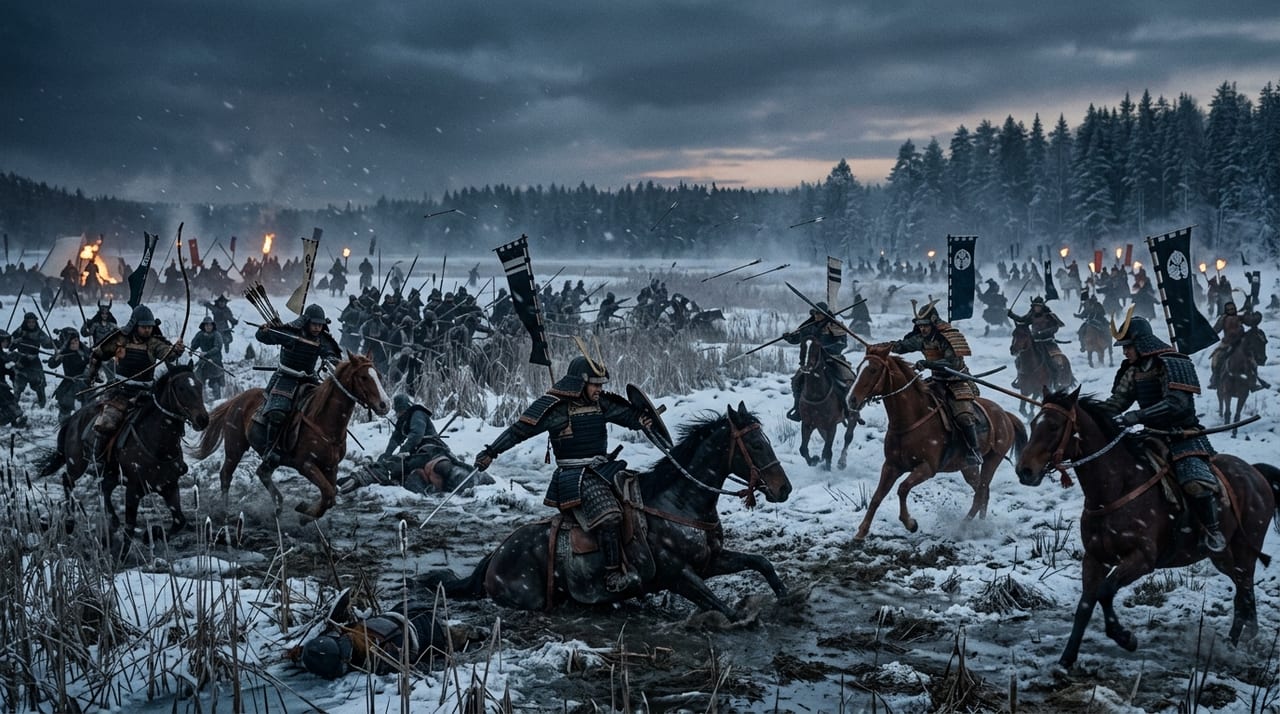
Yoshinaka urged his horse into the pine grove to face the numerous enemy troops. Although the difference in numbers was overwhelming, Yoshinaka did not flinch and galloped on. But ahead of the pine grove lay a deep paddy field covered with thin ice. Yoshinaka's beloved horse became trapped in the deep mud and could not move.
At that moment, Yoshinaka was struck by an arrow from horseback. The Tale of the Heike says that Ishida no Jirō Tamehisa shot the arrow at Yoshinaka. Yoshinaka was struck in the face beneath the helmet brim (uchikabuto) and, deeply wounded, fell forward onto his horse's neck, where Ishida no Jirō's retainer took his head. He was 31 years old.
Meanwhile, Imai Kanehira, upon confirming his lord's death, took his sword in his mouth and leapt from his horse. It was a fierce death that followed his lord.
The Battle of Awazu lies near the end of the Genpei War, the greatest battle of the warrior class in Japanese history. Swords of this era stand at an important turning point in the history of the Japanese sword.
The shift toward curved tachi (wan-tō) progressed from the middle of the Heian period onward, and at the time of the Genpei War, smiths of Ko-Bizen and Yamashiro were forging tachi. The commanders of the Genpei War fought wearing the finest swords of their age.
The Tale of the Heike describes Yoshinaka that day as wearing a hitatare of red-ground brocade and armor laced with Chinese twill (karaaya-odoshi), and as carrying "an imposingly mounted great sword (ikamono-zukuri no ōdachi)." However, the smith and the inscription of that sword have not been transmitted.
The Tale of the Heike also says that Tomoe pulled Onda no Hachirō Moroshige from his horse, pressed him against the front arch of the saddle, and wrenched off his head. It does not describe her using a sword.
Minamoto no Yoshinaka occupies a special place in Japanese warrior culture as a "tragic hero." The ruse at Kurikara Pass, his brief glory in Kyoto, and his fierce death at Awazu: through the war tale The Tale of the Heike, this story has been loved by the Japanese from the medieval period to the present.
The story of Yoshinaka and Tomoe condenses the themes of "bonds between lord and retainer," "the righteousness of the warrior," and "the bravery of women," and it resonates deeply with the sword culture's idea of "the sword as the warrior's soul." The tale that Yoshinaka kept driving his horse until the moment he sank into the marsh of Awazu embodies the Japanese ideal of the warrior's way: a warrior who bears a sword fights on to the very end.
Moreover, by killing Yoshinaka at Awazu, Yoritomo's rise to power accelerated and led to the establishment of the Kamakura shogunate. The establishment of the Kamakura shogunate held decisive significance for the establishment of the warrior class's status and for the institutional development of sword culture. The Kamakura period is called the "golden age" of the Japanese sword, and great smiths such as Masamune (Sōshū tradition), Ichimonji (Bizen tradition), and Rai Kunitoshi (Yamashiro tradition) were active. With Yoshinaka's death at Awazu and the establishment of Yoritomo's Kamakura shogunate, the door to this "golden age of the Japanese sword" was opened.
Kiso Yoshinaka
Kiso Yoshinaka (Minamoto no Yoshinaka) — the Genpei War's greatest tragic hero, killed at Awazu by arrow and fall into the marsh
Tomoe Gozen
Tomoe Gozen — legendary female warrior who fought beside Yoshinaka until the final parting at Awazu
Minamoto no Yoshitsune
Minamoto no Yoshitsune — commanded Yoritomo's forces in the pursuit from Uji River to Awazu
Minamoto no Yoritomo
Minamoto no Yoritomo — ordered Yoshinaka's destruction; the death at Awazu cleared his path to shogunal authority
Heian-Kamakura
Heian-Kamakura transition — the Battle of Awazu epitomizes the shift from Heian warrior culture to the Kamakura warrior system
The Genpei Conflict Period
Genpei War era — Awazu was the culmination of the intra-Minamoto power struggle that preceded the final reckoning with the Taira
Kamakura Middle Period Golden Age
Kamakura golden age — Yoshinaka's death at Awazu cleared the way for Yoritomo's shogunate and the golden age of Japanese sword production