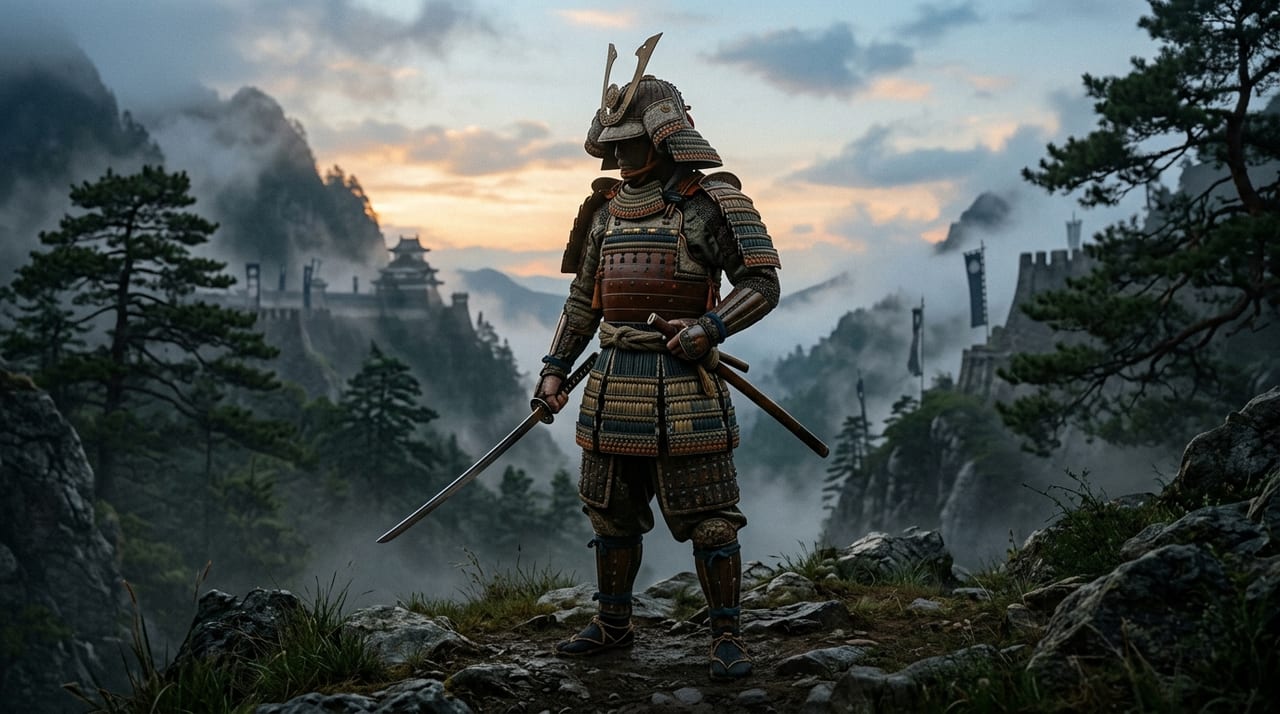
 * Image is for illustrative purposes only.
Kiso Yoshinaka
木曾義仲
The Rising Sun General — mountain warrior who shook the Heike and burned bright before his fall
Description
A Minamoto Child Raised in the Mountains of Kiso
Kiso Yoshinaka was born in Kyūju 1 (1154) as a son of Minamoto no Yoshikata. He lost his father in early childhood and was raised by Nakahara Kanetō in Kiso (present-day Kiso District, Nagano Prefecture). He grew up sturdy in the mountains of Shinano. The stamina he built racing across the Kiso mountains and the military knowledge of steep terrain he gained there would later be fully displayed in the battle at Kurikara Pass. His bold and magnanimous temperament won over the warriors of Shinano and Echigo, where rough men tended to gather, and when he raised his army, many local powerful families gathered under his banner.
The Uprising and the Ruse at Kurikara Pass
In Jishō 4 (1180), Yoshinaka also raised troops in Shinano, answering Minamoto no Yoritomo's uprising. Expanding his power while subduing the Hokurikudō, in Juei 2 (1183) Yoshinaka clashed with the great Heike army at Kurikara Pass on the border of Kaga and Etchū. In this battle Yoshinaka used a clever stratagem. Under cover of night, he is said to have driven a herd of oxen with torches attached toward the Heike army, and taking advantage of the confusion, he brought the enemy to total collapse at a stroke. Historians debate whether this stratagem actually happened, but there is no doubt that the battle at Kurikara Pass destroyed the Heike army and made Yoshinaka's name resound across the realm. Heike power on the Hokurikudō vanished overnight, and Yoshinaka's army pressed on toward the capital with the force of a raging wave.
Asahi Shōgun and Entry into the Capital
In the 7th month of Juei 2 (1183), a little over two months after the victory at Kurikara, Yoshinaka entered Kyoto. In The Tale of the Heike, Yoshinaka is said to have received the title 'Asahi Shōgun' (Rising Sun General) around this time. However, Yoshinaka's conduct in the capital afterward cast a complex shadow over history. Plundering by the rough warriors who had grown up in the mountains of Shinano tormented the people of the capital and rapidly worsened the nobles' opinion of Yoshinaka. Yoshinaka himself strove to maintain military discipline, but there were limits to how fully he could control a patched-together army. His political conflict with the Retired Emperor also deepened, and Yoshinaka sank further into isolation.
Yoshinaka's Death — The Decisive Battle at Awazu
When Yoritomo sent his younger brothers, Minamoto no Noriyori and Yoshitsune, west, Yoshinaka's fate tilted rapidly. In the 1st month of Juei 3 (1184), Yoshinaka fought the army led by Noriyori and Yoshitsune at Uji and Seta and was defeated. Fleeing with a small band of followers, he became stuck in a swamp at the pine grove at Awazu in Ōmi, along with his horse, and was finally cut down. He was thirty-one years old. Yoshinaka's valiant death, depicted in 'The Death of Lord Kiso,' was passed down for generations in later war chronicles as the story of a tragic hero. The presence of Tomoe Gozen, who fought alongside Yoshinaka to the very end, also adds an undying radiance to this hero's story.
Yoshinaka as a Tragic Hero
Kiso Yoshinaka is positioned as a typical example of the 'tragic hero' type in Japan's warrior culture. The brilliance at the height of his power and his sudden fall in an instant, his rough yet pure warrior temperament, and his lonely end, abandoned by both the court and Yoritomo — these struck the hearts of later generations deeply and gave rise to profound sympathy for Yoshinaka. Matsuo Bashō was deeply moved by 'The Death of Kiso' and wished for his own grave to be placed beside Yoshinaka's at Gichū-ji (Ōtsu, Shiga Prefecture). The light of 'Asahi Shōgun,' which shone for a moment amid the turmoil at the end of the Heian period, continues to burn eternally in Japanese culture without ever being extinguished.