New Arrivals — Browse our catalog for the latest authentic Japanese sword arrivals. Browse →
June 2, 1183 (11th day, 5th month, Juei 2)
Kurikara Pass, border of Etchū and Kaga provinces (present-day Toyama/Ishikawa border)
Forces
Kiso Yoshinaka Forces (Minamoto)
Taira Forces
About 9 min read
On the 11th day of the 5th month of Juei 2 (1183), at Kurikara Pass, a mountainous area spreading along the border between Etchū Province and Kaga Province, one of the most dramatic reversals in the history of the Genpei War was played out. This battle, in which the Minamoto army led by Kiso Yoshinaka (Minamoto no Yoshinaka) destroyed the vast Taira army, which boasted overwhelming numbers, through a stratagem, is an indispensable battle when discussing the warrior code and sword culture of the late Heian period.
Beginning with the uprising of Minamoto no Yoritomo, who received a ryōji (princely decree) from Prince Mochihito in Jishō 4 (1180), the Genpei War initially unfolded mainly in the Kantō region. However, Kiso Yoshinaka, who had his base in the Kiso Valley of Shinano Province, chose his own route of advance, heading south along the Hokurikudō, and by the spring of Juei 2 (1183) had extended his influence as far as Echigo and Etchū.
In response, to defend the capital, the Taira appointed Taira no Koremori (Kiyomori's grandson) as commander-in-chief and sought to advance from Kaga Province into Etchū Province. The strength of the Taira army is said to have been in the tens of thousands, although this figure includes exaggeration, and it deployed across the area around Kurikara Pass with the aim of controlling the Hokurikudō and annihilating Yoshinaka's army.
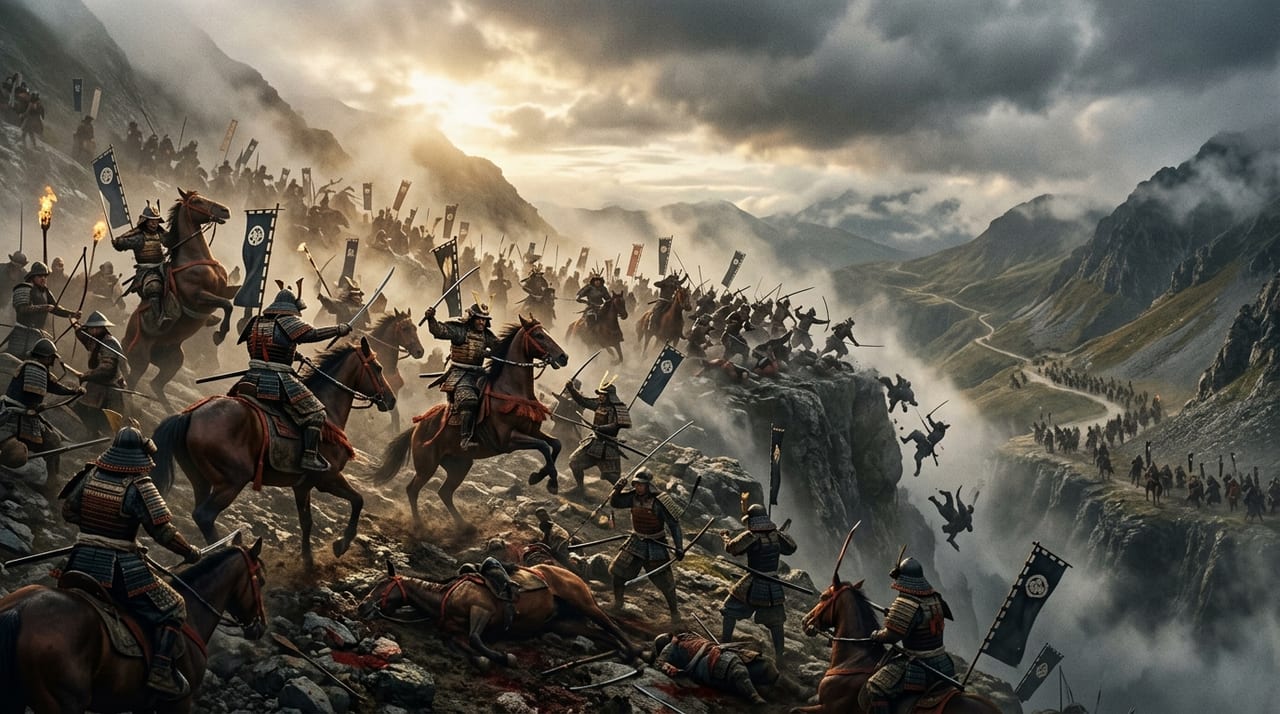
Yoshinaka's strategy at Kurikara Pass has been handed down to later generations as a skillful stratagem that avoided a head-on clash. According to the Genpei Jōsuiki, Yoshinaka tied torches to the horns of several hundred oxen and released them into the Taira camp at night (the fire-ox stratagem, kagyū no kei). The Taira army was thrown into confusion by the sight of a swarm of flames suddenly charging at them, and it is said to have fallen into the sheer cliffs of the Kurikara ravine and been destroyed.
From a historical standpoint, there are various theories regarding the factual basis of the fire-ox stratagem, and the possibility of exaggeration in later military chronicles has also been pointed out. However, in any case, Yoshinaka's army made maximum use of the terrain and, taking advantage of the pass's topographical features (deep valleys and steep mountain paths), encircled and annihilated the Taira army. The multi-front operation, in which a detachment circled through the mountains to form an encirclement while Yoshinaka's main force drew the Taira army in from the front, shows Yoshinaka's excellent strategic judgment.
The main force of Yoshinaka's army was centered on warriors of Shinano. By the late Heian period, long tachi with a pronounced curve, worn at the waist by mounted warriors, were already in use, and the warriors of Yoshinaka's army also carried tachi suited to mounted combat.
No reliable historical records survive concerning the sword that Kiso Yoshinaka himself favored.
Following the victory at Kurikara Pass, Yoshinaka advanced toward Kyoto while subduing the Hokurikudō. In the 7th month of that same year, the Taira abandoned the capital and fled to the western provinces, and Yoshinaka achieved his long-desired entry into the capital. However, Yoshinaka's government in the capital was short-lived. Serious friction arose between Yoshinaka, a rough northern warrior by origin, and the people of the capital, who were accustomed to courtier and imperial court culture, and acts of plunder and friction with the imperial court damaged Yoshinaka's reputation.
In the 1st month of the following year, Juei 3 (1184), the forces of Minamoto no Noriyori and Minamoto no Yoshitsune, dispatched from Kamakura, advanced on the capital to destroy Yoshinaka. Yoshinaka fought against the Kamakura forces at Awazu in Ōmi Province, and was killed in action after his horse became trapped in the mud. He was 31 years old (by the traditional counting of age). Yoshinaka's valiant death is depicted in the chapter "Kiso no Saigo" (The Death of Kiso) of the Heike Monogatari as a scene symbolizing Yoshinaka's martial prowess and solitude, and it formed part of the later ideal image of the warrior.
The Battle of Kurikara Pass vividly illustrates the role of the sword in the warfare culture of the late Heian period. The principal weapons of this era were the bow and arrow and the tachi; when mounted warriors had shot at the enemy with their bows and the fight came to close grappling, they drew their tachi and fought. The tactic of driving the enemy down into the Kurikara ravine shows that group tactics using the terrain, rather than hand-to-hand combat with swords, were the central approach.
The Battle of Kurikara Pass is inscribed for a long time in the history of the Japanese sword, both as the starting point for telling of the birth and tragic end of the hero Yoshinaka, and as a battle that embodied the sword culture of the warriors of the eastern provinces (Tōgoku) in the late Heian period.