New Arrivals — Browse our catalog for the latest authentic Japanese sword arrivals. Browse →
May 1019 (Kannin 3/3/28 to the 4th month)
Tsushima, Iki, Chikuzen Province, Hizen Province (present-day Nagasaki and Fukuoka Prefectures)
Forces
Japanese Defense Forces
Toi (Jurchen) Invaders
About 10 min read
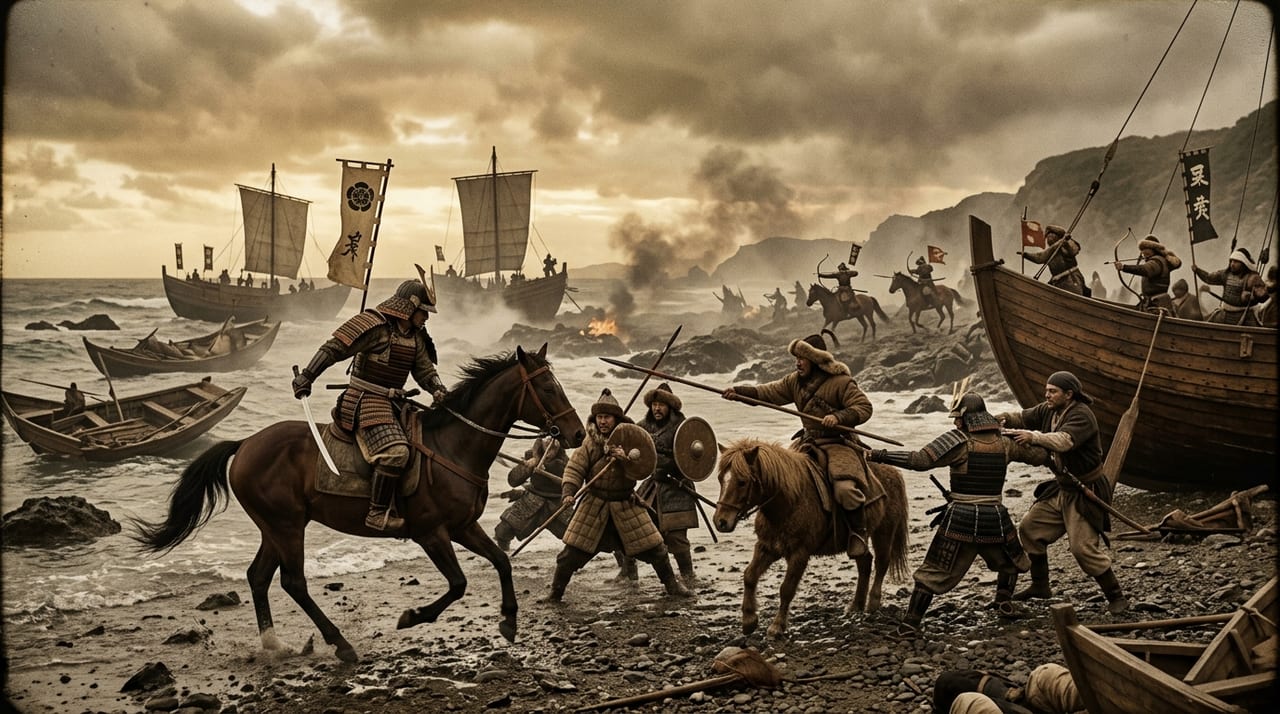
In the 3rd month of Kannin 3 (1019), a fleet of more than 50 vessels suddenly attacked Tsushima. These invaders, called the Toi, were a pirate band of Jurchen (the ancestors of the later Manchus). After ravaging Tsushima and Iki, they landed as far as Chikuzen Province and Hizen Province in northern Kyushu, where they repeatedly plundered, killed, and abducted people. Known as the Toi Invasion, this incident was an unprecedented foreign invasion of Japan during the mid-Heian period, and a major historical event that occurred about 250 years before the Mongol invasions.
"Toi" was the name used on the Korean Peninsula for the Jurchen (Nüzhen), and Japanese sources record it simply as "Toi." The Jurchen were the ancestors of the Jin dynasty of the 12th century and of the Later Jin and Qing dynasty of the 17th century. In this era, however, the Jurchen were still a confederation of tribes and had not formed a unified state.
The Toi are thought to have been Eastern Jurchen, who lived along the northeastern coast of the Korean Peninsula and repeatedly raided the coast of Goryeo. Jurchen piracy as far away as the waters near Japan had almost no precedent, so the Japanese initially took this to be an invasion by Silla.
On the 28th day of the 3rd month of Kannin 3 (1019), a Toi fleet of roughly 50 vessels and an estimated 3,000 people attacked Tsushima. On Tsushima, Tōharu, the governor of Tsushima, fled to Dazaifu, and many islanders were killed or abducted. The Toi then moved on to Iki, where they carried out fierce plunder as well. Fujiwara no Masatada, the governor of Iki, led 147 men to meet them, but he was killed in battle, and the people of Iki also suffered enormous losses.
It was Fujiwara no Takaie who halted the Toi invasion. Takaie had taken up his post at Dazaifu as Dazai no Gon no Sotsu (acting governor-general of Dazaifu). He was the fourth son of Fujiwara no Michitaka and was known for the incident in which he shot arrows at Retired Emperor Kazan, as well as for being the younger brother of Fujiwara no Korechika. He had requested the Dazai no Gon no Sotsu post himself, hoping for treatment for an eye ailment, and had been posted to Dazaifu. Faced with this crisis, he showed outstanding leadership.
Takaie mobilized local bushi bands across Kyushu and fought fierce battles with the Toi landing forces. In the fighting in Chikuzen Province and Hizen Province, local warriors clashed with the Toi raiding parties at many points. The Toi were a skilled fighting force, but through the Japanese advantage of terrain and the determined resistance of provincial warriors, they were gradually pushed back.
In the end, the Toi were driven off in Matsura District, Hizen Province, on the 13th day of the 4th month (lunar calendar). They then struck Tsushima again before withdrawing, and the damage was severe. According to the report from Dazaifu, 364 people were killed and 1,280 people were abducted. Some of those abducted were rescued when Goryeo forces pursued the Toi, and with Goryeo's assistance they were able to return home.
The Toi Invasion had a major impact on Heian-period politics and society. Even after receiving reports of the Toi attack, the court under Emperor Go-Ichijō could not devise effective countermeasures, and the practical work of defense was left to Dazaifu and local bushi. This fact clearly shows how hollow the court's military power had become as a centralized ritsuryō state.
This event was one turning point in which the bushi went beyond their role as the court's "police apparatus" and established their standing as "defenders of the realm." The fact that provincial bushi saved the state more than a century before the bushi entered central politics through the Hōgen Rebellion (1156) and the Heiji Rebellion (1159) also influenced the formation of the bushi class's self-awareness.
Murasaki Shikibu's The Tale of Genji is thought to have been written around the year 1000, and Sei Shōnagon's The Pillow Book belongs to the same period. The Toi Invasion was a foreign attack that struck during the age of Hikaru Genji, the height of court culture. In the same era when court nobles delighted in elegant waka poetry and music, warriors in Kyushu were fighting foreign invaders with swords in hand. This contrast vividly reflects the dual character of the Heian period.
The year 1019, when the Toi Invasion took place, falls within the era of "Ko-Bizen," the swords forged by Bizen smiths from the mid to late Heian period. Ko-Bizen smiths such as Tomonari and Masatsune are known, and they made elegant tachi with deep koshizori curvature.
However, there are no specific records of the swords carried by the warriors of Dazaifu, and the fighting centered on exchanges of arrows.
Records state that the Toi soldiers were armed with bows, swords, and shields, and that they used bows strong enough to pierce shields. On the other hand, it is also said that they were startled and hesitated at the sound of the Japanese kaburaya (whistling arrows).
There are also no direct sources on the swords that Fujiwara no Takaie used at Dazaifu.
The Toi Invasion is not well known in later times, but in Japanese history it holds an important place both as a precedent for "foreign invasion of Japan" alongside the Mongol invasions (1274 and 1281), and as an early example of bushi stepping into the historical spotlight as defenders of the realm.
Taira no Kiyomori
Taira clan leader who rose ~140 years after the Toi Invasion, embodying the warrior ascendancy
Minamoto no Yoritomo
Ultimate product of the warrior rise demonstrated by the Toi Invasion — founder of Kamakura shogunate
Hōjō Tokimune
Kamakura regent who directed the Mongol Invasion response, echoing the Toi precedent