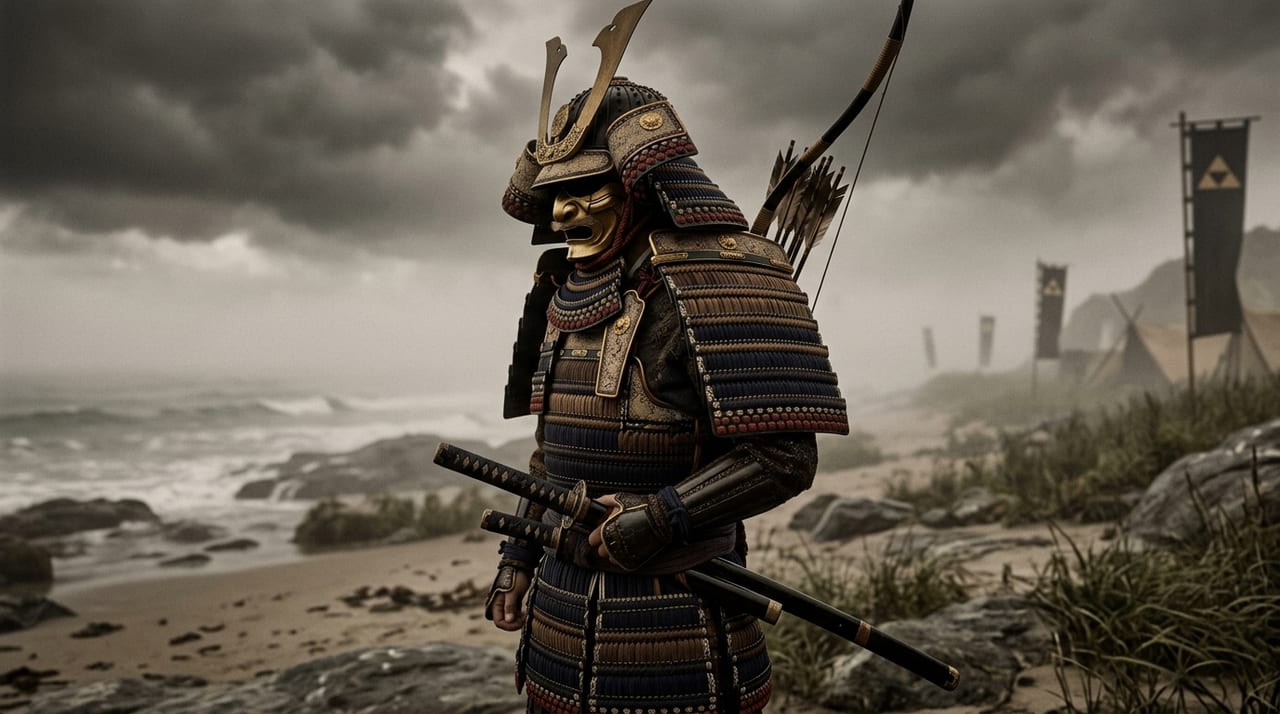
 * Image is for illustrative purposes only.
Hōjō Tokimune
北条時宗
The Young Regent Who Repelled the Mongol Invasions
Description
The Young Regent Who Faced a National Crisis
Hōjō Tokimune was born in the 3rd year of Kenchō (1251) as the son of Hōjō Tokiyori, the fifth regent of the Kamakura shogunate. At the young age of eighteen he became the eighth regent and twice repelled the Mongol Empire's invasions, the greatest external threat in Japanese history. His father, Tokiyori, was a renowned regent who built the golden age of the Kamakura shogunate. Raised under his father's tutelage, Tokimune inherited his father's legacy of mental strength and decisiveness and faced even harsher trials. In the Bun'ei War of the 11th year of Bun'ei (1274), a combined Mongol-Goryeo force of about 33,000 men, sent by Kublai Khan, landed in northern Kyūshū. Tokimune was only twenty-four at the time, yet with resolute bearing he commanded the gokenin in each region, and through their fierce fighting the Yuan forces were repelled.
The Kōan War and the Kamikaze
Just seven years after the Bun'ei War, in the 4th year of Kōan (1281), a second invasion, the 'Kōan War', began. This time Kublai Khan mobilized a force of about 140,000 men, combining the Eastern Route Army and the Jiangnan Army, an unprecedented force in scale. In advance, Tokimune had built stone walls (bōrui) along the shore of Hakata Bay to block landings, and he adopted the tactic of warriors repeatedly launching boarding attacks from small boats. Then, after nearly two months of fighting, the Yuan forces were thrown into confusion when a typhoon struck and were destroyed by the Japanese forces' all-out assault. This 'kamikaze' would be passed down in later ages as the basis of the ideology of Japan as a divine nation (shinkoku shisō). Without Tokimune's political decisions and military preparations, the kamikaze alone would not have brought victory. The leadership of the young regent was the true driving force that carried the nation through its crisis.
Swords as Symbols of Warrior Rule
The Kamakura period is one of the most important periods in the history of the Japanese sword, and in this era, when the Hōjō clan claimed supremacy, the form of swords changed greatly. Elegant tachi with a koshi-zori curvature, which had reached the height of refinement from the late Heian period to the early Kamakura period, gradually changed as combat experience accumulated, shifting to a more practical form with shallower curvature. In the mid-Kamakura period, tachi with broad blades and a majestic character appeared. By the late Kamakura period, after turmoil that included the two Mongol invasions, tachi with even broader blades and extended kissaki became more numerous. This trend led on to the majestic great swords (ōdachi) of the Nanboku-chō period.
Zen and Spiritual Cultivation
Tokimune deeply took refuge in Zen. He made Mugaku Sogen, who had come to Japan from Song China, his teacher and founded Engaku-ji. One month before the Kōan War, Sogen is said to have given Tokimune, who faced the return of the Yuan forces, a calligraphic inscription reading 'Makubonnō: do not be troubled or vexed.' The anecdote that this single phrase sustained Tokimune's spirit illustrates the essence of Kamakura culture, in which warrior spiritual cultivation and Zen were deeply intertwined. The tradition of incorporating the spirit of Zen as the mental attitude with which warriors went to battle with swords at their sides was established in this era. The age of Tokimune laid the foundation for the sword becoming a symbol of spirituality beyond a mere weapon.
An Untimely Death and Its Legacy
Tokimune passed away in the 7th year of Kōan (1284) at just thirty-four. His short life, nearly all of which was spent battling the Mongol threat during his tenure, was one in which he held firm to defend Japan's independence, and his achievements are immeasurable. The Kamakura shogunate continued Tokimune's policies afterward, and the power of the Tokusō main house of the Hōjō was further strengthened, but no leader of Tokimune's caliber appeared. The shortage of rewards for the gokenin after the Mongol forces were repelled heightened discontent with the shogunate. It is a historical irony that this became one of the remote causes of the later collapse of the Kamakura shogunate. Yet the independence of Japan that Tokimune defended to the end became the foundation for Japan's distinctive history, which continued through the turmoil of the Nanboku-chō period, the cultural flowering of the Muromachi period, and the path from the Sengoku to the Edo period.
Swords and Spirit of the Kamakura Warriors
The Kamakura warriors whom Tokimune commanded faced the Mongol forces wearing the finest swords of the day. Master smiths of the Awataguchi school, the Rai school, and the Bizen Fukuoka Ichimonji school were active, and many tachi were worn at the waists of Kamakura warriors and carried to the battlefields of Kyūshū.