New Arrivals — Browse our catalog for the latest authentic Japanese sword arrivals. Browse →
1274 (Bun'ei Invasion) and 1281 (Kōan Invasion)
Hakata Bay and Takashima Island, Hizen Province (present-day Fukuoka and Nagasaki prefectures)
Forces
Kamakura Shogunate Forces (Japanese Samurai)
Yuan–Goryeo Allied Forces
About 13 min read
In Bun'ei 11 (1274) and Kōan 4 (1281), Kublai Khan, grandson of Genghis Khan, sought to invade Japan on a large scale. The Great Yuan (Yuan), which he founded, commanded Goryeo forces in these attacks. The two invasions are collectively known as the Mongol invasions of Japan (Genkō). Also called the Bun'ei campaign (1274) and the Kōan campaign (1281), this war was the first full-scale foreign invasion Japan had ever faced, and it had a profound influence on Japan's military affairs, diplomacy, religion, and sword culture.
After his accession, Kublai repeatedly sent envoys demanding that Japan submit and pay tribute, but Hōjō Tokimune, shikken (regent) of the Kamakura shogunate, rejected every one of them. This resolute stance has been praised in later ages as a rare example of resistance against the Mongol Empire's pursuit of world conquest.
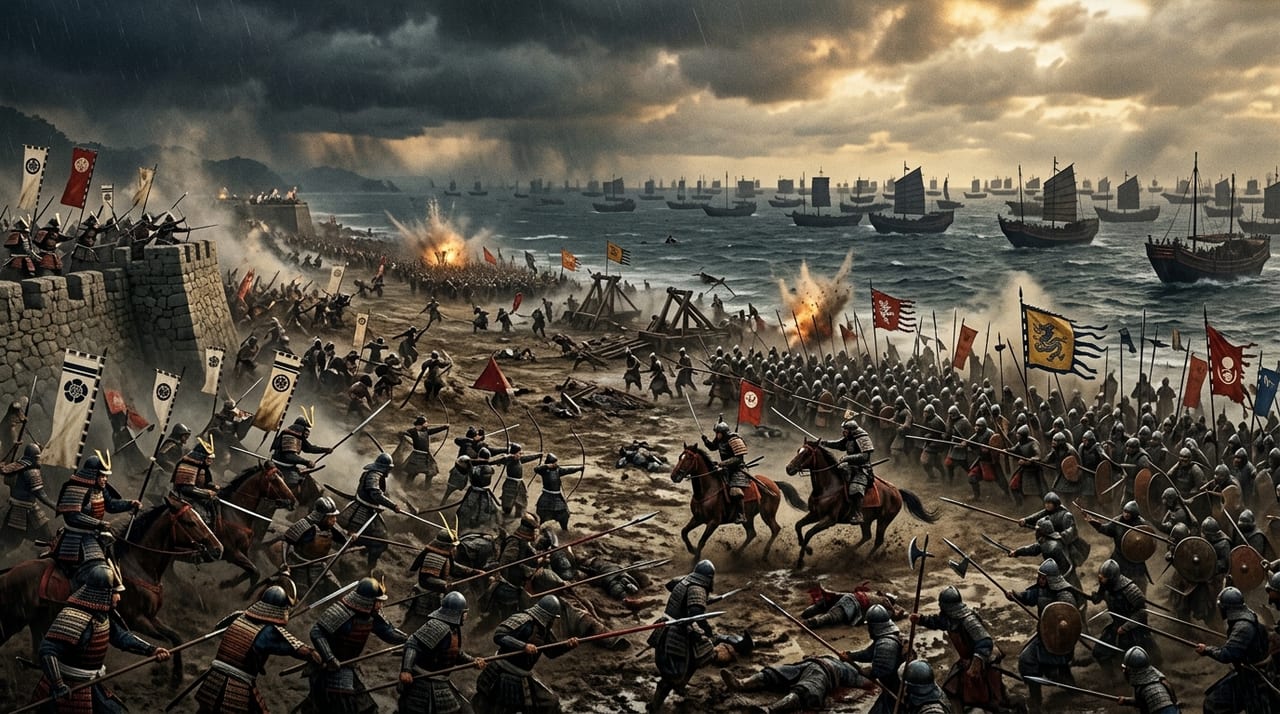
In the 10th month of Bun'ei 11 (1274), Yuan and Goryeo forces of about 30,000 troops (about 900 vessels) ravaged Tsushima and Iki, then landed at Hakata Bay. The Japanese defense was made up mainly of gokenin from Kyushu, but their combat experience and equipment differed greatly from those of the Yuan army.
The Japanese samurai had traditionally made individual one-on-one combat the basis of warfare. Their ritual style of fighting, in which warriors announced their names, exchanged arrows, and finally settled the matter with the tachi, could not hold up against a Yuan army that used coordinated mass tactics and gunpowder weapons. The Yuan forces made use of dense infantry and organized cavalry combat, long-range attacks with crossbows, and the exploding gunpowder bombs called tetsuhau (zhentianlei), which threw the Japanese samurai into great confusion.
The Japanese army struggled in the fighting at Hakata, but by the next morning the Yuan forces had withdrawn from Hakata Bay. It is also reported that they encountered a great storm during the withdrawal. Later, this help from the weather was spoken of as the forerunner of the kamikaze.
Drawing on the lessons of the Bun'ei campaign, the shogunate built stone defensive walls (Genkō Bōrui) along the northern coast of Kyushu to prepare for the next invasion. In Kōan 4 (1281), the Yuan organized the Eastern Route Army (40,000) and the Jiangnan Army (100,000), unprecedented expeditionary forces, and attacked Japan again.
However, the Japanese side had not neglected its preparations. Samurai used the walls as shields to block the Yuan landings, and they repeated night raids by small boats (youchi), inflicting damage on the Yuan fleet. As the standoff continued, on the night of the 30th day of the 7th month of Kōan 4 (1281), a violent typhoon (kamikaze) struck the Yuan fleet anchored around Takashima and Hirado Island. The great Yuan fleet suffered catastrophic damage. Fan Wenhu, the overall commander of the Jiangnan Army, along with many other officers and soldiers, fled in the ships that survived. Tens of thousands of Yuan soldiers were left stranded on Takashima, and most of them were killed by Japanese forces.
This 'kamikaze' later became linked with the Shintō doctrine of national protection, and it reinforced the idea that Japan was a sacred land protected by the gods (shinkoku). The name of the Kamikaze Special Attack Corps, the suicide attack units of the final phase of World War II, also derives from the memory of the Genkō.
The Genkō is also said to have been a turning point that brought technological innovation to Japanese sword culture. Some hold that this transformation was connected with the establishment of the Sōshū-den (Sōshū tradition), an important part of the history of the Japanese sword.
Before the Bun'ei and Kōan campaigns, the Japanese tachi were mainly slender, deeply curved, and elegant in form. This suited the fighting style of the Heian to early Kamakura periods, whose main aim was cutting strikes from horseback. However, problems became clear in fighting against the Yuan army. Conventional tachi were said to be prone to chipping and breaking in the fierce clashes of group battle.
Out of this reflection, fundamental changes in blade shape and forging technique took place in the late Kamakura period. The smiths of the Sōshū-den, led by Masamune of Sagami Province (present-day Kanagawa Prefecture), differed from schools such as the Bizen-den, which pursued the beauty of the jihada (surface grain). They established a new forging method that gave top priority to 'toughness in actual combat.'
The hallmark of the Sōshū-den is a rough jihada with itame and ko-itame grain, and a violent hamon in which large-grained metallic structures called nie stand out. This was the product of the finest metallurgical techniques of the time, which made the cutting edge extremely hard while giving the whole blade a tough resilience. Some hold that the combat experience of the Genkō prompted this technological innovation.
Hōjō Tokimune (1251–1284), one of the central figures of the Genkō, became shikken at just 18 years of age. Even when faced with the Mongol Empire's diplomatic letters, he resolutely chose to fight. Tokimune also deeply embraced the Zen (Rinzai school), and he invited Mugaku Sogen from Song China to serve as founding abbot of Engaku-ji in Kamakura. At the point where Zen and the sword, spiritual discipline and the martial way, intersect, Tokimune is remembered by later generations as a figure who embodied the ideal form of Kamakura bushidō.
Takezaki Suenaga, a warrior who fought in the Genkō, had an artist paint a record of his own valiant fighting, the Mōko Shūrai Ekotoba. This picture scroll depicts the bursting of tetsuhau and Yuan and Goryeo soldiers. It is a first-class historical source, and it visually conveys the appearance of the samurai of the time and the actual use of swords and bows.
For the Kamakura shogunate, the Genkō was a victory, but it exposed a fundamental problem of the feudal system: the distribution of rewards for merit. The fight against the Yuan was a fight to expel an external enemy, so there were no spoils (enemy land) to divide. The gokenin had fought at their own expense, risking their lives, yet they did not receive adequate rewards. This contradiction built up discontent toward the shogunate and became one of the remote causes of the collapse of the Kamakura shogunate in 1333.
However, in cultural and spiritual terms, the Genkō greatly deepened Japan's awareness of its own distinctiveness. The legend of the kamikaze strengthened the Shintō-based idea of national protection, and the sense that 'the Japanese sword is the sword of the divine land' took shape. The innovations in sword technology centered on the Sōshū-den prepared the golden age of the Japanese sword during the Nanboku-chō and Muromachi periods. The memory of the Genkō gave the Japanese sword the spiritual authority of a sacred sword that protects the nation. That authority has continued to flow at the root of the Japanese view of the sword down to the present day.
Hatakeyama Shigetada
Embodiment of Kamakura bushidō, connected to the martial spirit of the Mongol era
Hōjō Tokimune
Kamakura regent who led Japan's resistance to the Mongol invasions
Kusunoki Masashige
Warrior later celebrated as a symbol of patriotic loyalty, heir to the spirit of the Mongol resistance
1274年・1281年の元寇(文永・弘安の役)における蒙古軍の集団戦法・火薬兵器・集団射撃が、日本の武士の戦闘様式と刀剣観にどう影響したかを解説。元寇後に見られる刀剣形状の変化と、伝説的な「元寇の刀」の実像を追う。
2026-04-29
鎌倉幕府末期から建武の新政(1333〜36年)にかけて、日本刀は元寇の教訓を受けて大型化・実戦化の傾向を強めた。後醍醐天皇と足利尊氏の対立、南北朝時代の幕開けまでの激動期に、刀剣文化はいかに変化したか。
2026-04-14
寛仁三年、対馬・壱岐・博多湾を襲った刀伊の入寇と、藤原隆家の指揮下で在地武士団が太刀と弓で撃退した経緯を、平安期の刀剣史の視点から解説する。
2026-09-20
日本刀の切先(きっさき)は時代と流派によって劇的に変化する。猪首・大切先・中切先・小切先の形態的特徴と、それが生まれた歴史的背景を解説する。
2026-05-21