Late Kamakura Period, the Kenmu Government, and Japanese Swords — Changes in Warrior Society and Swords after the Mongol Invasions
 * Image is for illustrative purposes only.
Table of Contents
The Shock of the Mongol Invasions — Foreign Warfare Transformed the Sword
The Mongol Invasions (Genkō), as represented by the Bun'ei Campaign (1274) and the Kōan Campaign (1281), inflicted a grave military and political shock on Japanese warrior society. The combined forces of the Mongols, Goryeo, and the Southern Song employed the following tactics and weapons.
- Massed-formation tactics
- Poisoned arrows
- Tetsuhau (explosive projectiles)
These were fundamentally incompatible with the Japanese warrior culture that had idealized honorable one-on-one mounted combat, in which warriors would announce their names before deciding the outcome in single combat, and many gokenin found themselves in dire straits against the area-suppression tactics of massed infantry and firearms.
The greatest effect the Mongol Invasions had on Japanese swords was the enlargement of the sword. In order to counter the thick iron lamellar armor of the Mongol forces, a demand arose for blades that were longer, thicker, and heavier. Whereas conventional tachi had been approximately 70 to 75 cm in blade length, the appearance of ōdachi and nodachi with blades exceeding 90 cm from the late Kamakura period through the Nanbokuchō era was a direct response to this practical military demand. The increase in foot combat also meant that long swords that could be swung down powerfully with both hands, rather than swords worn at the hip and wielded one-handed, came to hold an advantage on the battlefield — an important factor that further drove the trend toward enlargement.
Furthermore, after the Mongol Invasions, discontent among the gokenin over postwar affairs deepened seriously. Because the invasions had been defensive wars, the shogunate had been unable to seize land from the enemy to distribute as rewards. Compensation for the gokenin who had risked their lives in battle was meager, and a rift opened in particular between the eastern gokenin, who depended on the shogunate's authority, and the powerful warrior clans of the west. In this era too, swords were proof of merit and symbols of reward, and the inequity of their distribution was a matter directly tied to the weight of a warrior's life and pride, becoming a distant cause of the shogunate's collapse.
The Rise of Tōkō in the Late Kamakura Period — An Era of Competition among Schools across the Country
From around the time of the Mongol Invasions through the late Kamakura period, the production centers of Japanese swords rapidly gained strength in Yamato, Sōshū, and Mino, in addition to Yamashiro and Bizen, making this the era in which the framework of the Gokaden began to take shape.
In Yamato, the following five great schools were completed, and the Yamato-den style of suguha and fine suguha was established.
- Tegai School
- Senjuin School
- Taima School
- Shikkake School
- Hōshō School
Through their deep connections with great religious institutions such as Kasuga Grand Shrine, Tōdai-ji, and Kōfuku-ji, the tōkō of Yamato handled a wide range, from practical swords for warrior monks to artistic swords for the aristocracy, and possessed a unique production environment supported by religious authority. The kitae-hada is based on masame, and they are characterized by a clear hamon with a tight nioi boundary, possessing an ascetic beauty.
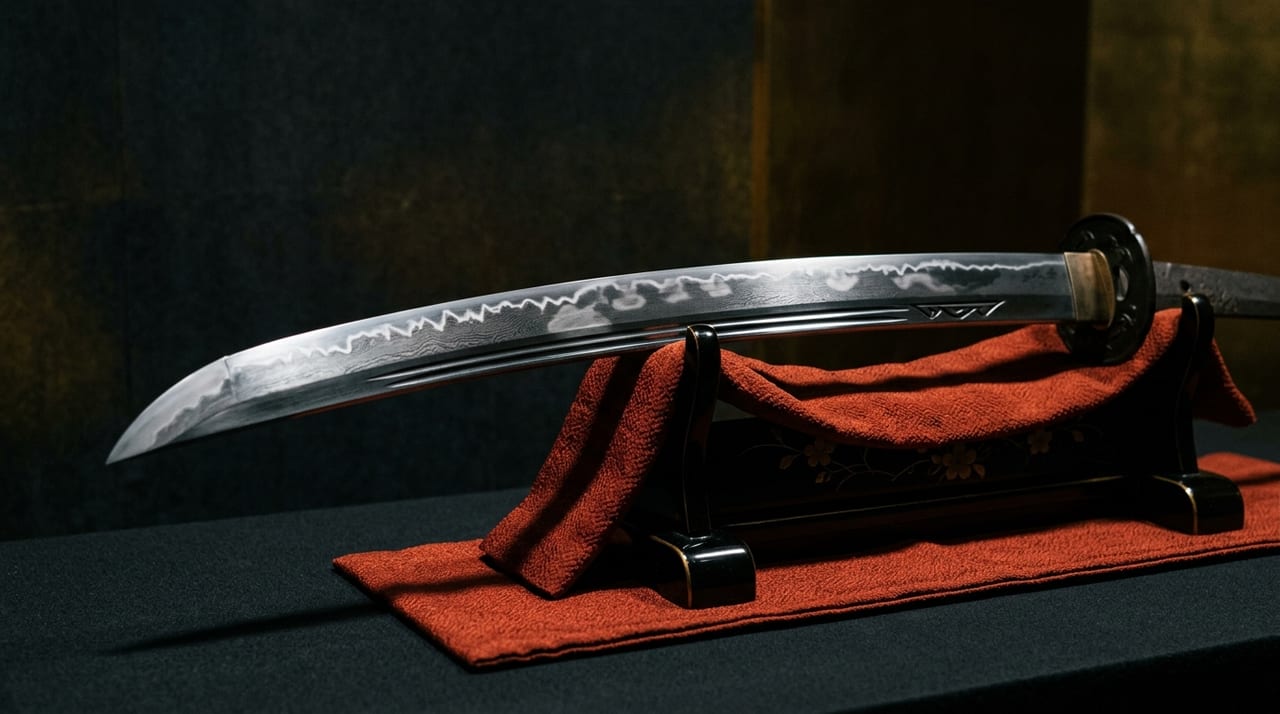
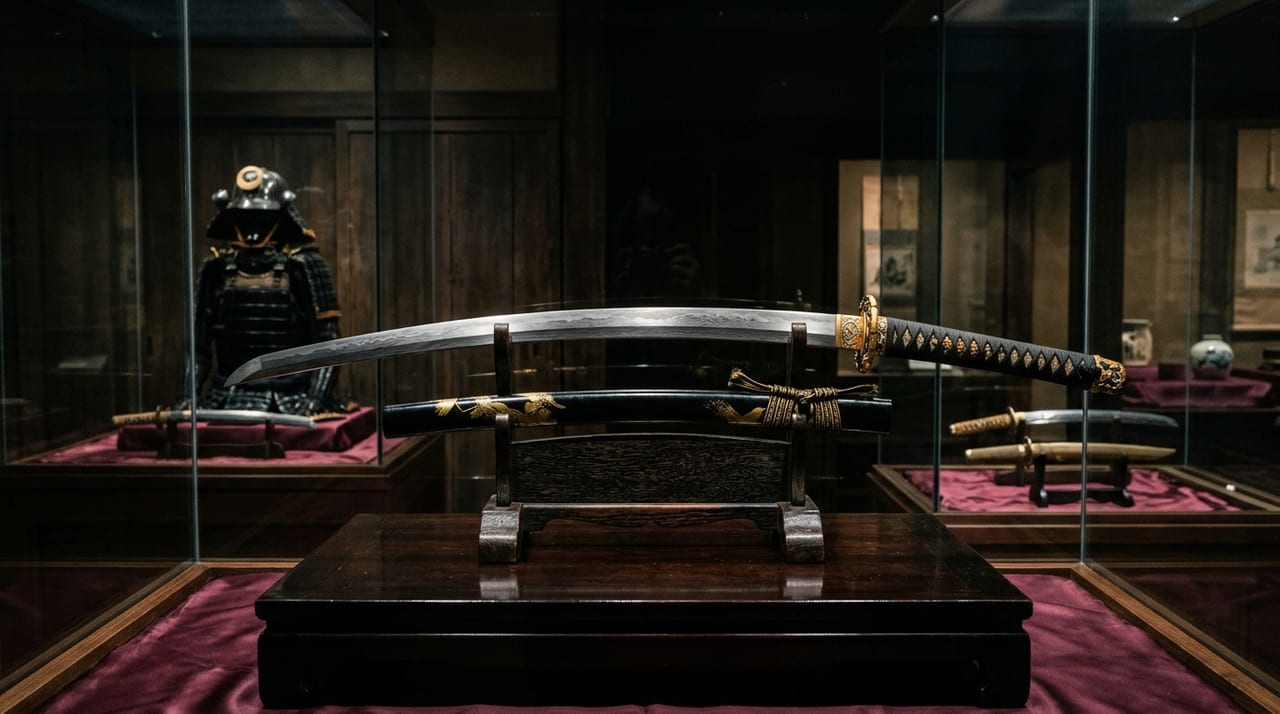
In Sōshū (Kamakura), Shintōgo Kunimitsu appeared, opening the path to the later flourishing of Sōshū-den — Masamune and Sadamune. Kunimitsu's swords are characterized by powerful nie and vigorous jigane, and he is highly regarded as a tōkō who achieved a high standard of balance between the practical demands of warriors and aesthetic value. The fact that Sōshū was the center of the Kamakura shogunate shortened the distance between tōkō and warrior power, creating fertile ground from which commissioned swords of the highest caliber were born. The tachi by Kunimitsu in the collection of the Tokyo National Museum conveys to this day the origins of the later Sōshū-den through its refined yet powerful construction.
Emperor Go-Daigo and the Kenmu Restoration — Swords as Proof of Political Legitimacy
Following Genkō no Hen (1331) and Shōkyō no Ran (1333), Emperor Go-Daigo destroyed the Kamakura shogunate and launched the Kenmu Restoration. However, this government collapsed in just three years, and Ashikaga Takauji seized Kyoto and established the Northern Court (the Muromachi shogunate). Emperor Go-Daigo fled to Yoshino and established the Southern Court, opening the curtain on the Nanbokuchō conflict that would last more than 60 years.
In this turbulent era, swords functioned beyond mere weapons as proof of legitimacy. Commanders on both Emperor Go-Daigo's side and the Ashikaga side began bestowing famous swords as rewards for military merit, and the possession of swords became a means of making political loyalty visible. Which master tōkō's sword a warrior wore and from whom it had been bestowed became signs indicating that commander's standing and rank, and the social meaning of swords became further layered.
What deserves particular mention in the Kenmu period is the group of swords said to have been held by commanders who served close to Emperor Go-Daigo, such as Kusunoki Masashige and Nitta Yoshisada, and many tōkō of Yamashiro and Yamato operated with the backing of either the Southern or Northern Court. This structure, in which political patronage and the economic survival of tōkō were inseparably linked, clearly illustrates a pattern that recurs throughout the history of Japanese swords: that a master tōkō could pursue the heights of technique by attaching himself to a specific wielder of power.
Technical Changes from the Late Kamakura through the Kenmu Period — The Establishment of Robust Construction
Technically, a clear change appeared in blade shape from the late Kamakura through the Kenmu period. The fukura (the swelling at the kissaki section) became fuller, and the center of the sori shifted from koshi-zori toward naka-zori (mid-blade curvature). This was a rational change in form designed to withstand the impact of downward strikes on the battlefield while maximizing cutting power.
In the hamon, variations of gunome and chōji developed, and nie-deki hamon came to be admired. Nie are the fine glittering particles that appear at the boundary of the hamon, and the changes in metallic structure arising from the density of heat also create visual power. In particular, Kunimitsu of Sōshū-den and his successors made extensive use of abundant ara-nie, greatly expanding sword aesthetics from a gentle, well-proportioned beauty toward a powerful, wild beauty.
The process by which the "perfected beauty" completed in the mid-Kamakura period — a beauty of restrained construction and proportion — was transformed through an age of warfare into "majestic beauty" is the essence of sword technique in this era. The tōkō responded to the demands of the battlefield without sacrificing aesthetic perfection, discovering new beauty within strength.
A Bridge to the Nanbokuchō Conflict — The Age Forged the Sword
Amid the turbulent historical upheavals of the Mongol Invasions, the fall of the Kamakura shogunate, the Kenmu Restoration, and the split into the Nanbokuchō, Japanese swords continued to evolve technically while responding to the demands of actual combat. The tendency toward "enlargement and greater grandeur" established in this era connects directly to the golden age of ōdachi and nodachi in the subsequent Nanbokuchō period.
In the Nanbokuchō period of conflict, ōdachi with blades of 1 meter or more were produced in large numbers, and not only scenes where mounted warriors mowed down enemy formations from horseback, but also scenes of infantry marching with swords carried on their backs became a common sight on the battlefield. The productive foundation that supported such demand lay precisely in the Gokaden groups of tōkō that had developed across the country from the late Kamakura period through the Kenmu era.
The phenomenon of "mass production of swords" that became prominent in the Nanbokuchō period is also rooted in the political turmoil and chronic state of warfare of this era. Not only artistic swords of a single piece by master tōkō, but also mass-produced practical swords came to be required on a large scale, and the economic scale and social role of the kaji expanded greatly.
This era, in which historical upheaval fundamentally transformed the form of Japanese swords, is positioned as a "period of transformation" in sword history. From the tachi of the mid-Kamakura period, where the aesthetic sensibility of a peaceful age reached its peak, to the ōdachi of the Nanbokuchō that grew ever more majestic in answer to the demands of warfare — the swords of the late Kamakura and Kenmu periods that bridged this transition are an indispensable chapter for understanding the diversity and underlying strength of Japanese swords.