The Structure of kawagane and shingane — The Forging Secret Behind the Japanese Sword's Union of Hardness and Toughness
 * Image is for illustrative purposes only.
Table of Contents
The Japanese sword is said to "not break, not bend, and cut well." Hard steel makes a sharp edge but is prone to breaking, while soft steel resists breaking but cannot hold an edge. The composite structure that wraps the soft shingane in hard kawagane is what resolves this contradiction. This article explains how kawagane and shingane are made, how they are combined, how the structure differs across different schools, and how this structure appears in the context of appreciation and appraisal.
kawagane and shingane — Division of Roles
The blade of a Japanese sword is made by combining two or more types of steel with different carbon content.
| Steel | Approximate Carbon Content | Properties | Role |
|---|---|---|---|
| kawagane | approx. 0.6–0.7% | Hard; becomes the edge through quenching | Covers the outside of the blade; forms the edge and surface |
| shingane | approx. 0.2–0.3% | Soft and tough | Forms the core of the blade; absorbs impact and prevents breaking |
| hagane | May be even higher than kawagane | Hardest | Used only in tsukurikomi applied to the edge portion |
| munegane | Close to shingane | Soft | Used on the mune side to withstand bending |
The higher the carbon content, the harder the steel becomes, transforming into a hard microstructure called martensite through quenching. Conversely, steel with lower carbon content does not readily harden and retains its toughness. The division of roles — kawagane handling the edge and surface while shingane forms the core — allows hardness and toughness to coexist in a single sword. The microstructure of steel is explained in detail in Ferrite, Pearlite, and Martensite.
Where the Materials Come From — tamahagane and oroshigane
The source material for both kawagane and shingane is tamahagane, produced through tatara smelting.
- Iron sand is reduced with charcoal to obtain tamahagane. The carbon content of tamahagane varies depending on the portion.
- The tōshō breaks the tamahagane into small pieces and visually sorts them into high- and low-carbon portions.
- Steel with insufficient carbon is adjusted through a process called oroshigane.
- The sorted steel is stacked, heated, and consolidated into a single mass (tsumiwakashi).
- Orikaeshi tanren is repeated to squeeze out impurities and even out the carbon content.
It is common practice to fold kawagane more times (over ten) and shingane fewer times (several). Each fold doubles the number of layers, and in kawagane thousands to tens of thousands of layers are built up. This layered structure appears on the surface as the jigane texture (itame, masame, etc.). For tatara smelting and tamahagane, see The Process from Iron Sand to tamahagane; for oroshigane, see oroshigane and Refining Techniques; and for the science of orikaeshi tanren, see The Science of orikaeshi tanren.
Tsukurikomi — How kawagane and shingane Are Combined
How kawagane and shingane are combined is called tsukurikomi. As used here, tsukurikomi refers to the method of combining the steels, not the cross-sectional shape denoted by terms such as shinogi-zukuri or hira-zukuri.
| Tsukurikomi Name | Structure | Characteristics |
|---|---|---|
| kōbuse | kawagane is bent into a U-shape to wrap the shingane | The most basic and widespread method; used by the majority of modern tōshō |
| hon-sanmai | hagane in the center, flanked by kawagane on both sides, with munegane placed at the mune | Different steels are used for the edge, sides, and mune; labor-intensive but high-performing |
| shihōzume | shingane is surrounded on all four sides by hagane, kawagane, and munegane | The most complex structure; requires especially advanced technique |
| makuri | shingane is wrapped in a plate of kawagane | Sometimes treated as a variant of kōbuse |
| muku | A single type of steel only | No shingane is used; seen in tantō and some kotō |
In kōbuse, the kawagane is drawn out thin, bent into a U-shape, and the shingane is inserted inside and forge-welded together. After that, the hizukuri process extends the piece into the form of a sword, resulting in a structure in which the kawagane covers the whole and the shingane sits at the core. The hizukuri process is explained in The hizukuri Process.
"Hardness and Toughness" Completed by Quenching
The composite structure reveals its true value at the moment of yaki-ire.
- Clay is applied to the blade (tsuchioki), thinly on the edge side and thickly on the mune side.
- When heated to approximately 800°C and plunged into water, the edge side — where the clay is thin — is rapidly cooled and transforms into martensite, hardening.
- The mune side, where the clay is thick, and the shingane — which has lower carbon content to begin with — do not harden and retain their toughness.
- As the microstructure on the edge side expands, the blade curves toward the mune. The sori of the Japanese sword is also a phenomenon produced by this structural difference.
In other words, the difference in carbon content between kawagane and shingane, the difference in clay thickness from tsuchioki, and the difference in cooling speed combine to achieve the property of being hard on the outside and soft on the inside. For the physics behind the formation of sori, see The Physics of sori Formation; for the formation of nie and nioi, see nie and nioi — The Science of Steel That Gives the hamon Its Brilliance.
The Japanese Sword from the Perspective of Modern Materials Science
The combination of kawagane and shingane embodies the same concept as "composite material design" in modern materials science.
- Hard and tough materials are combined to bring out properties unachievable with a single material.
- It relates to the concept of "functionally graded materials," which places hardness on the surface and toughness in the interior.
- The layered structure acts to arrest the propagation of cracks, increasing resistance to fracture.
The practice of the ancient tōshō, who arrived at this design using only experience and observation from the limited material of tamahagane, aligns with modern engineering theory. However, it should be noted that among kotō there are swords forged in the muku style without shingane, as well as swords with structures that do not fit modern classifications, so it cannot be said that "all Japanese swords are kōbuse."
Structural Differences by School
Among the major schools known as Gokaden, there are characteristic differences in the way the jigane is forged and in structure.
- Bizen-den: Tough jigane and nioi-based hamon. The kawagane forging is dense, and utsuri appears in the itame texture.
- Sōshū-den: Strength is required of the jigane to withstand the intense nie quenching. Chikei and kinsuji appear.
- Yamashiro-den: Refined and bright jigane. The kawagane forging is particularly fine.
- Yamato-den: Masame texture is prevalent; the kaji of the temples emphasized sturdiness.
- Mino-den: Pragmatic and utilitarian; a jigane appearance called shirake sometimes occurs.
Differences in jigane by school are compared in detail in A Comparative Study of jigane in the Gokaden.
How the Structure Appears in Appraisal and Appreciation
The structure of kawagane and shingane can also be read from the surface of the blade.
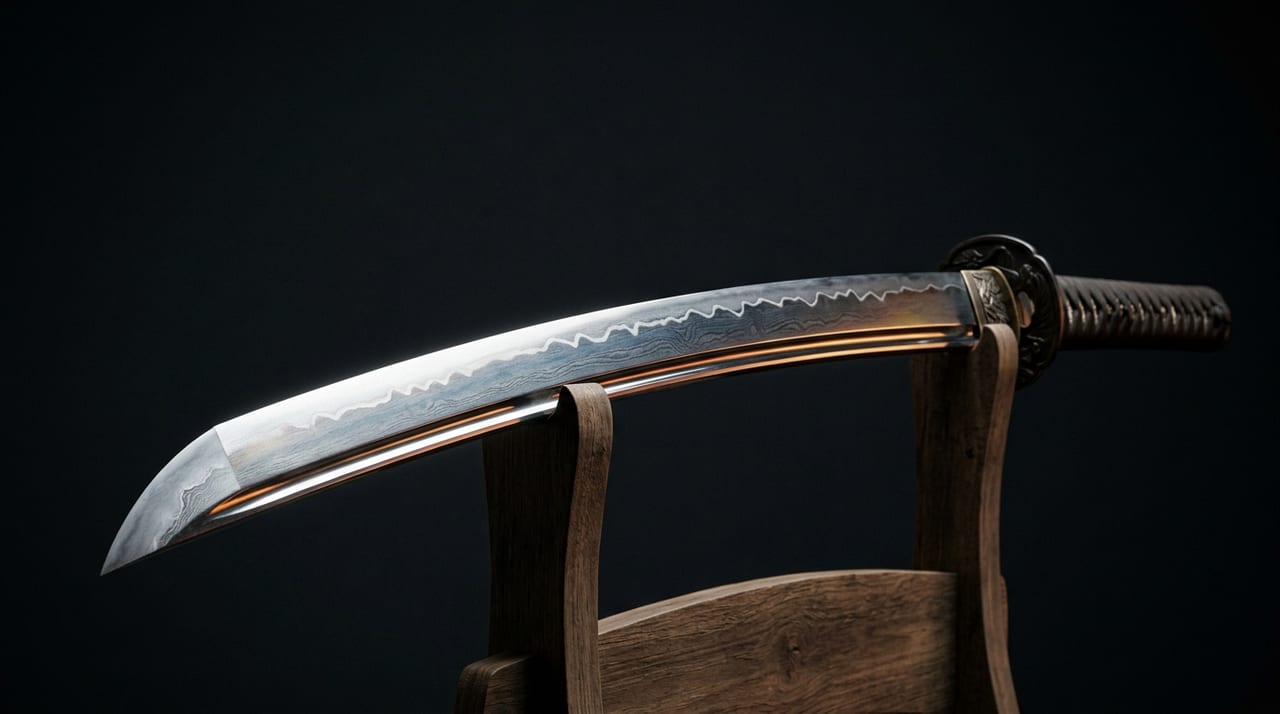
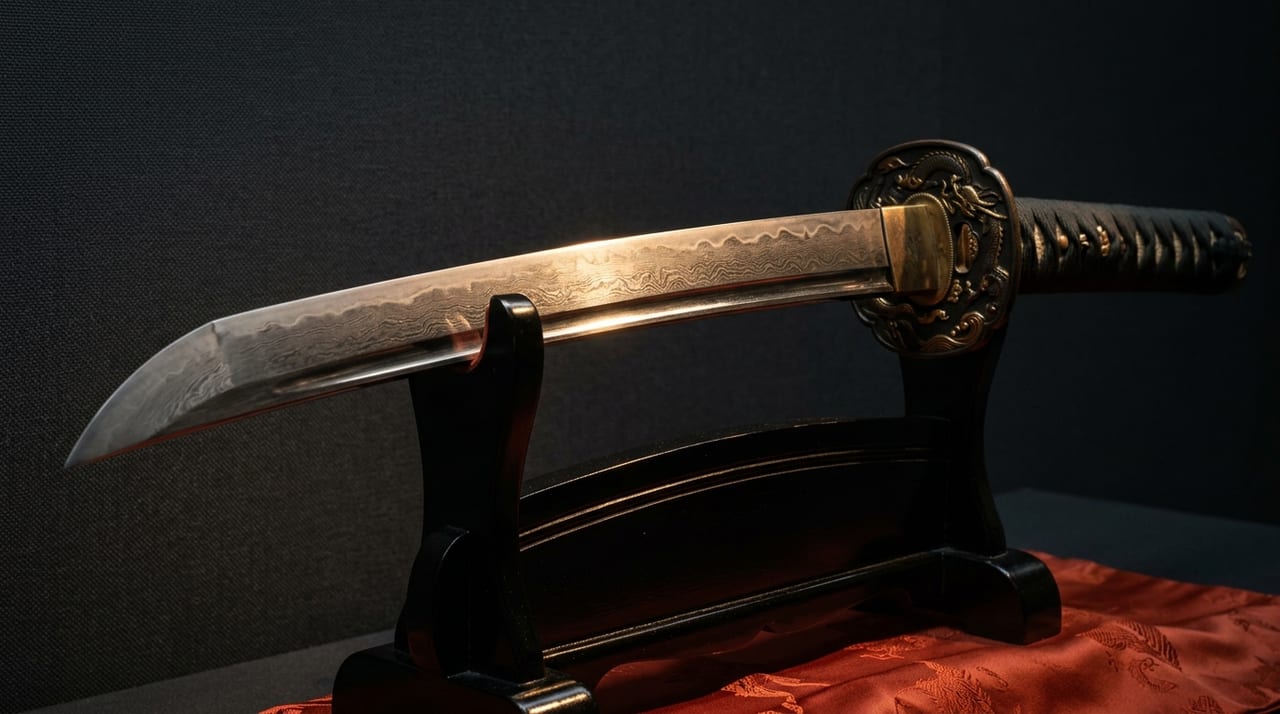
- Jigane texture: The layers produced by the orikaeshi tanren of kawagane appear on the surface as itame, masame, and mokume. The fineness of the texture indicates the care taken in forging the kawagane.
- Exposure of shingane: When repeated togi over the years thins the kawagane, the soft shingane comes to the surface. This is called "shingane ga deru," and the affected area of the jigane appears vaguely rough. It is an important indicator for judging the soundness of the sword.
- Effects of suriage: A sword whose nakago has been remade through suriage may expose the structure of the original nakago portion.
- The boundary between the hamon and the jigane: The boundary between the edge side of the kawagane — where the yaki-ire has taken effect — and the portion that has not hardened is the hamon. The brightness of the hamon reflects the carbon content of the kawagane and the skill of the yaki-ire.
A sword from which the shingane is showing has little margin for re-polishing and its value for appreciation is affected. When purchasing or appraising, check whether there are any rough areas in the jigane. The method for identifying suriage is explained in The Technique and Appraisal of suriage, and the formation mechanism of jigane is explained in The Formation Mechanism of jigane.
Summary
What underlies the performance of the Japanese sword is the division of roles between the hard kawagane and the soft shingane. Tamahagane is sorted, layers are built up through orikaeshi tanren, the steels are combined using tsukurikomi methods such as kōbuse and hon-sanmai, and hardness and toughness are fixed in place by tsuchioki and yaki-ire. This sequence of processes simultaneously achieves "not breaking, not bending, and cutting well." This structure — which aligns with modern composite material design — also manifests on the blade surface as the jigane texture and the exposure of shingane, providing clues for appreciation and appraisal. The materials-science aspects of the composite structure are also covered in The Composite Structure of kawagane and shingane: The Materials-Science Reason the Japanese Sword Neither Breaks Nor Fails to Cut.