The Science of Orikaeshi Tanren — The Effect of Fold Count, Temperature, and Layer Count on Steel Microstructure
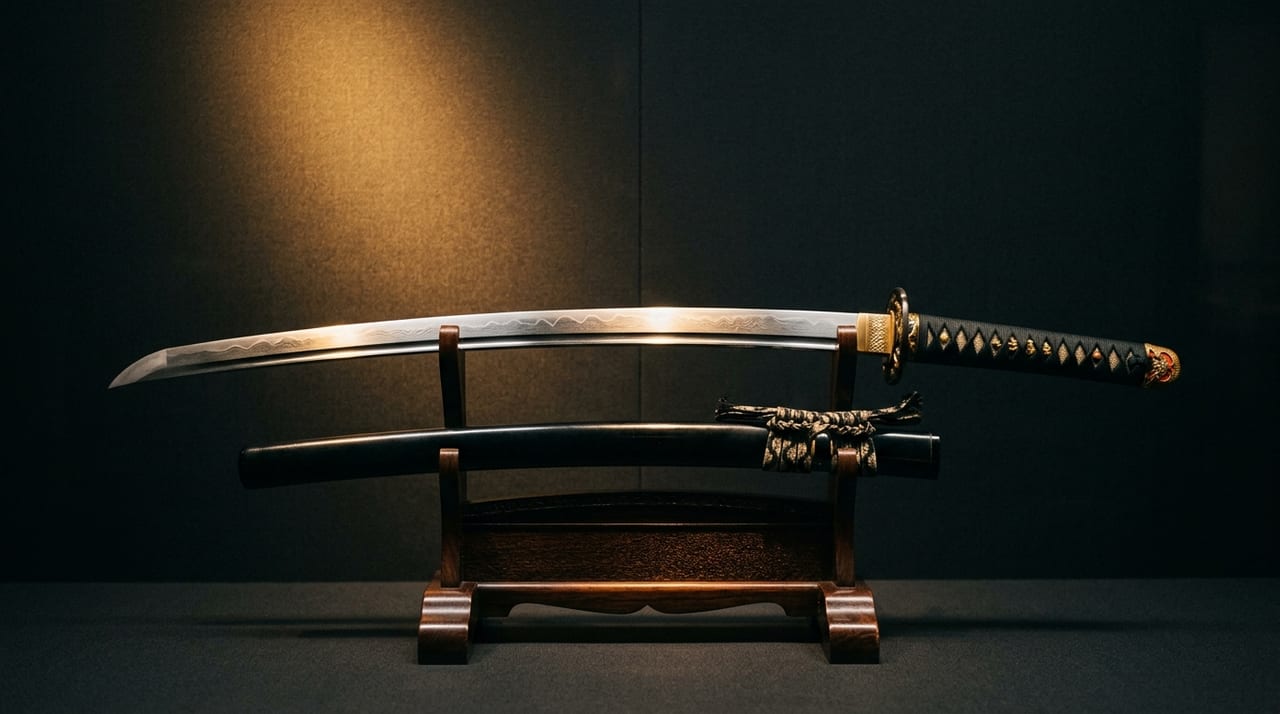 * Image is for illustrative purposes only.
Table of Contents
What Is Orikaeshi Tanren — The Fundamental Process That Transforms Steel in Japanese Swords
"Orikaeshi tanren" (folding) is one of the most important processes in Japanese sword manufacturing: it is the operation of repeatedly heating steel, hammering it out flat, folding it over, and hammering it again. The purpose of this process is not simply "strengthening" — it is to homogenize the internal microstructure of the steel, remove impurities, and ultimately create a material with optimal sharpness and strength.
The raw mass of tamahagane obtained through tatara (traditional smelting) is, in outward appearance, a mass of metal, but various problems lurk within: local variation in carbon content, residual slag (ore slag), inclusion of oxides, coarsening of crystal grains, and so on. If these are left unresolved and the steel is forged into the shape of a sword, it will be prone to insufficient strength and brittle fracture. Orikaeshi tanren is the core technology of the manufacturing process that resolves these problems.
Fold Count and Layer Count — Interfaces That Increase Exponentially
The number of folds in orikaeshi tanren and the number of steel layers produced are related exponentially. The relationship showing that n folds produce 2ⁿ layers is as follows.
| Fold count | Number of layers |
|---|---|
| 1 | 2 |
| 2 | 4 |
| 3 | 8 |
| 8 | 256 |
| 15 | 32,768 |
It is said that typical Japanese swords undergo approximately 8 to 15 folds, and at 8 or 15 folds, an extremely thin laminated steel body is formed.
The formation of this enormous number of interfaces (boundaries between layers of steel) brings about the essential effects of orikaeshi tanren. Each interface becomes a site for the redistribution of carbon, carbides, and residual slag, and local compositional imbalances are equalized through repeated heat and pressure. The principle behind this phenomenon is what modern materials science calls "diffusion enhancement through plastic deformation."
However, it is not the case that more folds are always better. It has been reported that beyond 20 folds, the layer thickness reaches the nanometer order, interfacial energy becomes excessive, and the steel conversely becomes brittle. There is also the problem of carbon being consumed by oxidation, causing the carbon content to drop too low. The empirical rule among traditional sword kaji that "12 to 15 folds is the upper limit" is consistent with modern materials science knowledge.
Temperature Control — The Optimal Heating Temperature Range for Tanren
The heating temperature in orikaeshi tanren is the single most important variable that directly affects microstructural changes in the steel. The temperature range suitable for working carbon steel is called the "forging temperature range" and varies depending on steel composition, but for medium-to-high carbon steel (carbon content 0.5–1.5%) used in Japanese swords, approximately 900–1200°C is considered appropriate.
In this temperature range, the steel takes on a face-centered cubic structure called austenite, entering a flexible state in which plastic deformation by hammering is possible. Outside this range, the following problems arise.
- Below 900°C, body-centered cubic ferrite begins to form, deformation resistance increases sharply, and the steel becomes "hard and brittle"
- Above 1200°C, as the melting point of the steel is approached, oxidation progresses rapidly and "burning" (yakisugi) occurs, degrading the steel microstructure
Traditional sword kaji judge temperature without a thermometer, reading it from the furnace flame and the color of the steel. The skill of reading temperature from color requires years of training, and the approximate correspondence between color and temperature is as follows.
- Dark red (approx. 750°C)
- Red (approx. 850°C)
- Orange (approx. 950°C)
- Bright orange (approx. 1100°C)
- Yellow (approx. 1200°C)
Judging the lower limit of the tanren temperature (around 900°C) in particular is difficult, and continuing to strike steel whose temperature has dropped too low carries the risk of internal "cold cracking" (hiewari) occurring.
The Mechanism of Impurity Removal — How Slag and Oxides Are Expelled
Another important effect of orikaeshi tanren is the removal of impurities in the steel. Tatara tamahagane contains trace amounts of slag (silicate-oxide complexes) that remain, and these cause strength reduction and brittle fracture in the steel.
When heated steel is struck with a hammer, the slag inside deforms and is pushed toward the surface. On the surface of the hot steel, slag mixes with the oxide scale and flies off as scattered matter called oroshi. By repeating this process, the slag content inside the steel decreases rapidly.
At the same time, the homogenization of carbon distribution also proceeds. The raw mass of tatara tamahagane contains a mixture of areas with high carbon content (called hakutetsu, with a white cross-section) and areas with low carbon content (called kuritetsu, with a dark cross-section). Through orikaeshi tanren, this carbon segregation is gradually resolved, and steel with a uniformly distributed carbon content throughout is formed. This homogenization causes the hamon (temper line) after yaki-ire (quenching) to appear beautifully and uniformly.
Refinement of Steel Microstructure — Grain Size Control Produces Sharpness
The effect of orikaeshi tanren on the crystal grain size of steel is also important. By repeatedly applying heat, cooling, and deformation, the crystal grains of the steel gradually become finer through repeated recrystallization and grain growth. Steel with fine crystal grains shows superior characteristics in all respects — strength, toughness, and uniformity — compared to steel with coarse crystal grains (Hall-Petch relationship).
The fineness of the martensite microstructure formed after yaki-ire (quenching) also depends on the crystal grain size prior to tanren. By pre-refining the crystal grains through orikaeshi tanren, the martensite formed after yaki-ire becomes uniform and fine, realizing a steel microstructure that achieves both high hardness and toughness. The texture of the jigane (steel of the blade surface) that appears after polishing — the diverse patterns such as mokume, itame, and ayasugi-hada — are the manifestation of this fine crystalline structure on the polished surface, and differences in the quality of orikaeshi tanren directly appear as the beauty of the jigane.
Degradation from Over-Folding — The Problems of Carbon Depletion and Brittleness
The most serious drawback of increasing the number of folds too many times in orikaeshi tanren is carbon depletion. When steel is exposed to air at high temperature, carbon on the surface is oxidized and escapes as carbon dioxide — a phenomenon called dattan (decarburization). The more folds are performed, the more times the steel is heated, and the decarburization-induced decrease in carbon content accumulates.
Steel with reduced carbon content has lower hardness after yaki-ire (quenching), becoming a "blade that cannot cut." Conversely, if a starting material with excessively high carbon content is used for the purpose of compensating, too much carbon may remain after folding, making the steel brittle. Traditional sword kaji grasp the "carbon balance during tanren" empirically and maintain optimal carbon content by selecting the appropriate number of folds and heating time.
This "carbon management" is itself one of the supreme skills of sword kaji. Even in modern materials science analysis, cross-sectional analysis of Edo-period masterwork swords reveals a surprisingly uniform carbon distribution, and one cannot help but marvel that the tōkō of the time achieved this sophisticated materials management through experience and intuition alone, without theoretical knowledge.