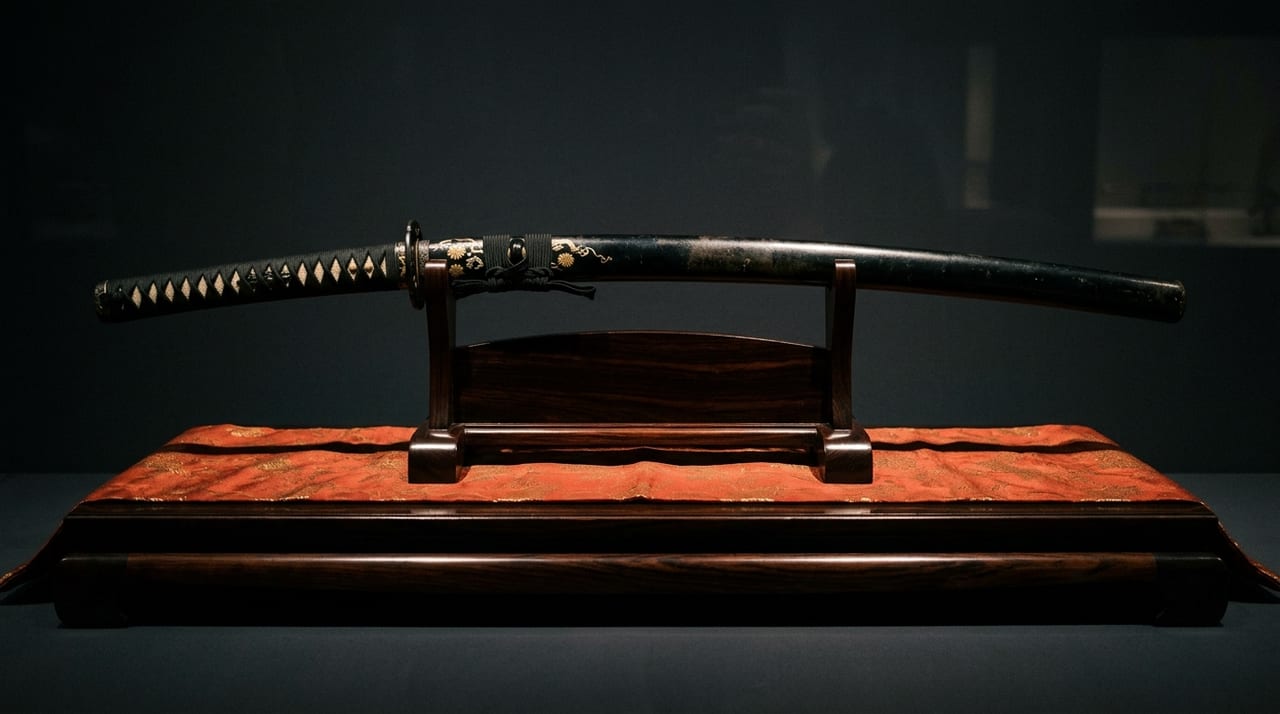
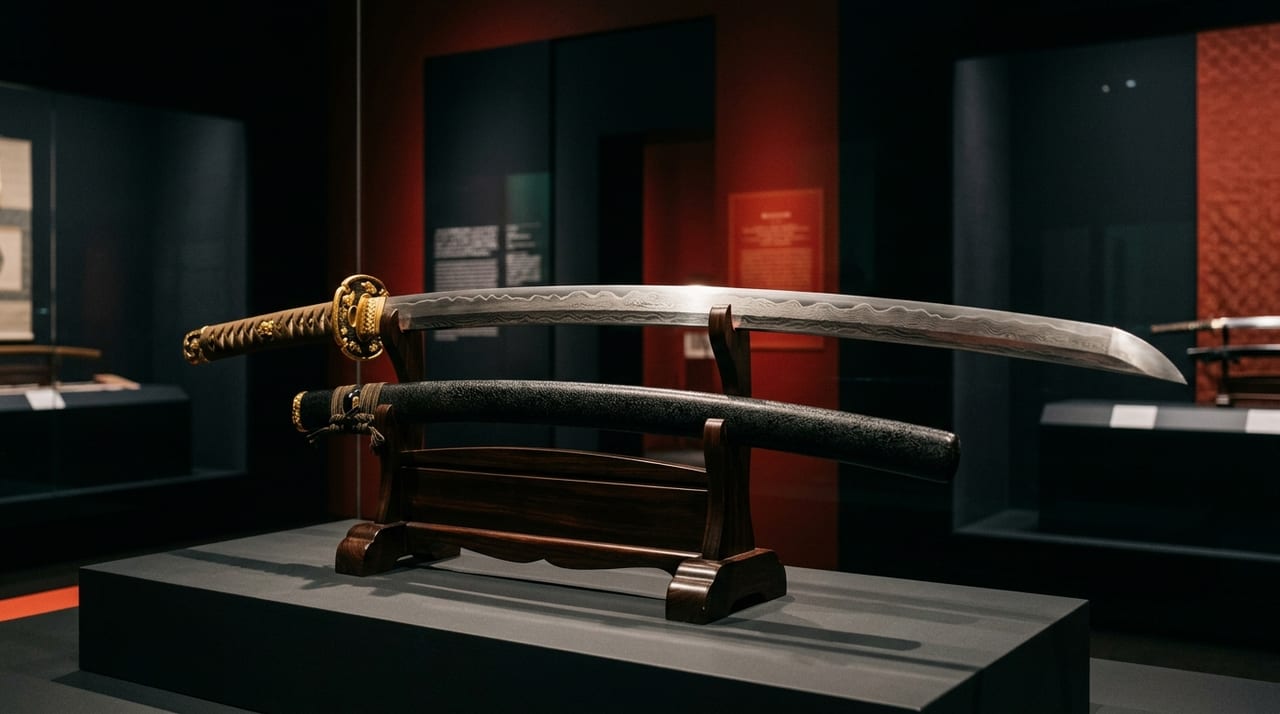
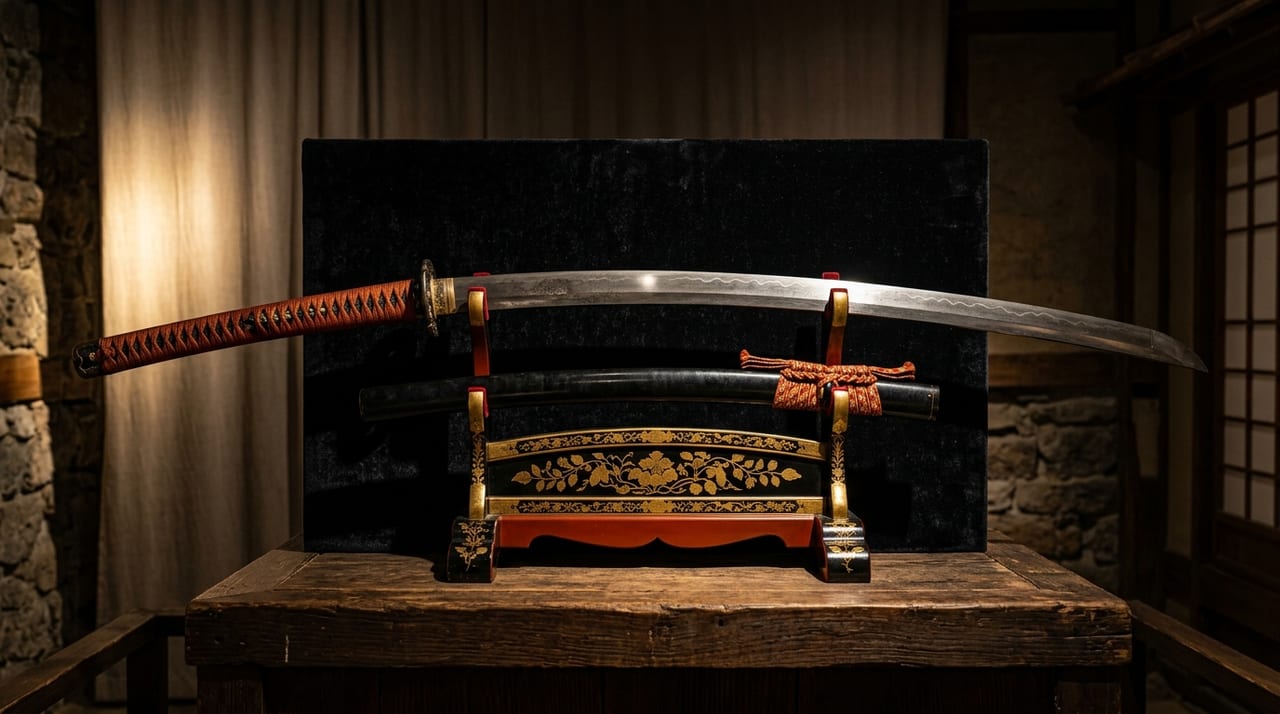
Nanbokuchō-period Blade Form and Its Transition: Formal Characteristics of Transitional Swords in the Enbun and Jōji Eras
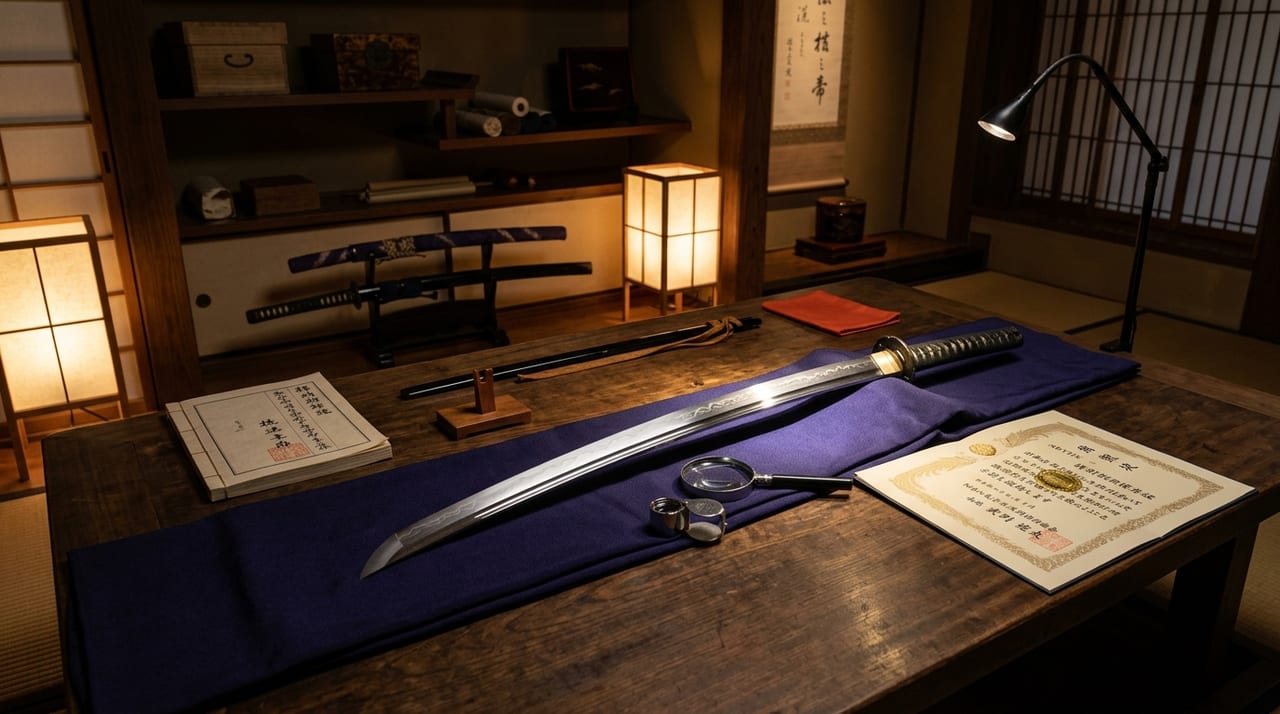 * Image is for illustrative purposes only.
Table of Contents
Nanbokuchō-period Blade Morphology: The "Period of Greatest Transformation" in the History of Japanese Swords
The Nanbokuchō period (1336–1392) was the era of the most dramatic changes in the morphological history of the Japanese sword. Blades from this period are known as the "Nanbokuchō-sugata" and serve as an important indicator in period attribution.
The primary direction of change was "enlargement": blades became longer and larger, the kissaki grew, and the mihaba widened. The embodiment of this tendency was the era of the ōdachi and nodachi, with the silhouette of "the Enbun–Jōji period (ca. 1356–1368)" most fully expressing these characteristics.
Why did swords enlarge so dramatically? The social backdrop of the prolonged Nanbokuchō conflict drove demand for more powerful weapons. The increased weight of infantry combat also played a role. Rather than being wielded on horseback, large swords swung two-handed by foot soldiers proved effective.
Formal Characteristics of the "Enbun-sugata": The Apex of Enlargement
In period attribution of Japanese swords, the term "Enbun-sugata" is used. It refers to the peak form of Nanbokuchō blades, typical of the Enbun–Jōji era (ca. 1356–1368).
Its formal characteristics are as follows:
Elongation of blade length: As tachi, examples with a cutting-edge length exceeding 80–90 cm become more numerous. Among ōdachi and nodachi, examples with blade lengths of 120 cm or more existed (though many surviving pieces were later shortened by suriage).
O-kissaki (large kissaki): The "ō-kissaki," in which the kissaki (tip section) becomes elongated, is one of the defining characteristics of Nanbokuchō blades. Examples with a kissaki length of 2.5–4.0 cm or more are common, sometimes reaching two to three times that of the inokubi-kissaki of the mid-Kamakura period (approximately 1.0–1.5 cm). The form is described as "ō-kissaki — chū-kissaki extending," with a sharply elongated tip.
Widening of the mihaba: The motohaba expands to approximately 3.4–4.0 cm. The sakihaba also becomes relatively wider as the kissaki enlarges, with the sakihaba/motohaba ratio rising to approximately 70–80% (a marked increase from the 55–65% of the early Kamakura period). This produces a blade form with "small fumigomi" — little tapering toward the tip — giving a substantial, solid impression.
Kasane (thickness): Examples exist with a moto-kasane of 0.8–1.0 cm or more, giving the blade considerable mass.
The "Revival" of Koshi-zori: Characteristics of Sori in the Nanbokuchō Period
Regarding sori, a counter-intuitive shift occurs in the Nanbokuchō period: from the "naka-zori" established in the mid-Kamakura period, there is a renewed tendency toward koshi-zori.
This is interpreted as a return to koshi-zori suited to infantry combat. Unlike the koshi-zori of the Heian period, which aimed at "ease of drawing on horseback," the koshi-zori of the Nanbokuchō period may correspond to a style of carrying large swords slung across the back while moving (ōdachi were often carried in this manner).
The Emergence of the Enbun Uchigatana: The Beginnings of the Uchigatana in the Nanbokuchō Period
The Nanbokuchō period was dominated by ōdachi, but it was also during this era that the beginnings of the uchigatana can be observed.
The uchigatana is shorter overall than the tachi (approximately 60–70 cm in cutting-edge length) and is carried thrust through the waist sash with the edge facing upward (the "sashikomi" manner), in contrast to the tachi, which is suspended with the edge facing downward.
From the late Nanbokuchō period through the early Muromachi period, practical uchigatana began to develop alongside the large tachi. The spread of the uchigatana would form the foundation for the transition to the "uchigatana as the mainstream" in the Muromachi and Edo periods that followed.
Shortening in the Ōei–Eikyō Eras: The Reversal of Enlargement
With the end of the Nanbokuchō conflict and the stabilization of Muromachi shogunate rule in the Ōei–Eikyō eras (1394–1441), sword morphology changed rapidly.
Oversized blades underwent "suriage" — a process in which the nakago is filed down to shorten the overall length. The majority of surviving Nanbokuchō tachi have lost their original length through suriage. Blades that have undergone suriage are called "suriage-mono," and estimating the "original form before suriage" is an important task in period attribution.
In formal terms:
- Cutting-edge length reduced to approximately 75 cm
- The kissaki reduced from ō-kissaki toward chū-kissaki and ko-kissaki (described as "the kissaki shortening")
- The mihaba also shows a tendency to shrink, with the motohaba reducing to approximately 3.0–3.4 cm
This reduction was not mere "degradation" but an adaptation to the new Muromachi-period style of combat — an emphasis on mobility in the close-quarters grappling of infantry warfare.
Nanbokuchō-period Characteristics in Jigane and Hamon
Nanbokuchō-period blades display characteristic tendencies not only in morphology (outward form) but also in jigane and hamon.
Jigane: A coarser surface mixing large itame and large mokume becomes more common. This reflects both the increase in forging volume (mass demand for large swords) and the technical cross-pollination between production centers (the spread of Sōshū-den influence).
Hamon: "Hiro-suguha" (broad suguha) and "large-scale irregular hamon" are prominent. Bold hamon such as "gunome-midare," "ō-gunome," and hitatsura in particular developed during the Nanbokuchō period. Hitatsura — a hamon in which the entire blade surface appears to have undergone quenching — is a technique characteristic of the Nanbokuchō period that emerged as the influence of Sōshū-den spread across the country.
Conclusion: Are Nanbokuchō Swords a "Transitional Period" or a "Pinnacle"?
It is possible to view Nanbokuchō sword morphology as a "transitional period" between Kamakura and Muromachi, but that framing alone is insufficient. The Nanbokuchō sword form — with its ō-kissaki, wide mihaba, and overall enlargement — represents one peak with its own complete expression, and the "contraction" (shukutai) toward the Muromachi period and beyond was not a diminishment but a different kind of optimization.
In attributing surviving Nanbokuchō mumei blades (swords bearing no mei of a master tōkō), comprehensively reading the formal characteristics of this period — ō-kissaki, wide mihaba, koshi-zori, itame jigane with large grain, and bold hamon — is the key to correctly identifying them as "swords of the Nanbokuchō period."
The process by which tōkō dispersed across the provinces during the Nanbokuchō conflict, and how the techniques of Bizen, Yamashiro, and Sōshū spread throughout the country, is discussed in Nanbokuchō-period Swordsmith Dispersal. Approaching Nanbokuchō swords through both the lens of morphological change and the propagation of schools gives a fuller, more three-dimensional understanding.