Tachi of the Nanbokuchō Period and Social Upheaval — What the Enlarged Blades Reveal About Warriors in an Age of Turmoil
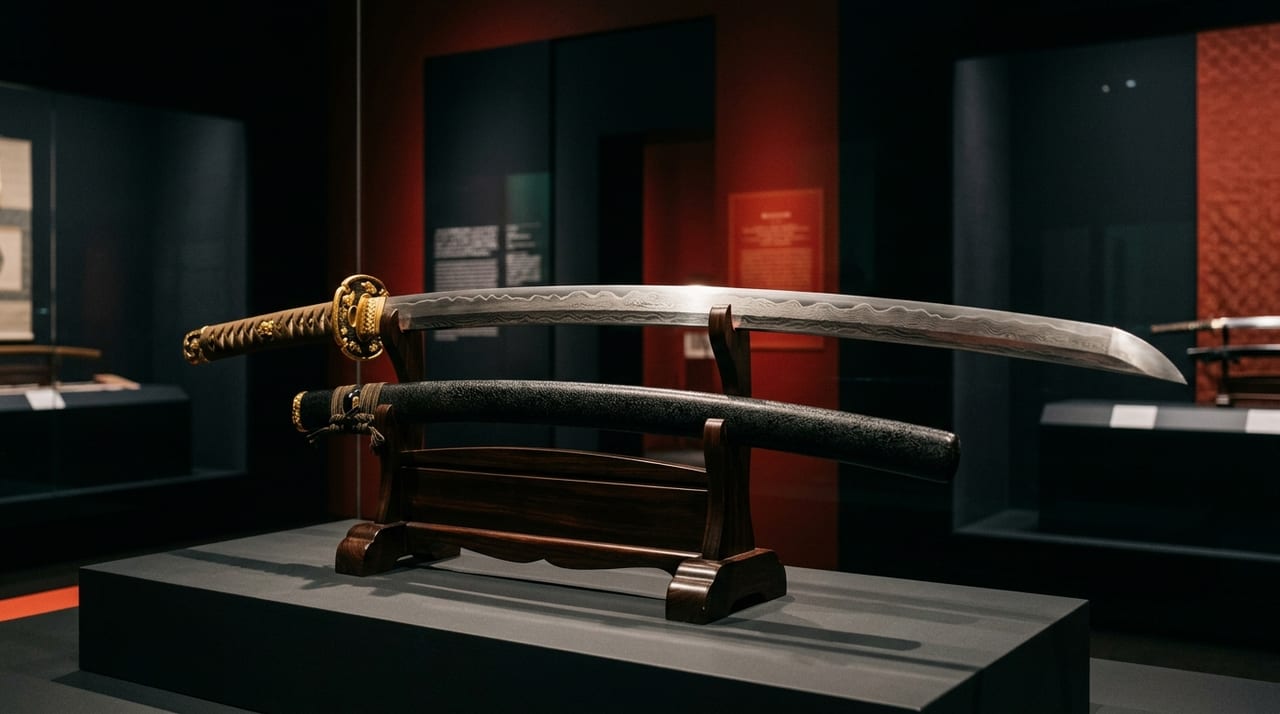 * Image is for illustrative purposes only.
Table of Contents
The Nanbokuchō Conflict and Changes in Swords
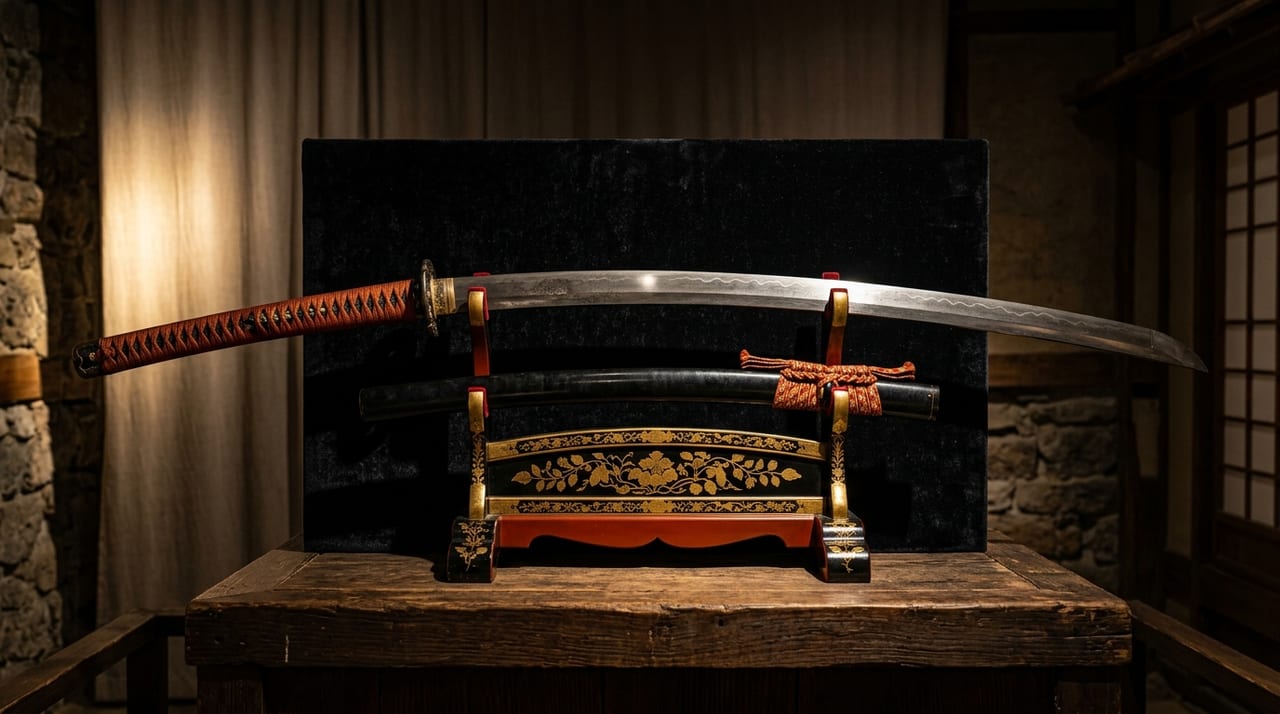
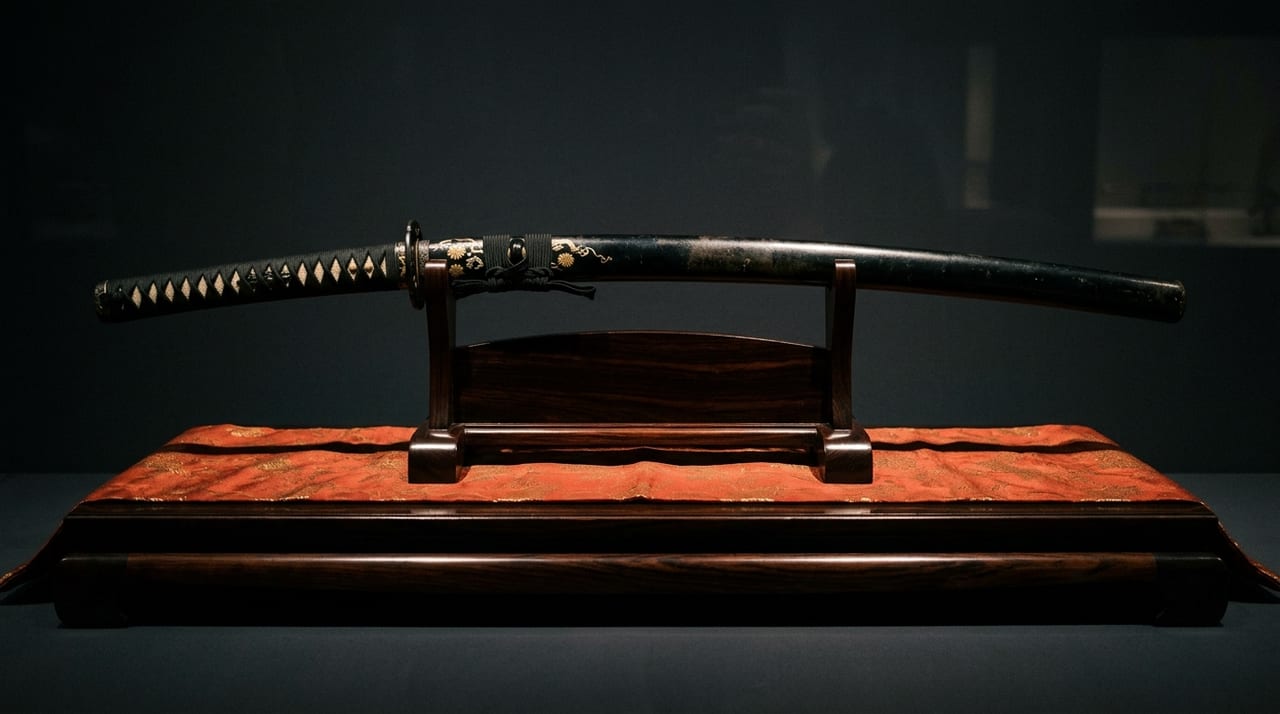
The Nanbokuchō period, spanning from 1336 to 1392, was an age of upheaval in which the imperial family split into two rival courts and warrior society was drawn into nationwide conflict. This political and social turmoil brought conspicuous changes to the form of Japanese swords: the enlargement and imposing grandeur of the blades.
From the late Kamakura period through the Nanbokuchō era, sword lengths increased dramatically. While tachi of the Kamakura period typically had a nagasa of around 2 shaku 5 sun (approximately 75 cm), the Nanbokuchō period saw blades exceeding 3 shaku (approximately 90 cm), and ōdachi and nodachi reaching 4 to 5 shaku were actually used on the battlefield. The swords of this age were not merely an evolution of weaponry; they were also cultural products that reflected the spirit and aesthetic sensibility of warriors who survived the turbulent era.
Why Did Blades Become Larger?
Nanbokuchō battlefields were shifting from the mounted archery combat of the Kamakura period toward massed infantry warfare. The style of mounted warriors exchanging arrows in single combat gave way to group fighting that made heavy use of ashigaru (infantry). To meet this change, it is thought that a demand arose for "enlargement" — using a long blade to gain distance from the enemy and increase the striking power of a downward blow from horseback.
The armor of the time had robust construction and increased thickness. To counter ōyoroi — grand armor that made extensive use of itazane (lacquered laminar plates) — considerable striking force was needed, and heavy, long-bladed swords were recognized as effective. Furthermore, the influence of military chronicles that celebrated heroic commanders cannot be overlooked. Literary works such as the "Taiheiki" praised the image of the imposing warrior, and this encouraged a culture of wearing ōdachi as an expression of self-identity and a display of the lord-vassal relationship. Thus, from both practical and symbolic perspectives, the enlargement of Nanbokuchō swords accelerated.
Notable Tōkō and Their Work
Nanbokuchō swords saw many master craftsmen active, centered on Osafune in Bizen Province. Lines descending from the school of Nagamitsu, the lineage of the Samonji School, and the group of tōkō following the Sōshū-den tradition each carved out their own distinctive domain during this period.
Worthy of particular note is the work of Kanemitsu. Osafune Kanemitsu, active from the late Kamakura period through the Nanbokuchō era, forged many large tachi, and his imposing style was celebrated by later generations as the epitome of "Nanbokuchō style." His hamon features large, bold gunome and chōji, with nie working strongly — a forceful swordmaking style. From an appreciation standpoint as well, the "dynamic beauty" that swords of this era exude is something rarely found in works from other periods.
The Tegai school of Yamato and the Samonji School of Chikuzen were also renowned as representative groups of tōkō of the Nanbokuchō period, winning the deep trust of commanders throughout the country.
The Reality of Ōdachi and Nodachi
Ōdachi of the Nanbokuchō period were not merely enlarged swords; they also possessed distinctive formal characteristics.
- Many survive in suriage form: Most surviving Nanbokuchō-era ōdachi were shortened in later periods by reducing the nagasa (suriage). How long the original blade was can be inferred from the extent of suriage visible in the remaining nakago (tang). Reading these traces is one of the true pleasures of appraising Nanbokuchō swords.
- The position of the sori (curvature) shifted: In the Kamakura period, "koshi-zori" — a pronounced curve concentrated near the base of the blade — was predominant, but in the Nanbokuchō period, "nakasori" and a more gradual overall curvature are observed. This change in profile is an important indicator for dating.
- Elongation of the kissaki (point): "Ōkissaki," in which the kissaki extends to considerable length, became fashionable, reflecting a design philosophy aimed at enhancing thrusting power. This ōkissaki is also a characteristic that visually distinguishes Nanbokuchō swords.
Since suriage alters the shape of the nakago and the position of the mei (signature), Nanbokuchō swords that retain an ubu nakago (a nakago left in its original state as manufactured without any modification) and carry a zaimei (signed) attribution are considered particularly rare. Conversely, even when a piece is mumei (unsigned) because the mei was lost through suriage, it is still possible to narrow down the period and school of production from the characteristics of the profile, hamon, and jihada (grain pattern of the steel), and this too is an important clue in appraising Nanbokuchō swords.
Appreciating and Collecting Nanbokuchō Swords
Tachi of the Nanbokuchō period enjoy enduring popularity among enthusiasts for their imposing workmanship. However, since many have been subjected to suriage and not a few have lost their mei (signature), appraisal requires deep knowledge to interpret the period-specific characteristics of hamon, jihada, and sori.
In appraisal, swords dated to the "Nanbokuchō period" are distinguished from Kamakura and Muromachi work by clear criteria. The jihada (grain pattern of the steel) often shows a flowing large itame, nie works strongly, and there is a tendency for rich activity of kinsuji and inazuma within the hamon. Comprehensively discerning these complex characteristics together is the true essence of Nanbokuchō sword appreciation.
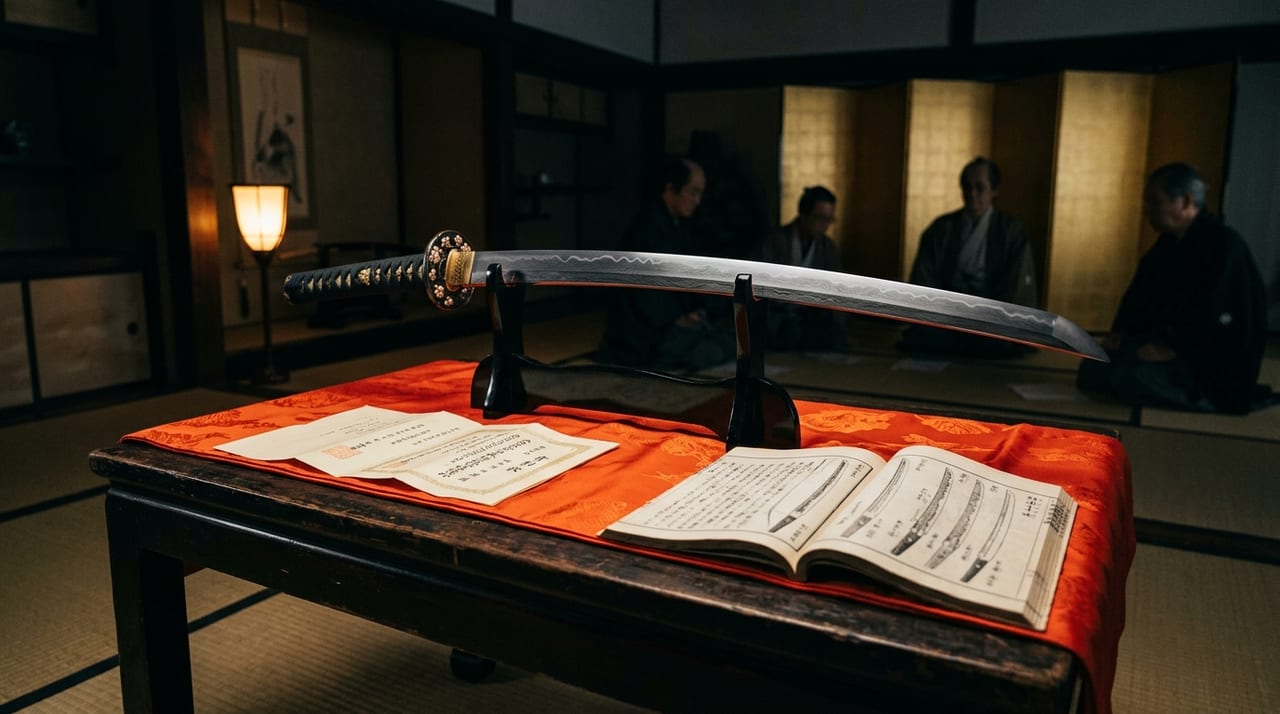
When acquiring a sword, confirming whether a kanteisho (appraisal certificate) exists and choosing a sword with a clear provenance is fundamental.
Note that in Japan, possessing a Japanese sword requires a registration certificate issued by the prefectural Board of Education. It is customary for the registration certificate to be transferred together with the blade upon sale or transfer of ownership, and at the time of purchase one should verify both that the registration certificate exists and that the mei and shape engraved on the nakago of the blade are consistent with the information recorded on the registration certificate. This point warrants particular attention when choosing a sword whose provenance is unclear.
Understanding Kanteisho Ranks and Grades
The kanteisho issued by NBTHK (the Society for the Preservation of Japanese Art Swords, a public interest incorporated foundation) contains multiple grades. In ascending order, these are Hozon Tōken, Tokubetsu Hozon Tōken, Jūyō Tōken, and Tokubetsu Jūyō Tōken; a higher designation means that the quality of the hamon and jihada, the condition of preservation, and the documentary value have been assessed more highly. Surviving Nanbokuchō-period tachi are few in number, and among them, zaimei works that retain an ubu nakago not infrequently receive a rating of Jūyō Tōken or above.
When examining a kanteisho, the basic verification procedure is first to confirm that the issuing organization, the name of the tōkō (swordsmith), the period, and the grade are clearly stated, then to cross-check that the mei, profile, and hamon characteristics visible on the blade match the information recorded in the kanteisho. A grade represents an evaluation at the time of appraisal and does not guarantee absolute value in itself; however, when choosing a sword from a period such as the Nanbokuchō era, in which later suriage and modification are common, the existence of a kanteisho from a reliable issuing body provides a sound basis for judgment.
Conclusion
The tachi of the Nanbokuchō period were a product born from the intertwining of the battlefield realities faced by warriors fighting for survival in a turbulent age and the cultural backdrop that celebrated heroic might. Viewed from the present day, the swords of this era represent a particularly distinctive chapter in the history of Japanese swords, and their imposing ōkissaki, powerful nie, and distinctive traces of suriage continue to captivate collectors and connoisseurs to this day.