The Dispersal of Swordsmiths in the Nanbokucho Period: How the North-South Court Conflict Scattered the Bizen, Yamashiro, and Soshu Smith Communities
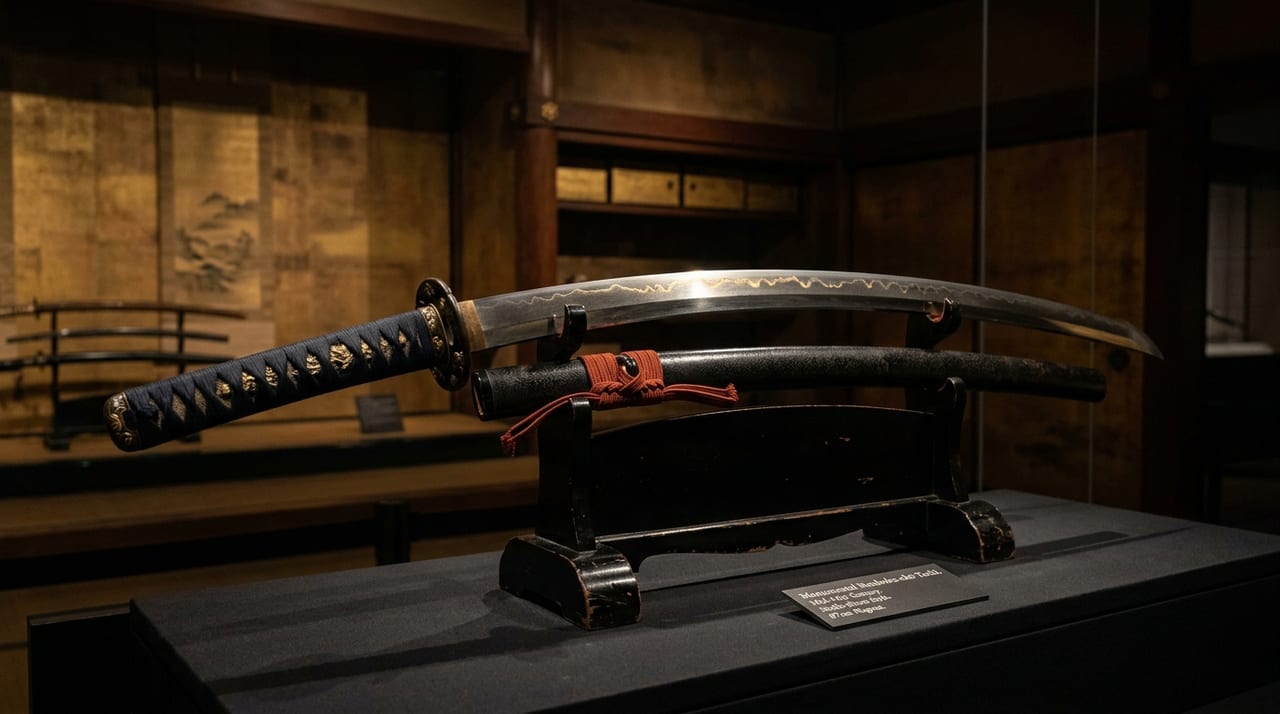 * Image is for illustrative purposes only.
Table of Contents
Turmoil of the Nanboku-chō Period and Its Impact on Sword-Making Communities
The Nanboku-chō turmoil, which began with the collapse of the Kenmu Restoration (1333–1336) and the relocation of Emperor Go-Daigo to Yoshino, engulfed the Japanese archipelago in warfare for more than half a century. This era also witnessed an explosive surge in demand for large blades such as odachi, naginata, and nagamaki. However, the warfare simultaneously prompted the migration and dispersal of artisan communities. This article traces, based on historical records and extant works, how the primary forge communities—Bizen, Yamashiro, and Sōshū—underwent reorganization.
Why were sword smiths forced to move? Several factors lay behind this:
- Devastation of workshops and fuel supply areas due to warfare
- Succession of patrons among court aristocrats and warrior clans
- The emergence of new commissioners due to the rapid increase in military demand
These factors combined to make it increasingly difficult for sword-smith communities to remain in one location.
Dispersal of Bizen Sword Smiths: The Contest for Patronage Among Shugo Daimyo
Before the Nanboku-chō period, master sword smiths of the late Kamakura era such as Osafune Nagamitsu, Kagamitsu, and Kanemitsu gathered at Osafune in Bizen (present-day eastern Okayama Prefecture), establishing the "Bizen" brand. However, as the turmoil began, guardianship of Bizen became fiercely contested among the Akamatsu, Yamana, and Ōuchi clans, and the patrons of the sword smiths changed rapidly.
The Kannō Disturbance of the 1350s—the internal strife between Ashikaga Takauji and Ashikaga Tadayoshi—further complicated Bizen's political situation, prompting some sword smiths to flee to Kyushu to serve Southern Court daimyo. Some scholars attribute the origins of later "Kyushu swords" in part to the techniques of Bizen-style smiths. Meanwhile, those who remained in Osafune began to inscribe "kendatsu-mei" (signatures with the guardian's family name added), changing the very form of signatures as a political survival strategy.
From the late Nanboku-chō period into the early Muromachi era, new-generation smiths such as Osafune Morimitsu and Osafune Yasumitsu rose to prominence in Osafune, and lineages that survived the turbulence of the Nanboku-chō period established the foundation for the next era.
Such shifts in patronage are said to have fostered flexibility in sword smiths, preventing them from adhering rigidly to specific styles and allowing them to adapt their work to commissioners' preferences. The diversity of expression in jigane and hamon seen in works transmitted as Bizen pieces to this day is not unrelated to this historical context.
Reorganization of Yamashiro Sword Smiths: From Awataguchi to New Production Centers
The Awataguchi school of Yamashiro (present-day southern Kyoto Prefecture) formed the foremost community of sword smiths from the late Heian through the Kamakura period, but it underwent marked decline after the Nanboku-chō period. Kyoto became a repeated battlefield during the turmoil, and the destruction of forges in the Awataguchi area was a contributing factor.
In its place rose the Rai school, with numerous odachi by smiths such as Rai Kunitoshi and Rai Kunitsugu surviving from the Nanboku-chō period. However, the Rai school too shifted its base repeatedly during the turmoil, with some members moving to the Yamato and Nara regions near the Southern Court. This migration became a distant cause of later technological exchange with various Yamato traditions.
What characterized Yamashiro sword smiths of the Nanboku-chō period was their transition to mass-production systems to meet soaring demand. In place of ceremonial short swords and the refined fittings of the Heian period, a system for rapidly mass-producing long tachi and naginata emphasizing practical combat was established. This represented a shift in quality control from high-priced elite works to prioritizing supply to guardian daimyo forces.
As sword smiths appeared in Yamashiro who absorbed techniques from Yamato and Sōshū, a foundation took shape in later eras for blades transcending regional production centers. The tradition of refined jigane inherited from Awataguchi did not disappear; it is thought to have evolved in form while being transmitted to later Kyoto works.
Dispersal of the Sōshū Tradition: Scattering of the Masamune Circle
Sōshū (present-day Kanagawa Prefecture) is the production center where Masamune (dates of birth and death unknown; active from the late Kamakura era to the early Nanboku-chō period) and his distinguished disciples established the "Sōshū tradition." While successors of Masamune such as Sadamune, Hiromitsu, and Akihiro were active, the Nanboku-chō turmoil accelerated the dispersal of the Sōshū tradition.
The disciples known as the "Ten Masamune Successors" were invited by guardian daimyo across the land and relocated, spreading Sōshū techniques throughout Japan. In Kanazawa (Kaga), Echizen, Mino, and Bizen, Sōshū-style smiths took root and generated new schools through fusion with local traditions. This was the historical process that amplified the diversity of "local traditions."
The fall of the Kamakura shogunate in 1333 caused the loss of direct patrons of the Sōshū tradition. Since the Ashikaga shogunate was based in Kyoto, Kamakura sword smiths were forced to seek new patrons and relocate. This large-scale dispersal paradoxically resulted in the spread of the Sōshū tradition as a "nationwide technology."
The dispersal of the Sōshū tradition is characterized not by mere imitation of techniques as they were, but by fusion with indigenous forging techniques in various regions, resulting in unique development. This is why works by smiths influenced by the "Sōshū tradition" appear different in jigane and hamon depending on the production center.
Points to Note When Evaluating and Collecting Nanboku-chō Blades
As a result of cross-regional technological exchange, many Nanboku-chō blades cannot be easily identified by the typical characteristics of the Five Schools alone. Moreover, this era also produced "kazuuchi-mono" (mass-produced swords for practical battlefield use), and a significant number of unsigned pieces are known to exist. Therefore, when examining Nanboku-chō blades, the practical standard is to rely not merely on visual impressions of jigane and hamon, but to place emphasis on a "kiwame" (judgment of period, province, and school) based on authentication certificates issued by official authentication institutions such as the NBTHK.
It is known that many odachi and nagamaki produced in the Nanboku-chō period were "susuri-agee" (shortened by refitting the tang) to dimensions more convenient for later warrior society. Works with original tangs intact are considered precious, and the condition of the tang and the presence or absence of a signature are essential clues for understanding the history of any given blade. When considering purchase or collection, it is desirable to confirm both such provenance information and the contents of authentication certificates.
The Technological Legacy Left by Turmoil
The dispersal of sword smiths during the Nanboku-chō period, though appearing negative on the surface, became a catalyst for innovation in the technological history of Japanese swords. As sword smiths from different production centers met and exchanged techniques, the boundaries of the "Five Schools" became blurred, and unique technological fusions emerged in various regions.
Examples of "hybrid techniques" born during the Nanboku-chō period include the following:
| Production Center | Fused Techniques |
|---|---|
| Echizen | Bizen-style toji hamon and Sōshū-style ōhada |
| Yamato (Nara) | Yamashiro-style disciplined jigane and Bizen-style abundant hamon |
These "hybrid techniques" became the foundation for the diversity of Sengoku sword smiths after the Ōnin War.
That descendants of sword-smith communities who survived the Nanboku-chō period produced celebrated smiths beloved by warlords throughout the land from the late Muromachi era into the Sengoku period owes to the difficult relocations and technological exchange of this era. The age of turmoil was indeed a period of great transformation that rewrote the technological map of the Japanese sword.