Shared Forges and Equipment Sharing in the Nihontō Industry: A New Trend of Regional Tōkō Collaborating to Distribute Costs
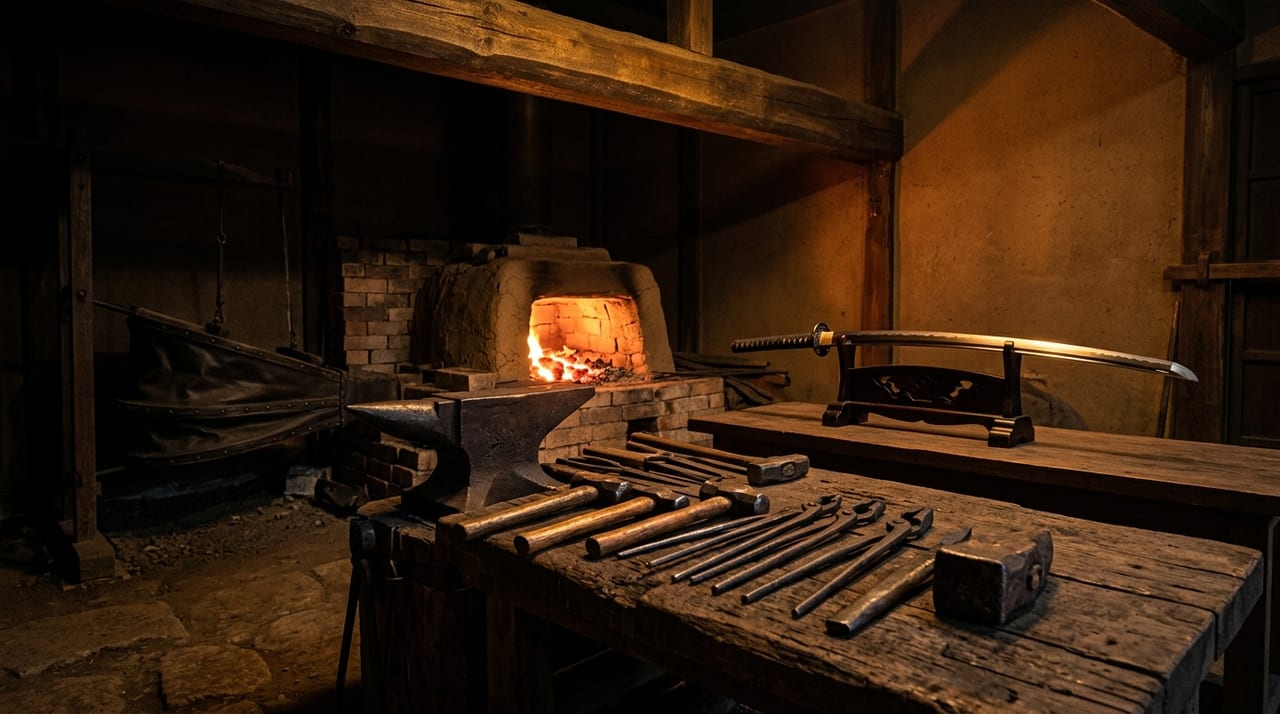 * Image is for illustrative purposes only.
Table of Contents
The Structural Burden of "Solo Establishment" for Tōkō
For a modern tōshō to establish an independent forge, the initial investment required for basic equipment alone — furnaces, fuigo, anvils, and various hammers — runs into several million yen. Furthermore, considering that the number of swords that can be produced is practically limited by the minimum tanren days per blade (15 days or more for tachi, katana, and naginata; 10 days or more for wakizashi, tantō, and similar swords; Aomori Prefecture "Approval for Production of Art Swords" review standards), combined with materials costs and utility expenses, it is extremely difficult for young tōkō to operate independently. In rural areas, cases of "apprentices closing up shop the moment they go independent" have occurred one after another, and this has become one of the causes of the successor problem.
The burden is not limited to equipment costs. Independent establishment also involves non-financial hurdles such as securing a suitable location for the forge, fire and soundproofing considerations, and coordination with neighboring residents. In urban areas, there are simply few properties suitable for a forge, and even in rural areas it is common to search for a suitable location by converting vacant houses or closed workshops. These non-financial burdens are also among the factors that make solo establishment difficult.
The measures attracting attention in recent years as a way to break through this situation are kyōdō kajiba (shared forges) and equipment sharing systems. These are arrangements in which multiple tōkō share furnaces and large equipment, dividing usage costs to keep individual fixed costs down.
Pioneering Examples of Shared Forges: Shimane, Fukuoka, and Gifu
The training forge attached to Shimane Prefecture's "Nittoho tatara" is well known as a pioneering example. Here, young tōkō work on sword production while sharing equipment for a fixed period, splitting the cost of materials and furnace upkeep. It functions as a "training-with-facilities-use" arrangement before independent establishment, and is highly regarded as a model for supporting regional tōkō.
In Fukuoka, a case has emerged where multiple young tōkō established an informal partnership to operate a shared forge converted from an old private residence. Because it is a loose association without legal-entity status, the capital risk is low, and a flexible arrangement in which each member maintains independent accounting while sharing only the facilities is its distinguishing feature.
In Gifu, in the city of Seki, against a backdrop of the concentrated cutlery industry, discussions are underway about developing a "cutlery hub" type of facility in which tōkō and cutlery craftsmen share equipment within the same premises. While forging temperatures and finishing differ between swords and kitchen knives, there is no small amount of technical overlap in furnaces and blowers.
What all three cases have in common is that rather than building a shared forge from scratch, they are based on frameworks already present in the locality — such as existing training programs, industrial clusters, and informal partnerships. The idea of how to combine local resources has become the common key to realizing shared forges.
The Business Model Transformed by Equipment Sharing
The traditional tōkō business model has essentially followed a single path: "leave the master's workshop → establish one's own forge → train a successor through a master-apprentice relationship." Equipment sharing adds another option to this structure.
The concrete economic benefits can be listed as follows. While a furnace has a useful life of 20 to 30 years or more if properly maintained, with sole ownership it is constrained by a single tōkō's annual operating hours. With shared ownership, the utilization rate rises and the amortization period for repair costs can be shortened. The same applies to fuigo and electric blowers.
On the other hand, challenges also exist. The clarification of operational rules is indispensable, covering matters such as coordinating usage times, managing furnace temperature records, and allocating the costs of consumables (bricks and refractory materials). Since tōkō are individual artisans, psychological resistance to entering another person's forge is not entirely absent.
Practical Points to Confirm Before Introducing Shared Use
For tōkō considering joining a shared forge, there are many practical matters that should be settled in advance. The following are representative examples.
- Management method for usage schedules: A system that clearly documents who uses the furnace and when is necessary to avoid overlapping bookings.
- Cost-sharing standards for consumables and repairs: Prior agreement is required on whether the cost of replacing bricks and refractory materials is prorated by frequency of use or split equally.
- Scope of liability in case of accidents or damage: When unforeseen events such as equipment damage or fire occur, it is necessary to clarify who bears responsibility and to what extent.
- Rules for withdrawal and new membership: How to recalculate equipment ownership shares and cost contributions when membership changes is also a matter that should be decided in advance.
These are issues common not only to shared forges but to any arrangement in which multiple businesses share assets, and putting them in writing rather than leaving them as verbal agreements is the fundamental approach to avoiding disputes.
Possibilities for Collaboration with Municipalities and Subsidies
In recent years, activity has been growing to direct subsidies toward equipment development for traditional crafts in the context of regional revitalization. Efforts to attract public funding for shared forge development by utilizing the Agency for Cultural Affairs' "Cultural Arts Promotion Expenses Subsidy" and industrial support subsidies from individual prefectures are on the increase.
The important point is that by applying in the form of "subsidies to the entity developing and operating the shared facility" rather than "subsidies to individual tōkō," multiple tōkō can more readily be recognized as beneficiaries. A composite application scheme involving both the municipal cultural property department and the industrial promotion department is considered effective.
When utilizing subsidies, it is also practically important to classify the target expenses in advance (whether they fall under equipment costs, renovation costs, or operating costs) and to keep spending records in preparation for post-application performance reports. Administrative tasks of this kind, which tend to be burdensome for individual tōkō, become easier to share when a managing entity serves as a single point of contact.
The Limits of Shared Operations and Respect for Individual Artistry
However, nihontō is built upon the cultural premise that "one tōshō takes responsibility for one sword." Even if multiple tōkō use the same furnace at a shared forge, the fact that each is an independent sword-making subject does not change. The mei is something cut by the individual, and responsibility for production cannot be divided.
Equipment sharing is limited to "sharing the space and equipment" and does not mean "sharing the act of production." Keeping this distinction clear is indispensable for ensuring the credibility and legal validity of shared operations.
The same applies in the context of appraisal. Even for swords produced at a shared forge, appraisal and the issuance of a kanteisho are conducted on a work-by-work basis, and whether equipment is shared or not does not affect the evaluation of the work itself. Sharing is purely a rationalization of the production environment and exists in a dimension separate from the value of the work or the skill of the individual.
Challenges for Industry-Wide Adoption and Future Prospects
At present, examples of shared forges are still few, and industry-wide institutional adoption will require the involvement of industry organizations (such as the Zen Nihon Tōken Hozonkai and NBTHK). The next step would be for the industry as a whole to share model cases and develop guidelines and standard contract forms for equipment sharing.
In today's increasingly digital world, shared forges that have experimentally adopted cloud-based equipment reservation management systems are beginning to appear. There are also initiatives to record and share furnace temperature histories with IoT sensors, and technological advances may support institutional shared operations.
In parallel with developing these technical aspects, alignment on operational matters — such as how much information participating tōkō share with one another and how frequently operations are reviewed — is also indispensable. Only when both institution and technology are in place can a shared forge function not as a temporary support measure but as a sustainable management foundation.
How to reconcile the individuality of tōkō with the rational sharing of equipment — this question has become an important issue that will determine the sustainable future of the nihontō industry.