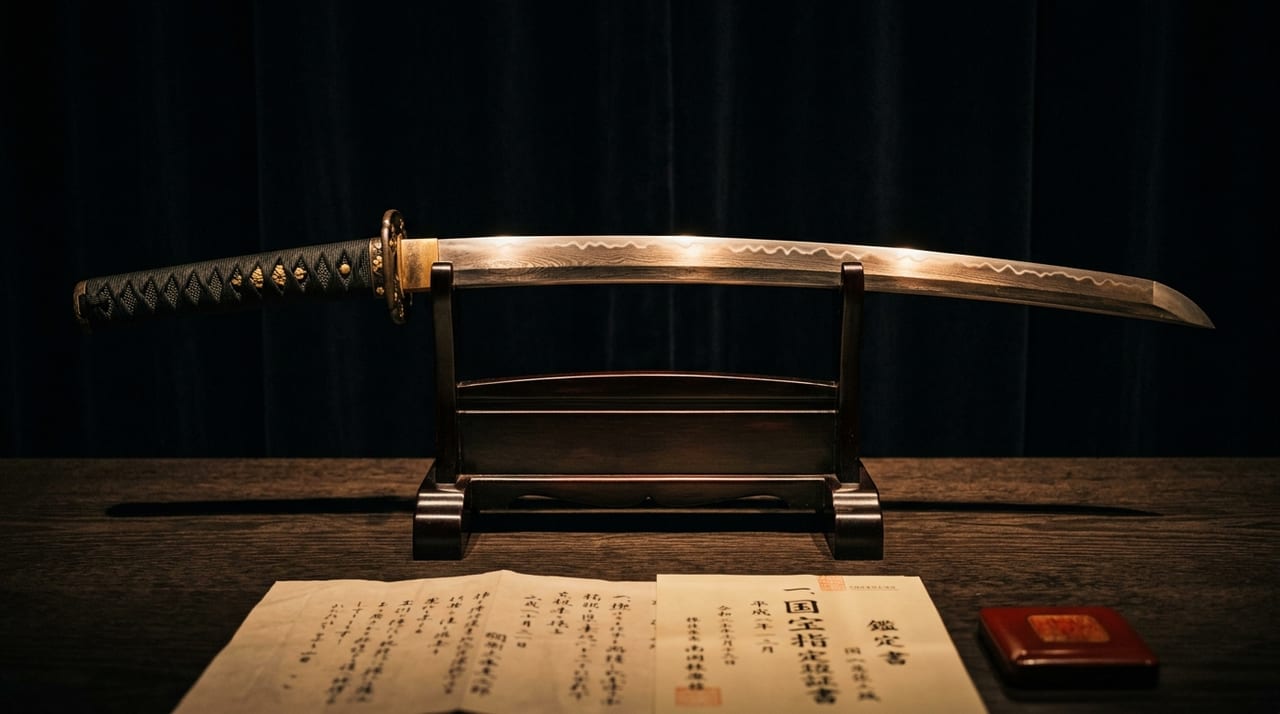
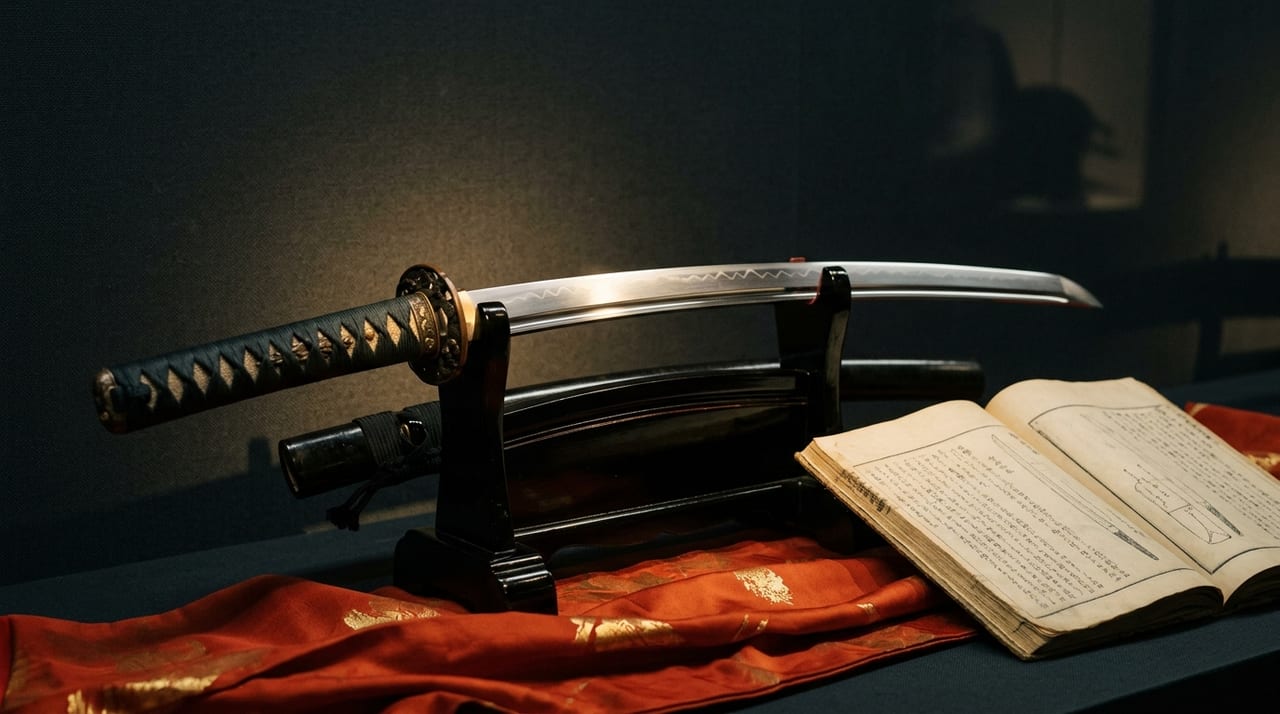
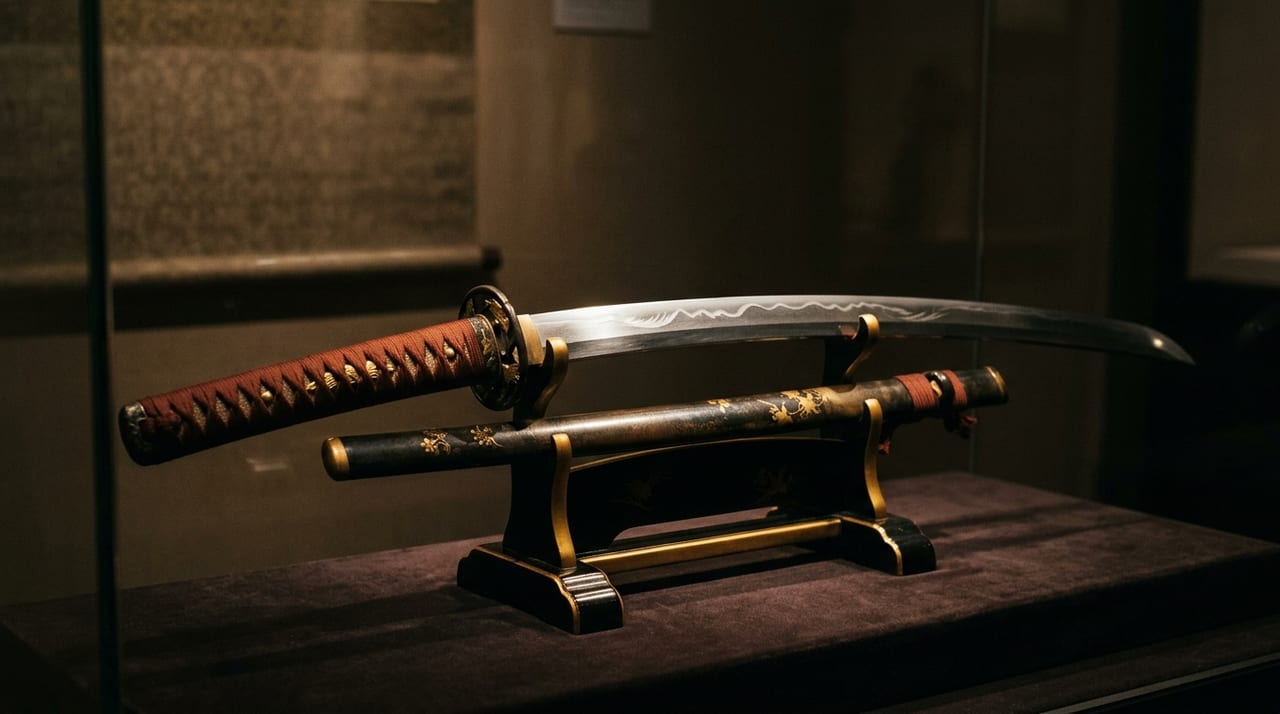
Muromachi Koto Sword Morphology: The Transition to Uchigatana, Changing Width Proportions, and the Bo-hi
 * Image is for illustrative purposes only.
Table of Contents
Muromachi Period Sword Morphology—A Changing Form at the Onin War Divide
The Muromachi period (1336–1573) was an era of significant transformation in Japanese sword morphology. The turning point was the Onin War (1467–1477).
Before Onin (Early to Mid-Muromachi): Continuation of the downscaling trend from the Northern and Southern Courts' "large-scale expansion." Tachi form was the mainstream, with swords functioning primarily as prestigious ceremonial blades of the shogunate and daimyo.
After Onin (Late Muromachi to Sengoku): As warfare intensified, the "uchigatana" (swords worn edge-up) spread rapidly, and the primary wearing style shifted from tachi (worn edge-down, suspended) to uchigatana (worn edge-up, thrust into the belt). The morphology optimized accordingly for this new method of use.
Early Muromachi Sword Form—Characteristics of a Scaled-Down Northern and Southern Courts Style
Tachi from the early Muromachi period (1394–1487, Oei through Bunmei eras) show forms reduced from the grand appearance of the Northern and Southern Courts.
Formal characteristics:
- Blade length: approximately 70–80 cm (either polished down from large Northern and Southern Courts works or originally forged shorter)
- Width at base: 2.8–3.2 cm (reduced from the 3.4–4.0 cm of the Northern and Southern Courts)
- Point: medium to small kissaki (reduced from the large kissaki of the Northern and Southern Courts)
- Curve: medium curvature with a slight tendency toward point-forward curve (approximately 1.5–2.0 cm)
This "scaled-down" sword form is aesthetically described as "restrained" and "well-proportioned," possessing a sense of harmony unique to the Muromachi period, distinct from both the grandeur of Kamakura and the exuberance of the Northern and Southern Courts.
The Progression of Uchigatana—The Reality of Morphological Change
After Onin, as the uchigatana became the primary practical blade, important changes appeared in sword morphology.
Changes in Wearing Style and Morphology
The tachi was worn edge-down, suspended from the waist belt by a "tachi-o" cord. The uchigatana was worn edge-up and thrust directly into the waist belt. This difference in wearing method actually influenced the requirements of sword form.
As an uchigatana, a sword compared to the tachi showed:
- Slightly shorter overall length: blade length of approximately 60–73 cm as the standard (shorter than tachi)
- Slightly shallower curve: approximately 0.8–1.8 cm (since the uchigatana is worn edge-up, a deep waist curve is difficult to wear)
- More uniform ratio of base width to point width: relative to the tachi, the point width is proportionally broader (point width/base width ratio of 70–80%), with a tendency toward uniform blade width
These represent optimization for the uchigatana's distinctive qualities of "ease of handling and swinging."
Changes in the Ridge Line
Accompanying the shift to uchigatana, changes appeared in the blade's cross-sectional form. A transition occurred from the tachi era's "rich flat-sided" form—where the area between the ridge and edge (the flat) was generously rounded—to the uchigatana's "high ridge" form. A high ridge (the blade's ridgeline protruding) increases the transmission efficiency of cutting force while also contributing to blade lightness.
The Establishment of the Bo-Hi—A Groove Culture Developed in the Muromachi Period
When discussing Muromachi period sword morphology, the presence of grooves (hi) is indispensable.
A hi is a groove carved into the ridge field (shinogi-ji: the area between the ridge and the spine) of the blade. The "bo-hi" (a single straight groove on the spine side of the blade)—the simplest form—became widely prevalent in the Muromachi period.
Multiple theories exist regarding the function of grooves:
- Weight reduction: decreasing the amount of metal and thus the weight
- Strength reinforcement: structural reinforcement of the blade (using the same principle as ribs in pillars)
- Wind-cutting sound: producing a "whoosh" sound (hi-ne) when swung, creating psychological and intimidating effects
- Decoration and aesthetics: simply for visual beauty
It is thought that in practice both weight reduction and strength reinforcement served as the primary functional purposes, with decorative significance added as well.
In the Muromachi period, alongside the bo-hi, the "soegi-hi" (fine addition grooves alongside the bo-hi) and "futasumi-hi" (two parallel grooves) also came to be seen.
Mass Production at Bizen Osafune and the Morphology of "Kazuchi" Blades
In the late Muromachi Sengoku period, Bizen Osafune (Okayama) produced swords in large quantities. To meet the massive demand of the sengoku daimyo, "kazuchi" (quantity-produced) swords prioritizing quantity over quality were mass-produced.
Formal characteristics of kazuchi blades:
- Simplification of hamon: rather than complex choji midare, the simpler gunome midare or straight blade were common, making manufacture easier
- Coarse steel: some examples omitted careful repeated forging, resulting in rough itame with "rough skin" appearance
- Simplified tang finishing: some show carelessness in how signatures were inscribed and in spine shaping
- Standardization: unlike individual masterpieces, the form became standardized and uniform
Distinguishing such kazuchi blades from masterworks produced at the same Osafune (works by master smiths such as Nagayoshi, Kanemitsu, and Motoshige) is important in appraisal.
Conclusion—The Morphological Significance of Muromachi Swords
The change in Muromachi period sword morphology corresponds to one of the most important "style transitions" in Japanese sword history—the shift from tachi to uchigatana. This transition was not merely "size reduction" but rather a coordinated change across wearing method, combat style, and social status representation.
The prevalence of the bo-hi, the high-ridge form unique to uchigatana, the relationship of curve to blade width in uchigatana form—by reading these morphological features, important judgments become possible regarding "is this a tachi or uchigatana" and "when in the Muromachi period was this made." These are crucial for period appraisal.
Regarding the regional development of the five major sword schools (gokadenor Gokan Den) underlying this style transition, detailed discussion appears in Muromachi Period and the Establishment of the Five Sword Schools. By examining the transition of sword form against existing examples, the precision of period appraisal continues to improve.