Morphological Features of Early Heian Swords — What Koshi-zori, a Slender Form, and Ko-kissaki Tell Us About the Founding Period Sword Form
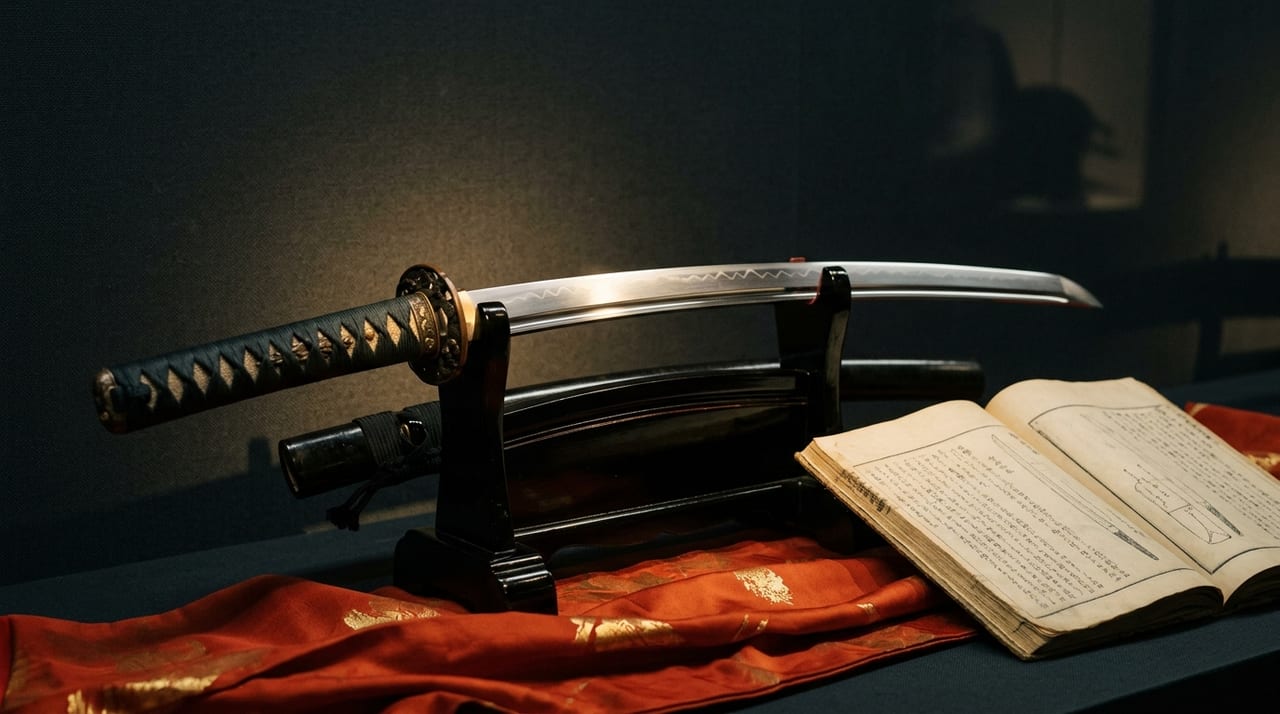 * Image is for illustrative purposes only.
Table of Contents
The Sword Form of the Founding Period — What to Read as "Morphological Features"
When reading the morphological features (sword form) of a nihontō, experts focus on five main elements.
- Sori (curvature): the amount of curvature in the blade and the position of its highest point
- Mihaba (blade width): the ratio of motohaba (the width near the base) to sakihaba (the width at the tip)
- Kasane (blade thickness): the thickness of the blade
- Kissaki (point) shape: the length and form of the tip
- Sori profile (koshi-zori, naka-zori, saki-zori): where the peak of the curvature lies
The early Heian period (794 to the latter half of the 10th century) was precisely the founding period in which the nihontō transitioned from the straight sword (chokutō) to the curved tachi. The sword forms of this era possess a morphological individuality that is clearly distinct from those of later periods.
Koshi-zori — The Characteristic Blade Curvature of the Founding Period
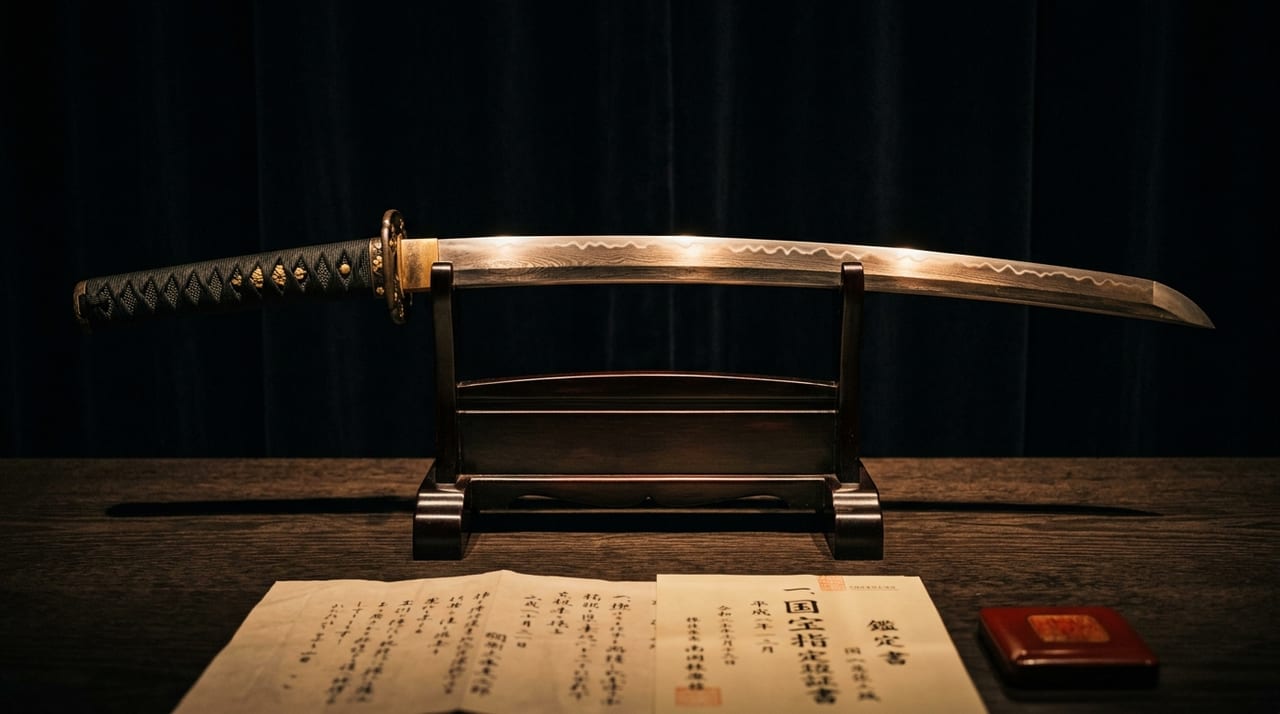
One of the most prominent morphological features of early Heian tachi is koshi-zori.
Koshi-zori refers to a sori whose highest point lies at the base of the blade (the koshi), close to the nakago (tang). It is distinguished from naka-zori, in which the peak of the sori falls near the center of the blade, and saki-zori, in which the sori peaks toward the tip.
Why is koshi-zori so prevalent in early Heian swords? Various theories exist, but the most widely accepted explanation draws on both the stage of development of forging technology and practical requirements.
From the perspective of forging technology, in the early days of steel refinement through orikaeshi tanren (folding), the technical difficulty of curving the entire blade uniformly was high. It is thought that allowing the blade to curve naturally from its base (the koshi) produced a relatively stable sori.
From a practical standpoint, koshi-zori was considered advantageous for drawing the sword on horseback. The tachi was worn suspended at the hip with the edge facing downward (the "tachi wearing method"). When drawing, a blade with koshi-zori could be pulled from the saya (scabbard) along a trajectory less likely to catch on the horse's saddle.
Measurements of extant early Heian tachi (jōkotō or early kotō examples) show that most exhibit koshi-zori with the peak of maximum curvature at approximately 30 to 40 percent of the total length from the nakago.
The Slender Motohaba-to-Sakihaba Ratio — The "Tapering" of the Founding Period Blade
Early Heian tachi are characterized, compared to tachi of the Kamakura period and later, by an overall slender mihaba (blade width) and a large difference between motohaba and sakihaba.
Motohaba is the width near the hamachi (the boundary between the blade and the nakago (tang)); sakihaba is the width just before the yokote (the boundary line between the kissaki (point) and the edge). The smaller the ratio of sakihaba to motohaba — that is, the more strongly the blade narrows toward the tip — the more pronounced the fumigomi, or "tapering," is said to be.
Among early Heian tachi, examples in which the sakihaba is approximately 55 to 65 percent of the motohaba are common. By contrast, mid-Kamakura period tachi tend to show a sakihaba-to-motohaba ratio rising to around 65 to 75 percent.
The influence of continental (Tang) sword styles has been identified as the background behind the emergence of this slender, strongly tapered sword form. Since tōkō (swordsmiths) of the Nara and early Heian periods began from the sword-making techniques and forms transmitted from China and the Korean Peninsula, the interpretation holds that the slender blade shape of the straight-sword era was retained for some time even after the transition to the curved tachi.
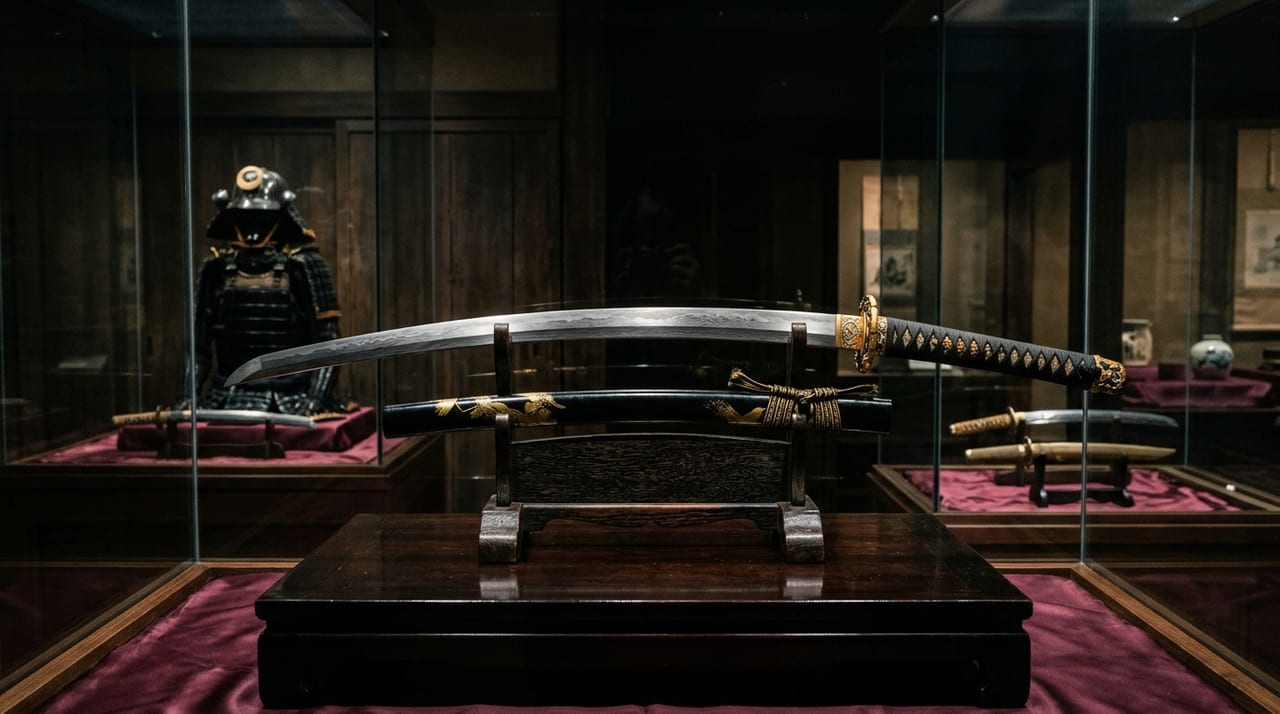
In examples from the Ko-Hōki tradition — one of the oldest extant tachi, held at the Tokyo National Museum (estimated 9th–10th century) — all three features of slender form, koshi-zori, and ko-kissaki can be confirmed.
Ko-kissaki — The Understated Kissaki Form of the Founding Period
The third morphological feature of early Heian tachi is ko-kissaki.
Kissaki (point) refers to the shape of the tip of the sword, and there are several varieties according to size and form. Ko-kissaki is characterized by a relatively short kissaki, with the section continuing from the edge (the kissaki length and fukura length) being understated in form. By contrast, the inokubi-kissaki, which developed in the mid-Kamakura period, is a short, rounded kissaki; from the late Kamakura period through the Nanbokuchō era, the large ō-kissaki developed.
Two reasons are given for the prevalence of ko-kissaki in the early Heian period.
Constraints of forging technology: The tip is subject to intense stress concentration and is one of the most technically demanding parts to forge. In the founding period, when precise shaping of the tip was difficult, a small and understated kissaki may have been the natural form.
Practical characteristics: Ko-kissaki is considered a form that prioritizes cutting strikes (kiri) over thrusting (tsuki). This is consistent with the predominant combat style of the Heian period, which centered on cutting from horseback.
A Period of Coexistence Between Hira-zukuri and Shinogi-zukuri
The early Heian period was also a transitional era in terms of the cross-sectional shape (zukuri) of the blade.
Before the establishment of shinogi-zukuri — the standard form of today's nihontō, in which a ridge called the shinogi (ridge line) runs near the center of the blade's width — examples also existed of hira-zukuri, in which the blade's cross-section is close to triangular and has no shinogi.
Hira-zukuri is used today mainly for tantō and wakizashi, but examples with cross-sections close to hira-zukuri are also found among tachi of the founding period. This too reflects both continental sword influences and the stage of technological development.
Reading the Founding Period Sword Form from Extant Examples
Extant early Heian tachi are exceedingly rare, and most are designated as jūyō bunkazai (Important Cultural Property) or kokuhō (National Treasure) and are held in museums and shrines.
Comparing their measured data, common morphological characteristics emerge: overall length of 75 to 80 cm (blade length of approximately 65 to 72 cm), koshi-zori of approximately 1.5 to 2.0 cm, motohaba of 2.5 to 2.8 cm and sakihaba of 1.4 to 1.8 cm (sakihaba-to-motohaba ratio of 55 to 65 percent), and ko-kissaki.
Compared to swords of later periods, these features give an impression of being "delicate, with the curvature concentrated toward the base," but they are considered to have been a necessary form suited to the forging technology of the founding period and the combat styles of the time.
Conclusion — The Influence of the Founding Period Sword Form on Later Eras
The prototype sword form of koshi-zori, slender mihaba, and ko-kissaki established in the early Heian period became the foundation on which improvements and developments were built in later eras. In the Kamakura period, morphological changes occurred in which the motohaba broadened and the kissaki became the inokubi-kissaki; in the Nanbokuchō era, swords became larger; and in the Muromachi period, they were reduced in size and made more practical — all of these transitions can be understood in contrast to the early Heian prototype.
In the period authentication of nihontō, the morphological features of the sword form are among the most important criteria. Knowing what form the founding period sword took leads to an understanding of the "reference point" from which the transitions of later eras can be read.
For the koshirae (mounting) of Heian period tachi, reading The Structure and History of Hantachi Koshirae alongside this article will help clarify the relationship between sword form and fittings.