The Hizukuri Process: The Core Smithing Technique That Gives a Nihontō Its Form
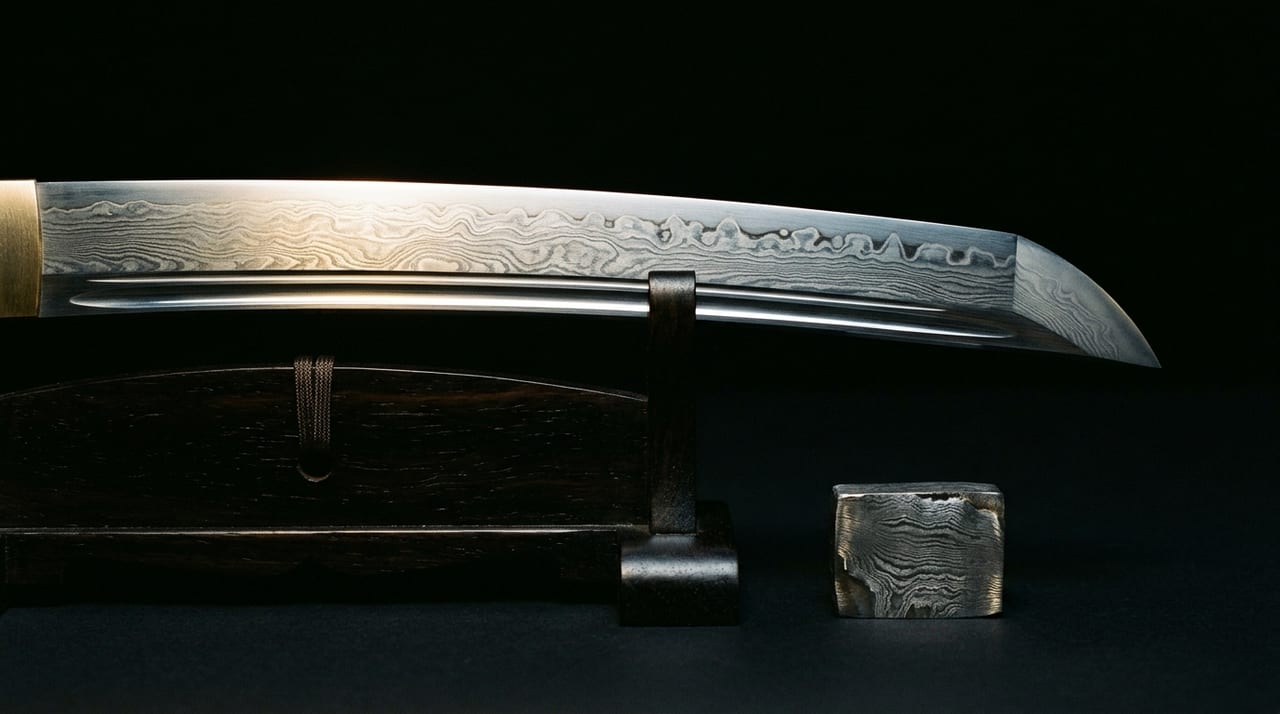 * Image is for illustrative purposes only.
Table of Contents
What Is Hizukuri: The Process of Giving Form After Orikaeshi Tanren
The mass of steel that has had its impurities removed and its steel structure homogenized through orikaeshi tanren (folding) does not yet have the form of a blade. Hizukuri is the general term for the process of heating this steel mass in a furnace and hammering it into the shape of a sword. If orikaeshi tanren is the process that determines the "quality" of the material, then hizukuri can be said to be the process that determines the "form (sugata)" of the sword.
Hizukuri is not merely a task of shaping form. The direction of striking, the amount of force applied, and control of heating temperature determine everything from the sori (curvature) and width of the blade to the thickness distribution, center of gravity, and flex characteristics. Much of a sword's cutting ability, ease of handling, and durability depends on the skill of hizukuri. It is in the hizukuri process that the swordsmith's ability is most directly tested.
Sunobe: Drawing Out the Steel Mass Into the Form of a Blade
The first stage of hizukuri is sunobe. The steel mass that has completed the assembly process is reheated in the furnace, and in its red-hot state it is drawn out lengthwise using a large hammer (otsuchi). At this stage, while keeping the finished form of the sword in mind, the aim is to roughly shape the length and cross-sectional form of the material.
What is important in sunobe is the management of heating temperature. If temperature management goes wrong, the following risks arise.
- If overheated ("yakisugi"): the crystals of the steel coarsen and brittleness increases
- If the temperature is too low: the deformation resistance of the steel increases, raising the risk of cracking from hammer blows
The optimal striking temperature is roughly in the range of 900 to 1,200°C, and the smith judges this empirically from the color of the flame (dark red through orange through yellow). Even modern tōkō (swordsmiths) fundamentally judge temperature by eye, and it takes several years to acquire this intuitive skill.
During sunobe, the tōkō (swordsmith) does not simply draw out the steel but applies hammer blows that are mindful of the steel's cross-sectional form. Because a nihontō has a distinctive cross-sectional form called shinogi-zukuri — a diamond-shaped cross-section with a ridge line (shinogi-suji) running along the center of the blade — deformation that is mindful of the thickness ratio between the edge side and the mune (back of the blade) side is applied from this stage onward.
Muneuchi and Hatori: Precise Shaping of the Cross-Sectional Form
Once the rough length has been secured in sunobe, the process moves to precisely shaping the cross-sectional form through muneuchi and hatori. Muneuchi is the work of hammering the mune (back) side of the blade into a square shape, while hatori is the work of thinly drawing out the edge (cutting edge) side to create the blade form.
These two processes are carried out by alternating them repeatedly. When the mune is struck, the steel flows toward the edge side; when the edge is struck, the steel is pushed back toward the mune side. While maintaining the balance of this "push and pull," a uniform distribution of thickness across the full length is achieved. To give each part — from edge to mune, from kissaki (point) to nakago (tang) — the appropriate thickness and width, it is necessary to repeatedly rework each area while rotating the blade.
At this stage, a skilled tōkō (swordsmith) designs the form with an eye toward the final result after polishing and after yaki-ire (quenching). In the yaki-ire (quenching) process the sori (curvature) changes (the edge side contracts and the curvature increases), and in the polishing process the cutting edge becomes thinner. Calculating these amounts of change in advance, the mastery required is to intentionally create "reverse curvature" and a "thicker cutting edge" at the hizukuri stage.
Soridashi: The Hammer Technique for Controlling the Sori of the Blade
The characteristic bow-like sori (curvature) of a nihontō has both elements that occur naturally and elements that are made intentionally. First, as a physical principle, because the volume change on the edge side and the mune (back of the blade) side differ during yaki-ire (quenching), the steel tends to curve toward the edge side. By hammering out this phenomenon in the reverse direction at the sunobe stage, the amount of sori in the finished product can be controlled.
The technique of drawing out the sori (curvature) in hizukuri is called uchizori, and it is the operation of placing the edge side against an anvil (daigane) while the blade is heated in the furnace and hammering up the mune side into an arc. How much uchizori to apply differs according to the type of steel used, the form of the assembly, and the target amount of sori in the finished piece, and it requires technical judgment unique to the individual smith.
Sori (curvature) is not merely an aesthetic feature but has functional meaning. Appropriate sori facilitates drawing cuts during a slash and optimizes the contact angle between the blade and the object, enhancing cutting ability. Excessive sori leads to a decrease in blade strength and worsening of operability, while too shallow a sori restricts thrusting movements. The ideal amount of sori has also changed in accordance with changes in era, school, and combat style, and this has given rise to the diversity of nihontō sugata (form) in each era.
Sakimarume and the Formation of the Kissaki
Once the form of the blade has taken shape, the kissaki (point) at the tip is formed. The kissaki is not simply a pointed shape but has a distinctive form delineated by a clear boundary line called the yokote, with the kissaki face (kissakimen) and the cutting edge joined at a precise angle.
The formation of the kissaki is a part of hizukuri that requires particularly advanced skill. The character of the sword changes greatly depending on the "size," "roundness," and "angle of the kissaki."
| Type of Kissaki | Characteristics |
|---|---|
| Okissaki (large kissaki) | Superior thrusting capability and cutting range |
| Kokissaki (small kissaki) | Suited to precise handling and thrusting |
The imposing okissaki of the ōdachi of the Nanbokuchō period and the delicate kokissaki of the kodachi of the peaceful Edo era clearly reflect the differences in historical background and the demands on a weapon.
Particularly careful temperature management is required when striking the kissaki. Because the tip has little steel and a small heat capacity, the temperature drops quickly after it is removed from the furnace. If the blade is forced into shape when the temperature has dropped too far, cracks form, so the shape is refined little by little while repeating small reheating steps. Some tōkō (swordsmiths) describe the process of drawing out the kissaki as "the moment of creating the sword's face," and this conveys its importance and difficulty.
The Individuality of the Sword Determined by Hizukuri: Where the Smith's Hand Leaves Its Mark
The blade that has passed through the hizukuri process still has a rough surface, but its "skeleton" and "form" have already been determined. The blade at this stage is called the kiji (base), or shirotanya, and the processes of tsuchioki (applying the clay coating), yaki-ire (quenching), and polishing that follow do not greatly alter the form and structure of this kiji.
It is hizukuri that determines the one-of-a-kind individuality of that sword. Countless factors such as the following combine to give birth to a kiji whose form will never be the same twice.
- The smith's build
- Strength of force
- Dominant-hand habits
- The condition of the furnace on that day
- The weight of the hammer used
Much of the reason why nihontō are said to have "individuality" and "a face" derives from the subtle differences that arise in this hizukuri process. For further details, please feel free to contact us via the inquiry form.