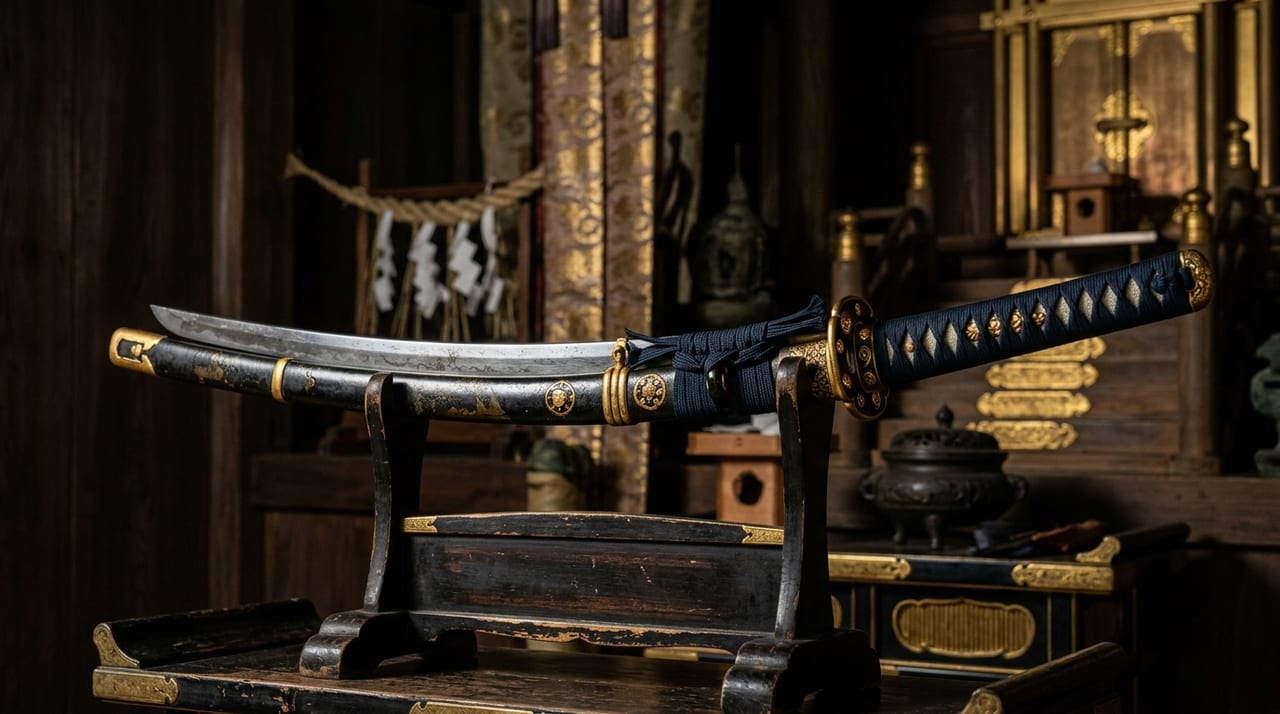
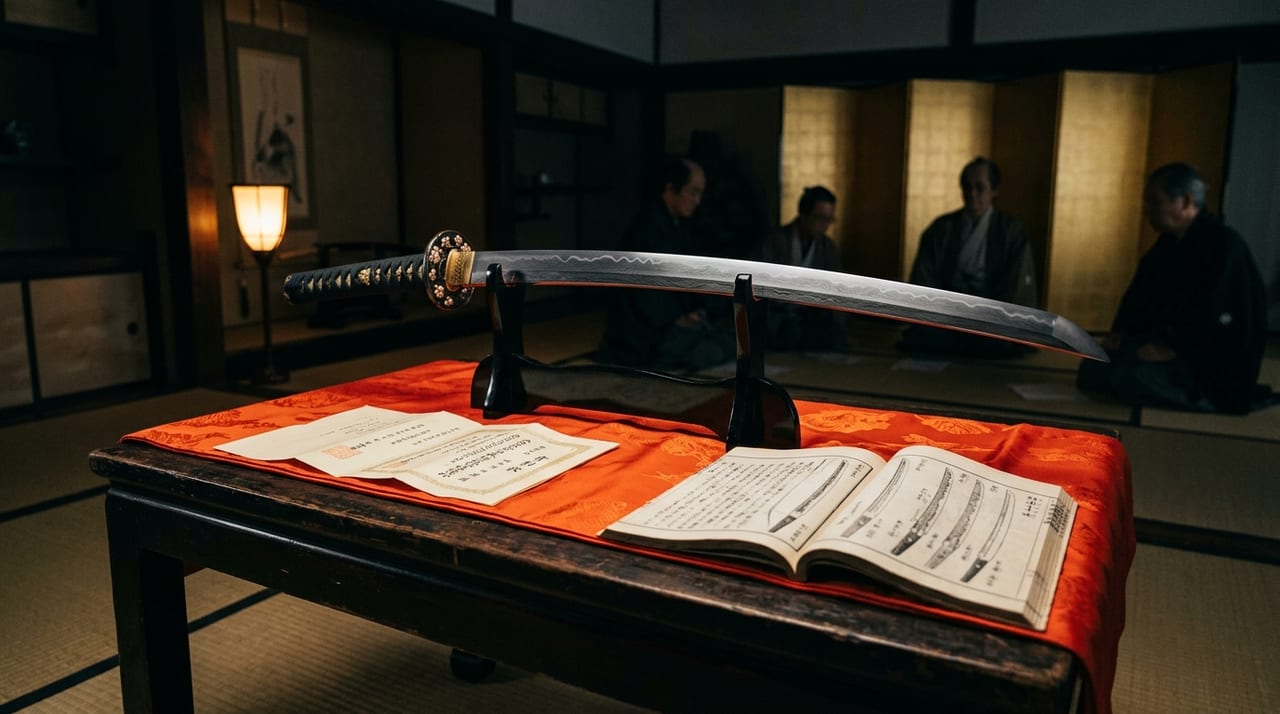
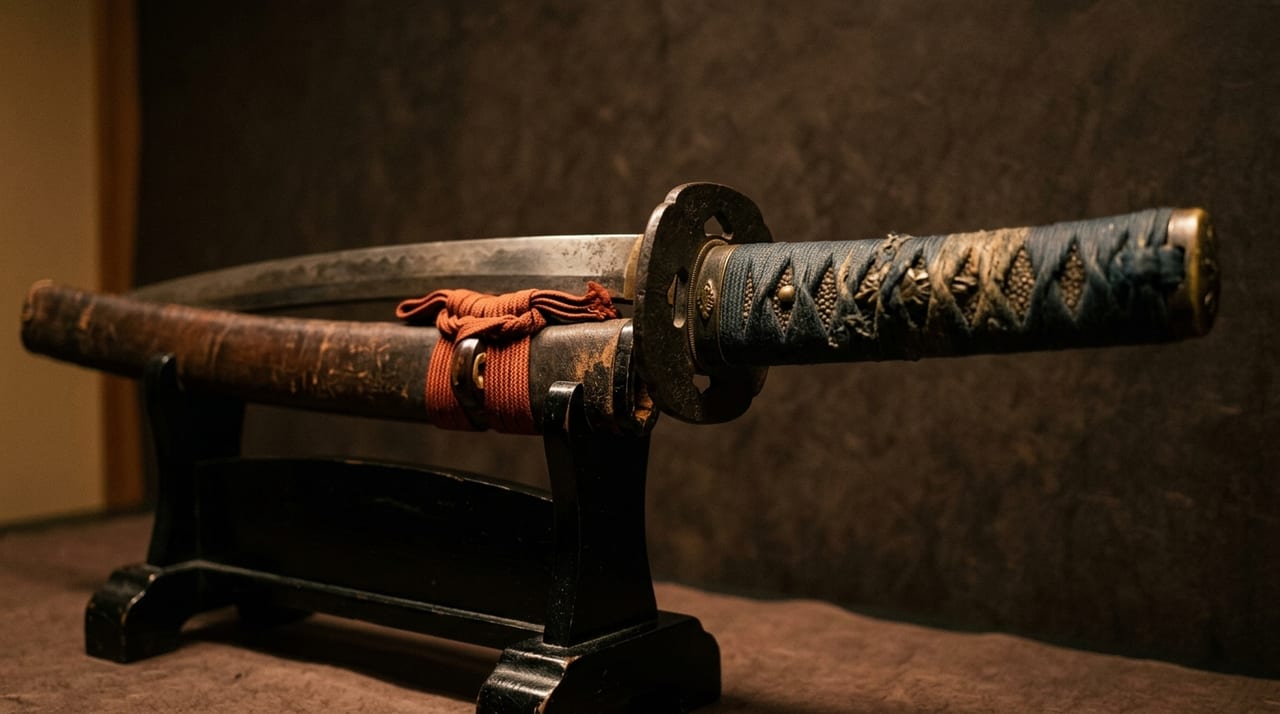
Morphological Characteristics of Kamakura-Period Swords — The Tachi of a Warrior Government as Expressed by the Inokubi-kissaki, Robust Proportions, and Nie-deki
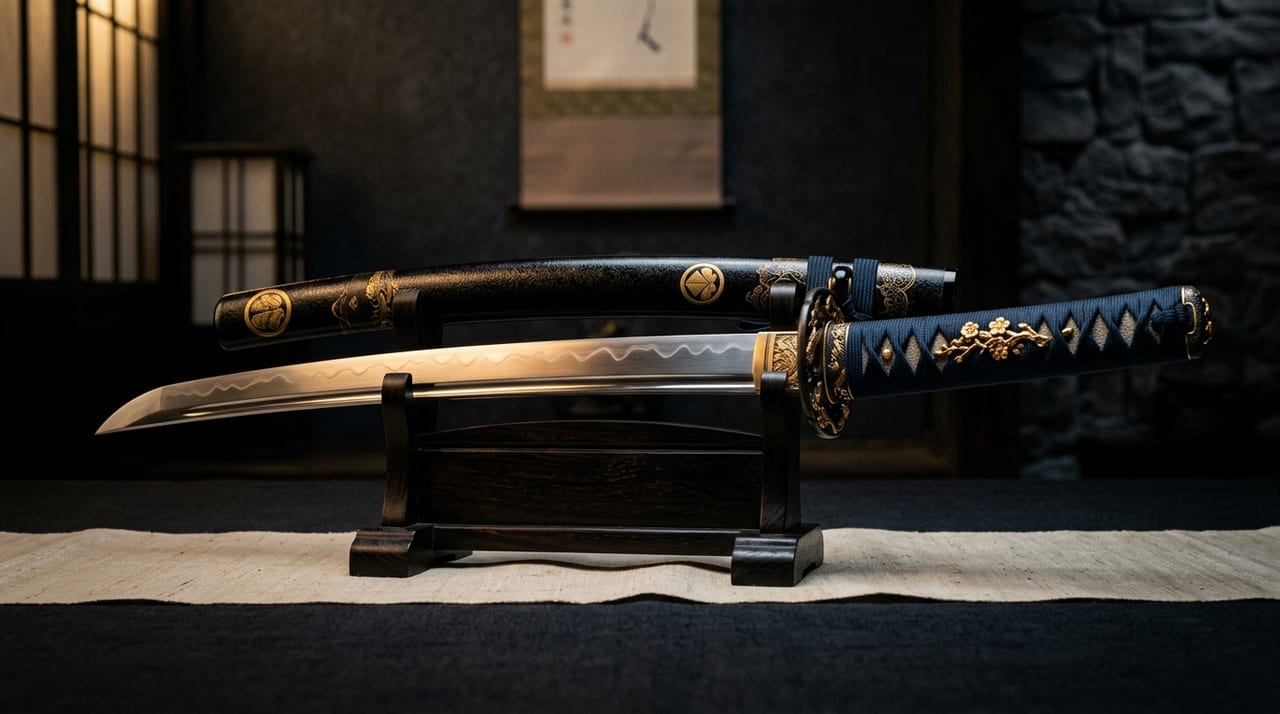 * Image is for illustrative purposes only.
Table of Contents
"Reading" a Kamakura Sword — A Perspective on Morphological Attribution
There is a conventional wisdom that "Kamakura swords are powerful." Yet few people understand this in terms of concrete morphological data on sword shape. Precisely grasping the morphological characteristics of Kamakura swords is the foundation of period attribution — the estimation of when a given sword was made.
The morphology of swords from the Kamakura period (1185–1333) can be understood in three broad phases:
- Early Kamakura (c. 1185–1250): a transitional period inheriting the style of the late Heian period while the mihaba widened
- Middle Kamakura (c. 1250–1300): establishment of the inokubi-kissaki and robust proportions
- Late Kamakura (1300–1333): morphological changes reflecting shifts in tactics after the Mongol invasions (1274 and 1281)
The Form of Early Kamakura Swords — Breaking from the Heian Style
Tachi from immediately after the founding of the Kamakura shogunate (late 12th–early 13th century) largely inherit the style of the late Heian period. Against the backdrop of the rise of warrior rule, demand for swords expanded in both quantity and quality, and changes began to appear in their form as well.
The most striking change is the widening of motohaba and sakihaba. What had been approximately 2.5–2.8 cm in motohaba during the early Heian period widened to approximately 2.8–3.2 cm in the early Kamakura period. This reflects a shift in the emphasis of sword use from "decorative status markers" to "weapons for actual combat."
Koshi-zori remained the mainstream sori, though there was a tendency to draw somewhat closer to naka-zori compared to the Heian period. In terms of overall length, blades centered on a cutting-edge length of around 75 cm grew larger in pursuit of practicality.
The Form of Middle Kamakura Swords — Establishment of the "Inokubi-kissaki"
The middle Kamakura period (mid-13th century) is one of the most important turning points in the morphological history of the Japanese sword. It was during this period that the "inokubi-kissaki" became established.
The inokubi-kissaki is a kissaki with a relatively short length and a compact, powerful sakihaba. The fukura (the rounded belly of the kissaki) tends to be somewhat flat, and the name derives from the characteristic of being "short and compact like a boar's neck." Larger than the modest ko-kissaki of the Heian period yet not as elongated as the ō-kissaki of the Nanbokuchō period — it is a moderate shape distinctive to the middle Kamakura period.
As a practical reason for the development of the inokubi-kissaki, one can point to the need to balance the durability and cutting performance of the kissaki in the "kisha (mounted archery)" and slashing strikes that were the primary combat tactics of Kamakura warriors. Because sufficient thickness is secured in the kissaki, it is resistant to breakage and can withstand the impact of a cutting blow.
The mihaba expanded to approximately 3.0–3.4 cm in motohaba, and the robust taihai became established. Motokasane (motokasane: the thickness of the blade near the ha-machi) also reached approximately 0.7–0.9 cm, and the sturdy construction stands out.
Sori in the Kamakura Period — The Shift from Koshi-zori to Naka-zori
From the middle Kamakura period onward, the sori of the blade gradually shifted to naka-zori — sori in which the peak of the curve lies near the center of the blade.
The shift from koshi-zori to naka-zori is linked to changes in the actions of drawing and striking from horseback in mounted combat. Koshi-zori is said to be advantageous for the motion of drawing from the saya, while naka-zori is considered superior for transmitting force during a striking blow. Here one can see the process by which, as battlefield experience accumulated, forms that enhanced combat efficiency were selected.
Sori depth of approximately 1.8–2.5 cm is typical of the middle period — deeper than the early Heian period (1.5–2.0 cm) and deeper than the later uchigatana (0.5–1.8 cm). "Deep sori" is a defining characteristic of the tachi (the large long sword).
Morphological Differences by Tradition — Contrasting Forms of the Bizen-den, Yamashiro-den, and Sōshū-den
During the Kamakura period, groups of tōkō from the Gokaden (five traditions) — Bizen, Yamashiro, Yamato, Sōshū, and Mino — were active, and there are morphological differences in their characteristics by place of production.
Bizen-den (Okayama): The motohaba is on the wider side and the difference from the sakihaba is relatively small (sakihaba-to-motohaba ratio: 65–72%), with a pronounced inokubi-kissaki. The jigane is primarily itame, with a lustrous quality known as "Bizen-hada." The hamon is typically chōji-midare.
Yamashiro-den (Kyoto): Slimmer and more refined than Bizen. The sakihaba-to-motohaba ratio of 60–68% shows a somewhat stronger taper than Bizen. The jigane is ko-itame, with a refined quality known as "Yamashiro-hada." The hamon is often suguha or ko-midare.
Sōshū-den (Kanagawa): Developed at the heart of the Kamakura shogunate, the Sōshū-den is characterized by the most "robust" construction, with both mihaba and kasane fully developed. It is distinguished by a rough jigane mixing ō-itame and ō-mokume, and a hamon rich in deep nie.
These differences by place of production are not mere matters of taste; they are interesting for reflecting the social background in which each group of tōkō was situated — whether directly attached to the shogunate, close to the court aristocracy, or rooted in regional warrior bands.
Nie-deki and Nioi-deki — Hamon Characteristics of Kamakura Swords
In examining the hamon, nie and nioi are important concepts.
Nie: a state in which the steel crystals (martensite) that gleam within the yakiba are visible in a coarse, distinct manner. They glitter like sparks. A sword of "nie-deki" has these in abundance.
Nioi: a state in which nie gather in extremely fine, uniform clusters and glow softly like mist. A sword of "nioi-deki" is characterized predominantly by this.
Swords of the middle-to-late Kamakura period, particularly those of the Sōshū-den, are characterized by "nie-deki." The Bizen-den is primarily "nioi-deki," while the Yamashiro-den often exhibits the intermediate "nie-nioi" between the two.
This difference is thought to be primarily due to differences in production methods (temperature control during yaki-ire and variations in tsuchioki), making it an important indicator for place-of-production attribution.
Late Kamakura — The Impact of the Mongol Invasions on Sword Form
The Mongol invasions — the Battle of Bun'ei (1274) and the Battle of Kōan (1281) — are said to have influenced Japanese tactics and weapons demand, but careful assessment is needed regarding their impact on sword morphology.
There is a theory that battlefield experience in the Mongol invasions increased demand for "a tip strong against thrusting," which is sometimes cited as leading to changes in the kissaki after the late Kamakura period (a tendency toward a somewhat larger and more pointed kissaki). However, this interpretation is divided among sword researchers, and there is persistent caution against attributing the primary cause of morphological change to the Mongol invasions.
What is clear is that over the course of the late Kamakura period (from the Kenchō through Shōwa eras), the kissaki shape was shifting from the inokubi toward the chū-kissaki direction. This became the groundwork for the transition to the ō-kissaki of the Nanbokuchō period.
Conclusion — The Essence of Warrior Culture Expressed in the Form of Kamakura Swords
The tachi of the Kamakura period most directly embody the influence that the establishment of warrior rule had on sword culture. The wide motohaba and robust proportions, the practical beauty of the inokubi-kissaki, the hamon rich in nie — these morphological characteristics are the product of an era in which battlefield experience and the advancement of swordsmithing technique coincided.
In contemporary sword appraisal, these morphological characteristics serve as the most critical criteria for determining "whether a sword is Kamakura period or not." Grasping Kamakura swords as measurable morphological data rather than merely as impressions of being "old" or "classical" forms the foundation of a reliable appraiser's eye.