Edo Shinto Blade Morphology: From Keicho Robust Forms to Horeki Restrained Elegance
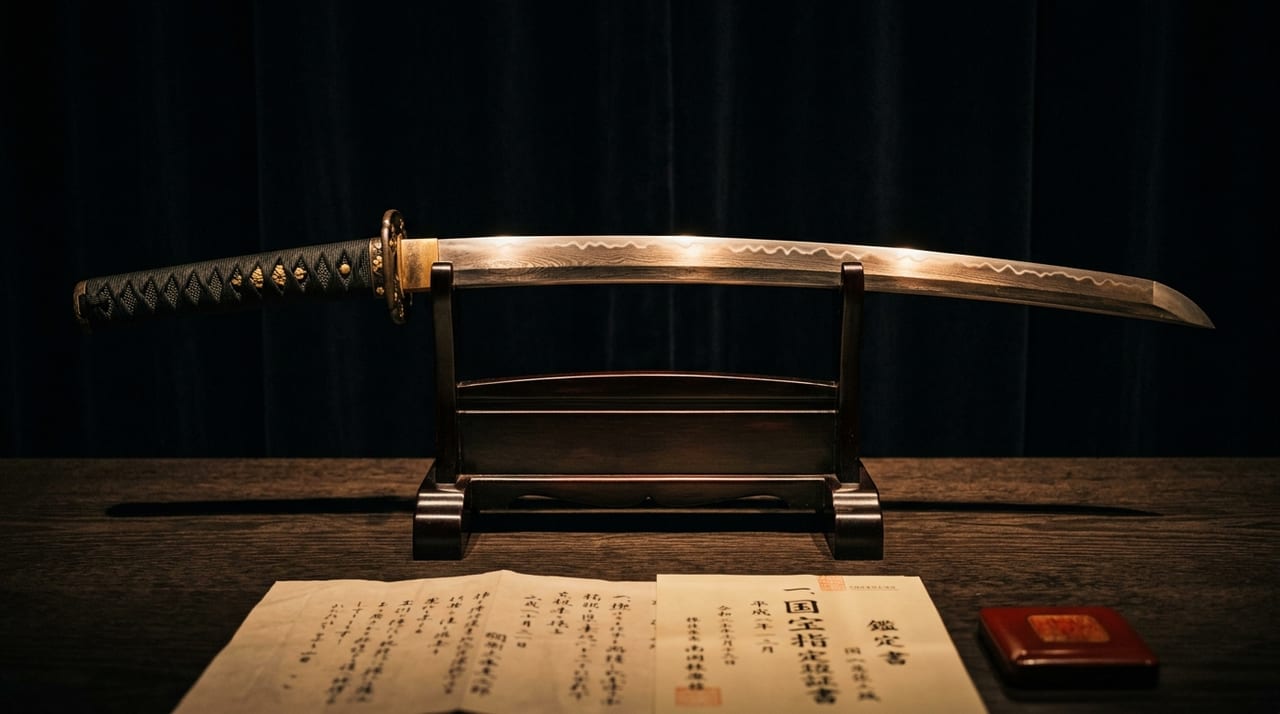 * Image is for illustrative purposes only.
Table of Contents
What is Shintō (New Swords) — Premise of Morphological Analysis
"Shintō (new swords)" is a term used in Japanese sword history to distinguish swords made after the Bunroku-Keichō era (1590s) from "Kotō (old swords)." It primarily refers to swords made throughout the entire Edo period (1603–1868), though in a broader sense it also includes works from the Toyotomi regime period onward.
Shintō and Kotō differ significantly in forging methods, the texture of the metal, and the tendency of blade patterns, but morphology (form) also represents an important historical transition as a period classifier. This is the theme of this essay.
When organizing the morphological transitions of Edo shintō, it is helpful to divide them into the following three periods:
- Keichō–Kan'ei period (ca. 1596–1643): Majestic forms of the early shintō period
- Jōō–Hōei period (ca. 1652–1710): Majestic and broad forms of the Genroku cultural period
- Shōtoku–Meiwa period (ca. 1711–1771): Establishment of "shimari-sugata" (compact form) after the Hōreki period
Let us examine the transitions of these three periods together with morphological data.
Shintō Form of the Keichō–Kan'ei Period — Grandeur of the Early Period
The shintō swords of the Keichō–Kan'ei years (ca. 1596–1643) often possessed practical forms that continued from the late kotō period. This was an era when lasting peace had not yet been fully established, and practical demands on swords still remained.
Morphological characteristics:
- Width at the base: Approximately 3.0–3.4 cm, relatively broad
- Width at point/width at base ratio: Approximately 70–76%
- Point shape: Medium to somewhat large kissaki (point length approximately 1.5–2.0 cm)
- Curve: 0.8–1.5 cm, mostly medium curve
- Thickness: Relatively full thickness at the base (approximately 0.7–0.85 cm)
Representative sword makers of this period include Horikawa Kunihiro of Sōshū, Iga-no-kami Kinmichi, and Nagasone Okisato (Kotetsu). The form of Keichō shintō possesses transitional characteristics where the composure of kotō and the bright metal texture specific to shintō (niwa-kana jigane) coexist.
Shintō Form of the Genroku–Hōei Period — Peak of Grandeur
The Genroku era (1688–1703) was the flourishing period of "Genroku culture," and this cultural efflorescence is reflected in the morphology of swords.
The morphology of shintō during this period:
- Width at the base: Expanded to approximately 3.2–3.6 cm (broader than the Keichō period)
- Width at point/width at base ratio: 72–80% (broad point, giving a "tensioned" appearance)
- Point shape: Medium to somewhat large kissaki tendency (point length approximately 1.8–2.5 cm)
- Curve: Approximately 0.9–1.6 cm, medium curve
- Flat side: Rich flatness on the cross-section (rounded thickness), giving an impression of "fleshy bulk"
This is the characteristic known as "Genroku form," giving an impression of "grand, broad, with tension toward the point."
Representative sword makers of this period include Sukehiro (2nd generation, Kanbun–Tenna period) of Osaka and Shinkai (Inoue Shinkai, son of Izumi-no-kami Kunisada and representative master of Osaka shintō). The works of these makers, famous as synonymous with Osaka shintō, embody the grandiose form of the Genroku era.
Shintō Form of the Shōtoku–Meiwa Period — Transition to "Shimari-Sugata"
Entering the 18th century, during the Shōtoku–Hōreki–Meiwa years (ca. 1711–1771), the form of shintō changed to what is called "shimari-sugata" (compact form).
Morphological characteristics of "shimari-sugata":
- Reduction in base width: Approximately 2.8–3.1 cm (reduced from the 3.2–3.6 cm of the Genroku period)
- Decrease in width at point/width at base ratio: 65–72% (return of the tendency to taper toward the point)
- Reduction in point size: Small to medium kissaki (point length approximately 1.2–1.8 cm)
- Curve: Approximately 0.7–1.2 cm, somewhat shallow
- Thinning of thickness: Base thickness approximately 0.65–0.75 cm, relatively thin
Overall, it gives an impression of being "slender with elegance," "possessing balanced beauty." It lacks ostentation, but this was an age where precise forging and the quality of blade patterns were valued.
Representative sword makers of this period include Ōmi-daijō Tadahiro and Izumi-no-kami Kunisada. It should be noted that Echizen-no-kami Sukehiro (1st generation) was a sword maker of the Kanbun–Tenna period (ca. 1661–1682), which differs in era from the "shimari-sugata" period after Shōtoku.
Morphological Differences by Production Region — Edo, Osaka, and Kyoto
Even within the same shintō period, there are differences in morphological tendencies depending on the place of manufacture (production region).
Edo (Musashi) school: Sword makers of Edo, which developed in the lap of the Tokugawa shogunate, tend to favor forms that are overall "practical and well-balanced." The width at base and width at point ratio are balanced, with moderate curve. The kissaki is most often medium.
Osaka (Settsu) school: As a commercial city, Osaka possessed a rich culture, and its sword makers responded to the demands of wealthy merchants and daimyo. The representative production region of the broad, fleshy, and grandiose form of the Genroku period. In particular, the Osaka shintō of Sukehiro and Shinkai established a unique aesthetic.
Kyoto (Yamashiro and Ōmi) school: Kyoto sword makers, following the tradition of the Yamashiro school from the kotō period, tend to favor relatively slender and refined forms. They emphasize precise metal texture and blade pattern, characterized by a "refined, slender" morphology.
Changes in Hamachi-Kado — Fine Morphological Details of the Shintō Period
As a fine morphological indicator for distinguishing shintō from kotō, there is the "hamachi-kado" (angle of the hamachi edge).
The hamachi refers to the notch on the edge side at the boundary between the blade and the tang (nakago). Whereas in kotō the angle of the hamachi (hamachi-kado) is often a "gentle" rounded shape, from the shintō period onward, there is a tendency for the hamachi-kado to change to a "sharp, nearly perpendicular" shape.
This is related to changes in quenching technology (the range of quenching, the method of soil placement), and researchers pay attention to it as a subtle indicator for distinguishing between kotō and shintō.
Summary — What the Transitions in Edo Shintō Form Tell Us
The transitions in shintō form—from the grandeur of Keichō to the broad, fleshy form of Genroku to the compact form of Hōreki—faithfully reflect the changes in Edo society.
From actual combat to decoration and art. From a practical item for samurai to a spiritual symbol and art object of the warrior class. This change appears in sword form. The broad form of the Genroku period is an expression of cultural prosperity and confidence, while the compact form after Hōreki is a product of an "age of research and refinement."
In shintō authentication, when determining the era, these morphological transitions—particularly the measured data of base width, point width, point length, and curve—become the most reliable objective indicators. The technique of reading era from form is the most basic of basics in Japanese sword authentication.