The Metallurgy Behind Jihada — How Itame, Mokume, and Ayasugi Patterns Form
 * Image is for illustrative purposes only.
Table of Contents
What is Jigane? — The True Face of Steel Revealed Through Polishing
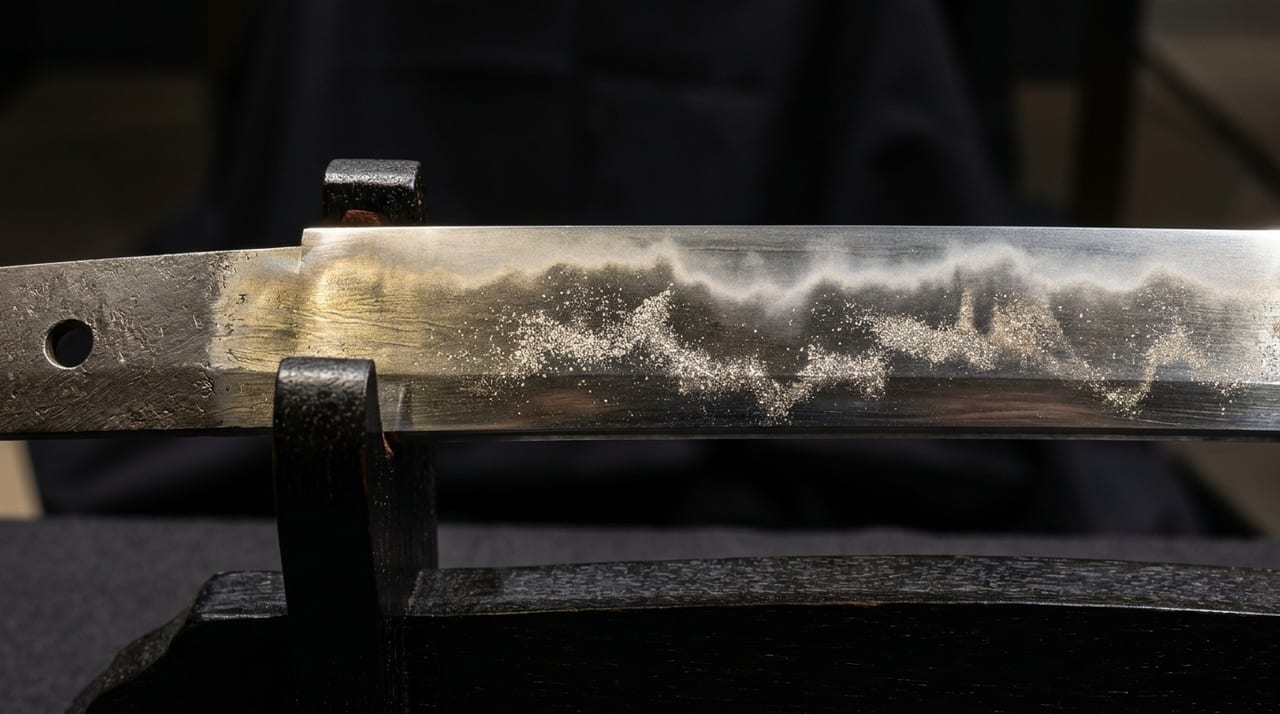
On the surface of a Japanese sword's blade, particularly in the area closer to the spine than the hamon, spreads a surface pattern called "jigane." This is created when the blade's surface is polished, causing the internal structure of the steel — layers of crystal structure created through forging — to be exposed on the surface. Jigane is not merely a surface pattern; it is a "record book of forging" where the complete history of folding and forging repeated hundreds of times is etched into the blade.
The saying "you can determine the province from the jigane" is well-known among appraisers, because jigane faithfully reflects the origin, school, and era. Good jigane has aesthetic value and also serves as a direct indicator of the swordsmith's skill and the quality of materials used. Modern sword researchers emphasize the observation of jigane as one of the first elements to examine in authentication.
Primary Jigane Surface Patterns and Their Characteristics
Itame
The most commonly seen surface pattern, characterized by irregular striations similar to the "itame" pattern in wood grain. It is a typical result of folding and forging techniques and is frequently seen in Bizen, Soshu, and Mino traditions. Itame is subdivided into categories such as "nagareitame" (flowing itame), "midareitame" (irregular itame), and "ooitame" (large itame) depending on the direction and density of the flow. The smoothness of the flow indicates the precision of temperature control during forging, and those with minimal disturbance and uniform flow demonstrate higher technical mastery.
Mokume (木目)
This skin pattern features finer node-like patterns more densely packed than itame, with its name derived from wood grain patterns. It is particularly common in Yamato tradition blades and demonstrates the accumulation of delicate folding and forging. Skin with densely packed fine mokume tends to form through repeated forging at high temperatures for short periods, serving as evidence of progressive homogenization of the steel.
Mokume (杢目)
This surface pattern resembles the complex fibrous patterns that appear near tree knots, and sometimes displays spiral or radial patterns. It is frequently seen in works of the Yamashiro tradition, particularly in pieces by the Rai and Awataguchi schools, and results from delicate and complex forging techniques. Fine mokume is considered evidence of the most advanced folding and forging techniques and has been highly valued since ancient times.
Ayasugi Hada
An extremely distinctive surface pattern characterized by regularly intersecting diagonal striations similar to cedar wood grain. It is the defining characteristic of Gassan school blades, to the point that "ayasugi hada = Gassan school" is not an overstatement. Its formation requires a unique forging technique — "ayasugi kitae" — which intentionally combines folding in diagonal directions. This technique was inherited by Living National Treasure Gassan Sadakazu (second generation) and his son Gassan Sadatoshi, and continues to be reproduced in modern swords.
Masame and Nagarehada
Masame, frequently seen in some Yamato tradition blades and northern school swords, is an orderly surface pattern with parallel striations running like the masame pattern in wood. It indicates that the folding direction is consistently aligned. In contrast, nagarehada displays striations as if the steel's structure flows strongly in one direction, seen in works of the Satsuma and Naminohira schools. It is often found in pieces said to use continental iron (nanban-tetsu) as material, with the flow characteristics of the material directly reflected in the surface pattern.
Metallurgical Formation Mechanism
Why do so many diverse surface patterns emerge? The answer lies in the metallurgical understanding of the forging process.
In the manufacture of Japanese swords using tamahagane as the raw material, multiple steel types with different carbon contents are first combined and repeatedly folded and forged. During this process, the steel forms a structure of many stacked layers, with subtle differences in carbon concentration, crystal phase, and grain size between each layer. In the final polishing stage, when polishing abrasives and plant-derived acids (rice bran and whetstone mud) are applied to the blade's surface, these different phases are selectively corroded and reflect light, becoming visualized as surface patterns.
The specific mechanisms include:
- Contrast from Carbon Concentration Differences: High-carbon areas (pearlite structure) appear dark, while low-carbon areas (ferrite structure) appear bright. This distribution pattern of light and dark forms the foundation of the surface patterns.
- Effect of Crystal Grain Size: Forging at high temperatures for short periods results in fine crystal grains (fine mokume or mokume), while low temperatures over longer periods produce coarser grains (large itame). Differences in grain size change how light scatters, directly determining the fineness of the patterns.
- Folding Direction and Layer Orientation: The direction and number of folds determine the orientation of the layers. Regular unidirectional folding produces masame, while irregular multidirectional folding produces itame and mokume. Ayasugi hada is a special pattern that emerges only through intentional combination of diagonal folding.
- Precise Temperature Control During Forging: If the temperature deviates from the appropriate range of approximately 1200–1300°C, the layer structure deteriorates and uniform patterns fail to develop. Skilled smiths judge the temperature visually from the forge's color (white-hot, orange, or red) and create the ideal layer structure.
Appreciation of Jigane — Controlling Light and Viewing Angles
To properly read jigane, appropriate lighting and observation technique are essential.
The recommended environment is soft natural light coming through a window on a clear day, or high-quality LED spotlights with high color rendering (Ra95 or higher). With fluorescent or indirect lighting, fine details of jigane become obscured and are difficult to distinguish. During observation, slowly tilt the blade while varying the angle at which light strikes it, and check for pattern changes across different areas: near the spine, near the edge, at the base (moto), and at the point (saki). Even on the same blade, the density and type of surface pattern can vary by location.
The main points of appreciation and evaluation are as follows:
- Fineness and Density: Densely packed fine mokume or mokume is evidence of advanced technique. Coarse itame can indicate issues with materials or the number of folding cycles.
- Uniformity: The more uniform the surface pattern is across the entire blade, the more stable the forging process was, raising the quality assessment.
- Jinie: Fine bright points that shine on the jigane, traces of structural changes during hardening (martensitic transformation). Blades with fine and evenly distributed jinie receive the highest-level appraisals.
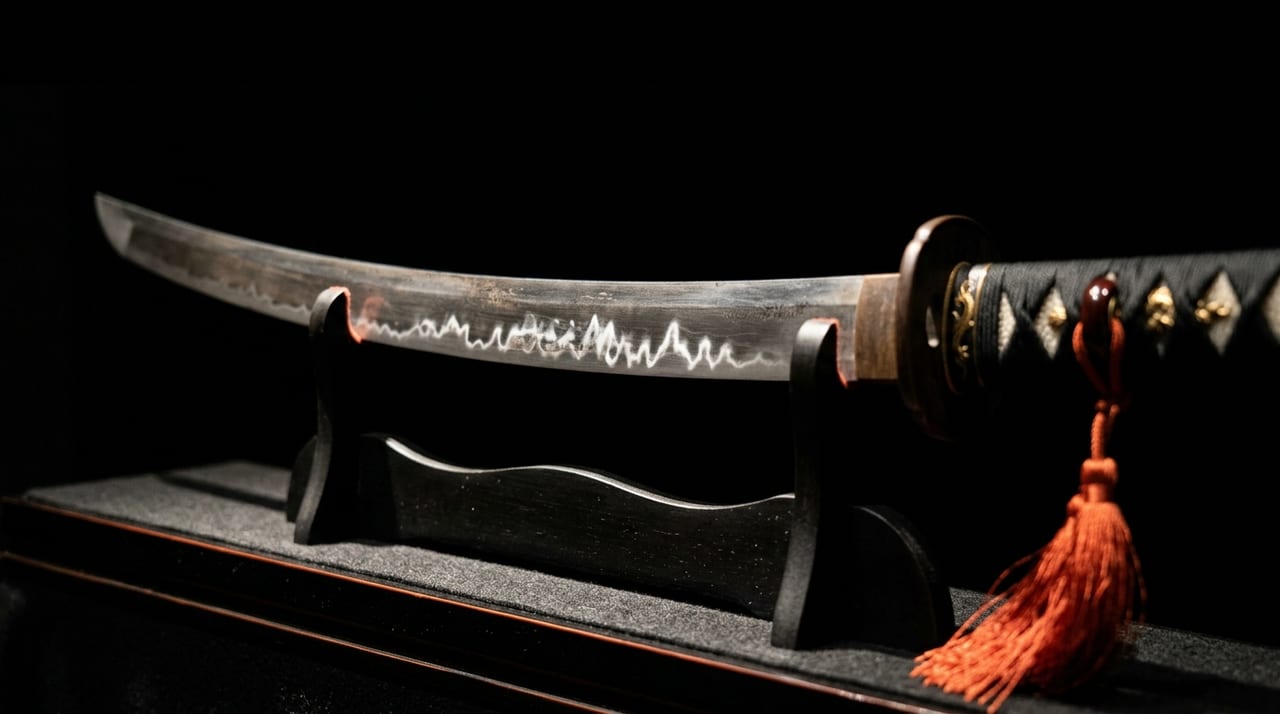
- Chikei: Fine bright lines that appear near the boundary between the hamon and jigane. Blades with abundant chikei receive high jigane evaluations and are frequently seen in superior examples of Soshu and Yamashiro traditions.
Jigane Characteristics by School and Province
| School/Province | Typical Jigane | Notes |
|---|---|---|
| Yamashiro (Rai, Awataguchi) | Fine mokume, small itame | Uniform and fine jinie |
| Yamato | Mokume, masame | Characterized by orderly vertical striations |
| Bizen | Large itame, itame | Flowing itame mixed with disturbance |
| Soshu | Itame with large particles of nie | Abundant chikei, brilliant nie |
| Mino | Flowing itame | Sharp flow with strong directionality |
| Gassan School | Ayasugi hada | Most distinctive surface pattern |
| Satsuma, Naminohira | Nagarehada | Attributed to the use of nanban-tetsu |
Conclusion — The Ability to Read Jigane Cultivates the Appraiser's Eye
The jigane surface pattern is a visual crystallization of the entire process: which materials the swordsmith selected, how many times the steel was folded, and at what temperature it was forged. Jigane not only serves as important evidence for provenance authentication but also contains information directly connected to quality assessment, estimated production era, and authenticity appraisal.
The ability to appreciate jigane is refined only through repeated viewing of actual examples. Actively participating in sword exhibitions at museums and art museums, as well as sword appreciation gatherings in various regions, and accumulating experience encountering authentic examples from diverse provinces, eras, and schools is essential. Once one can discern subtle differences in surface patterns, it becomes apparent how distinctly the technical characteristics of each school stand out, even when discussing "Japanese swords" in general. Cultivating the eye to read jigane is a shortcut to approaching the core of sword authentication.