Formation Mechanisms of Nie and Nioi: Understanding Blade Pattern Beauty Through Martensitic Transformation in Metal Structure
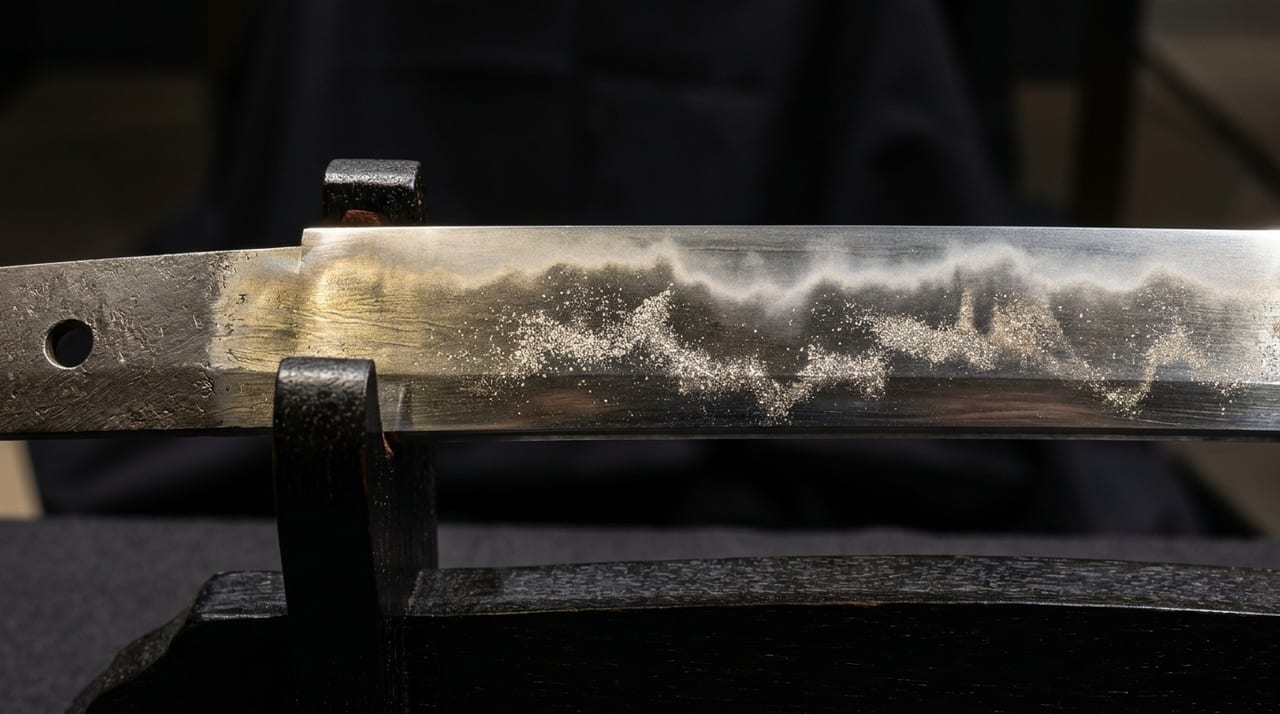 * Image is for illustrative purposes only.
Table of Contents
Nie and Nioi—The Two Cardinal Elements of Japanese Sword Blade Patterns
The most essential concepts when appreciating a Japanese sword's blade pattern are "nie" (肉眼で確認できる粒状の輝き) and "nioi" (におい). These two terms describe the differences in microscopic structures that compose the blade pattern and are indispensable knowledge for evaluating a sword's artistic value.
Nie (沸): Granular sparkle visible to the naked eye. Particles that shimmer like sand grains. Observable without magnification.
Nioi (匂): A misty, diffuse boundary that glows like fog. Particles are too fine to be individually visible; instead recognized as an overall "band of light."
Why does a blade pattern born from the same quenching process display two types of appearance—granular (nie) and misty (nioi)? Modern metallurgical science provides the answer to this fundamental question.
Foundations of Quenching—What is Martensitic Transformation?
Understanding blade pattern formation requires knowledge of "martensitic transformation," the change in metal microstructure.
Basic Changes in Steel Microstructure
When steel (iron containing carbon) is heated to high temperatures (800–900°C or above), the iron's crystal structure transforms into "austenite." This austenite can hold most of the carbon as a solid solution.
When cooled rapidly from this high-temperature state (such as by immersion in water), carbon has no time to precipitate out. Instead, it transforms into "martensite," a structure with carbon trapped inside. Martensite is extremely hard (among the hardest steel microstructures), but simultaneously brittle.
The blade pattern in a Japanese sword appears as the boundary line where "martensite has formed."
The Formation Mechanism of Nie—The Sparkle Produced by Coarse Martensite
How does nie (granular sparkle) form?
The Relationship Between Cooling Rate and Crystal Grain Size
When the quenching (rapid cooling) rate is "comparatively slower," there are relatively fewer nucleation sites for martensitic transformation, allowing individual martensite crystal grains time to grow larger. These large martensite crystals become visible to the naked eye as "nie."
Larger grain sizes result in:
- Visibility to the naked eye
- Greater "variation in reflection angles" when light strikes them, producing a glittering sparkle
- Observation as "ara-nie" (coarse nie) with large particles
Temperature Conditions and Nie Quality
High-carbon steel + somewhat lower quenching temperature: Conditions that favor formation of large martensite grains and coarse nie. The strong nie seen in the Soshu tradition (Masamune, Sadamune) results from this mechanism.
Quenching water temperature: Cold water (winter) causes excessively rapid cooling, tending to produce smaller martensite particles. Warm water (summer) results in somewhat gentler quenching, making nie more likely to appear.
The Formation Mechanism of Nioi—The Diffuse Light Produced by Fine-Grained Martensite
Nioi (misty light) appears under conditions opposite to nie—when martensite crystal grains are extremely fine.
Conditions for Fine-Grain Formation
Very rapid cooling or higher quenching temperatures create numerous nucleation sites for martensitic transformation, resulting in smaller individual crystal grains. These fine martensite particles:
- Cannot be individually confirmed by the naked eye (0.1mm or smaller)
- Appear collectively as a "light-scattering band"—this is nioi
The "Bizen nioi-deki" (Bizen style nioi pattern): The nioi-deki favored by swordsmiths of Bizen Province (Okayama) is produced when fine martensite particles form uniformly, creating a blade pattern that glows softly and diffusely like mist. The traditional Bizen quenching water temperature (from the Yoshii River) and temperature management are believed to have promoted this fine-grain formation.
Intermediate States of Nie and Nioi—The Continuity of "Nie-deki" and "Nioi-deki"
Nie and nioi are not binary opposites but form a continuous spectrum:
| State | Grain Size | Appearance | Representative School |
|---|---|---|---|
| Ara-nie (rough nie) | Large (>0.5mm approx.) | Coarse, grainy sparkle | Soshu tradition, vigorous works |
| Nie (standard) | Medium (0.1–0.5mm approx.) | Sand-grain sparkle | Soshu, Yamashiro |
| Ko-nie (fine nie) | Small (0.05–0.1mm approx.) | Fine sparkle | Yamashiro tradition, Shinshinto |
| Nioi | Minute (<0.05mm approx.) | Diffuse light | Bizen tradition |
| Deep nioi | Extremely minute | Mist-like radiance | Ichimonji, early Masamune |
Formation Mechanisms of Chikei and Kinkusuji
In addition to blade patterns, "chikei" (ground pattern) and "kinkusuji" (golden line pattern) observed on the ji (field) of the sword are also related to metal microstructure:
Chikei (地景): The boundary portions of steel layers formed through repeated folding and forging, which become visible through quenching and polishing processes. Appears as dark flowing lines. The movement and density of chikei are one standard for evaluating the ground structure.
Kinkusuji (金筋): Like chikei, traces of repeated folding and forging, but appearing as gleaming thin lines under specific conditions. Metallurgically a variant of chikei, sometimes interpreted as pure iron (low-carbon) layers becoming exposed.
Dialogue Between Modern Metallurgy and Swordmaking Technology
Modern materials science and metallurgical researchers have conducted detailed studies on the blade pattern formation mechanisms of Japanese swords.
Research by the Japan Institute of Metals: In the 1980s–90s, research groups at the Japan Institute of Metals conducted detailed microstructural analysis of Japanese sword cross-sections, scientifically documenting martensite organization and quenching traces in blade pattern areas.
Knowledge Exchange with Swordsmiths: As scientific analysis has progressed, the empirical knowledge of swordsmiths (craftspeople) has often aligned with scientific explanations. This has attracted attention as an example where "ancient rules of experience are backed up by modern science."
Practical Observation Methods for Blade Pattern Appreciation
Observing conditions for properly appreciating nie and nioi:
- Light source: Natural light (outdoor north-facing light) or fluorescent lighting. Direct sunlight creates excessive reflection.
- Observation distance: 30–50cm. Too close prevents seeing the whole pattern; too far obscures details.
- Light angle: Illuminate the blade from a 15–30 degree angle. The appearance of nie and nioi changes dramatically depending on angle.
- Magnification: When examining fine nie and nioi details, use a magnifying glass (5–10x magnification).
Conclusion—Science Reveals the Truth Behind "Craftsman's Intuition"
Understanding the formation mechanisms of nie and nioi explains why swordsmiths obsess over "today's quenching water temperature," "furnace temperature," and "depth of clay application." All these parameters determine martensite grain size—in other words, the quality of nie and nioi.
The intuition honed through a thousand years of experience is actually a rational operational procedure that modern materials science later came to explain. This discovery proves that the Japanese sword is simultaneously a work of art and a tangible practice of precision materials engineering.