The Physics of Sori — How Residual Stress, Martensitic Transformation, and Differential Cooling Rates in the Blade-Forging Process Produce the Curve of the Nihontō
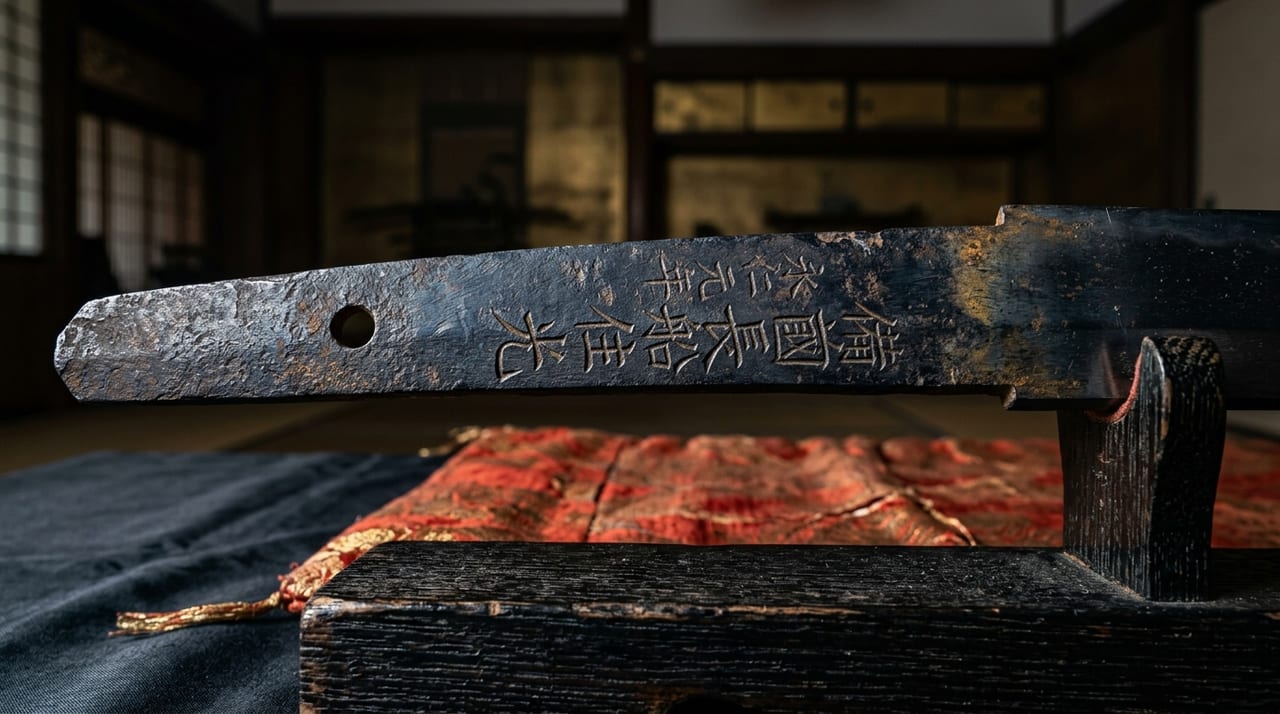 * Image is for illustrative purposes only.
Table of Contents
How Does the Sori of the Nihontō Arise?
One of the most striking features of the nihontō is the beautiful curve traced along the blade — the sori. This sori is not merely a design choice but an inevitable product of metallurgical physics in the blade-forging process. In the heat-treatment process of yaki-ire, the edge and the mune (the back of the blade) cool at different rates, and the difference in volumetric change generates internal stress that bends the entire blade — understanding this phenomenon is nothing less than approaching the very essence of nihontō craftsmanship.
This article explains the mechanism by which sori arises in the nihontō from a metallurgical-physics perspective, and discusses how the tōshō controls this phenomenon to produce a blade of the intended form.
Phase Transformation in Steel — What Is Martensite?
To understand the sori of the nihontō, one must first grasp some basic knowledge of "phase transformation" in steel.
Steel, composed of iron (Fe) and carbon (C), undergoes changes in crystal structure (phase) depending on temperature. At high temperatures (approximately 723°C and above), the steel forms a phase called austenite, in which carbon is uniformly dissolved into the iron crystal lattice. When cooled rapidly (quenched) from this state, the carbon has no time to be expelled from the crystal lattice and the steel transforms into the crystal structure known as martensite, in which the carbon is trapped within the lattice.
Martensite is significantly harder than ordinary iron (ferrite) or pearlite (approximately 600–800 HV on the Vickers scale), and is the microstructure essential for keeping the nihontō's edge sharp. What is important here is the physical fact that the volume of iron expands by approximately 4% during martensitic transformation.
The Temperature Differential Between the Edge and the Mune During Yaki-ire
In the yaki-ire process of the nihontō, a clay coating (tsuchi — a mixture of clay, whetstone powder, charcoal, and other substances) is applied to the blade, which is then heated in a furnace and plunged into water for quenching. At this point, the cooling rate varies depending on the part of the blade.
The edge, where the clay is applied thinly (or not at all), drops sharply in temperature the moment it contacts the water, and martensitic transformation proceeds preferentially. The mune, coated with a thick layer of clay, cools more slowly and undergoes only a more gradual transformation (to pearlite, bainite, or similar microstructures).
This difference in cooling rate produces two important outcomes. First, the edge expands in volume due to its transformation to martensite. Second, the mune undergoes only a gradual transformation and therefore experiences no volumetric change comparable to that of the edge. It is this asymmetry that is the source of the sori.
Residual Stress and the Mechanism by Which Sori Develops
The difference between the volumetric expansion of the edge and the change in the mune generates residual stress within the blade. Specifically, the force of the edge trying to expand and the force of the mune trying to restrain it are in opposition, and as a result the entire blade curves like a bow.
In the immediate aftermath of yaki-ire, the blade is often plunged into water edge-downward, and at this stage a phenomenon may sometimes be observed in which the blade first bends toward the edge side (becoming convex on the edge side). However, once cooling is complete and the volumetric increase from martensitic transformation at the edge stabilizes, the sori characteristic of the nihontō is finally established, with the mune side convex and the edge side concave.
The Tōshō's Control of Sori
The tōshō exploits this physical phenomenon and controls a variety of factors with precision in order to produce a blade of the intended sori (form).
- Tsuchioki (applying the clay coating) most directly determines the sori. Applying the clay thinly on the edge and thickly on the mune creates the differential in cooling rate. The composition, thickness, and distribution pattern of the clay are each tōshō's proprietary secret, and designing the hamon and planning the sori simultaneously constitutes an advanced skill.
- Heating temperature and soaking time also affect the magnitude of the sori. Heating the entire blade uniformly to the austenitizing temperature is ideal, but in a long blade temperature variation between different parts is prone to occur. The uniformity of this temperature distribution determines the symmetry of the sori.
- Water temperature and the method of plunging the blade are factors that determine the cooling rate. The lower the water temperature, the faster the cooling and the more martensitic transformation is promoted. Furthermore, the angle, speed, and depth at which the blade is inserted into the water subtly vary the differential cooling rate across the different parts of the blade.
The Aesthetics of Sori and Form — Where Physics and Beauty Intersect
The sori of the nihontō, while arising from physical necessity, is also a formal feature laden with cultural and aesthetic significance. The koshi-zori of the Kamakura period, the naka-zori of the Nanbokuchō period, the "standard form close to naka-zori" of the Edo period — the preferred quantity, position, and shape of the sori has shifted from era to era, and this has become an important element in the connoisseurship and evaluation of a blade's sugata (form).
The tōshō adjusts the amount of sori in the blade beforehand in its rough-forged state before yaki-ire, aiming for the final form while anticipating the deformation that will occur after quenching. This is a skill that rests on an intuitive mastery of metallurgical physics, and can be said to be the moment in which the tōshō's experience and sensibility are concentrated. When one understands the mechanism of sori formation scientifically, it becomes all the more clear that the craft of making the nihontō is not merely artisanal skill but a sophisticated intellectual and technical endeavor that adroitly manipulates physical phenomena.