Rikkoku Gohon: The Historical Hierarchy of Sword-Producing Regions and Material Quality Established in Late Heian Japan
 * Image is for illustrative purposes only.
Table of Contents
What is Rikkoku Gohon? — The Primordial Standard for Japanese Sword Quality Evaluation
"Rikkoku Gohon" (Six Provinces, Five Materials) is a hierarchical system of quality evaluation regarding the production regions, materials, and forging methods of Japanese swords, said to have been established during the late Heian period through the early Kamakura period. This concept occupies an important position in sword appraisal culture, and it remains a profound subject of ongoing debate in modern sword research concerning its formation period and content.
"Rikkoku" (Six Provinces) refers to six official provinces (kokushi) that were regarded as particularly excellent sword-producing regions. Generally, six provinces are cited: Yamashiro, Yamato, Bizen, Sagami, Mino, and Echizen, though depending on the historical source, Satsuma may be listed in place of Sagami, so the enumerated provinces are not necessarily fixed. "Gohon" (Five Materials) is said to represent a hierarchy of sword materials, but the specific content is poorly documented in classical texts and is more often conveyed through later appraisal documents and oral traditions.
The Composition of Rikkoku — Why These Six Production Regions Were Chosen
Each of the six provinces selected as Rikkoku had geographical and technical foundations that fostered excellent sword-making culture.
| Province | Major Schools/Swordsmiths | Characteristics |
|---|---|---|
| Yamashiro Province (Kyoto) | Awataguchi-ha, Sanjō-ha, Rai-ha | Centered on the imperial court culture of Heian-kyō, it flourished as a sword supplier to the nobility, warrior clans, and temples. Its style is characterized by refinement and elegance. |
| Yamato Province (Nara) | Tegai, Senjuin, Taima, Hōshō, Shikkake (The Five Yamato Schools) | An ancient sword-producing center where many swordsmith communities were connected to major shrines and temples. It produced numerous practical swords of solid craftsmanship. |
| Bizen Province (Present-day Eastern Okayama) | Swordsmiths centered on Osafune | Known as Japan's largest sword-producing region. The abundant iron sand, charcoal, and water in the Yoshiigawa basin drainage were ideal for forging, and a major industry developed. The Bizen tradition's characteristic choji-midare (clove-pattern) blade is highly valued worldwide even in modern times. |
| Sagami Province (Kanagawa) | Yukimitsu, Masamune, Sadamune, and others (Founders of the Sōshū tradition) | Positioned at the center of the shogunate's warrior government as the seat of the Kamakura shogunate. The Sōshū tradition, characterized by vigorous itame (wood-grain) steel and a strong nie-laden blade pattern, exerted profound influence on subsequent sword production. |
| Mino Province (Gifu) | Swordsmiths centered on Seki | A production center that rose to prominence during the Muromachi period, supplying practical swords in large quantities. Its forging methods emphasizing repeated folding and its bright, brilliant blade patterns are characteristic, and it was widely favored by warring states daimyo. |
| Echizen Province (Fukui) | Echizen Yasutsugu and others | A relatively new production center among the Six Provinces, yet it established a high position as an official shogunate swordsmith. |
The Concept of Gohon — The Hierarchy of Material Quality
The concept of "Gohon" is even more ambiguous than "Rikkoku," and a definitive definition is difficult to establish. It is believed that iron sand production regions known for producing high-quality tamahagane (crucible steel) — such as those from iron-sand washing in the Chugoku Mountains — occupied the higher ranks, with lower-quality iron placed in lower ranks. The specific content of the five materials varies by source, and various classifications exist, including tamahagane, pig iron, knife iron, and nanban iron (European iron).
The quality of materials was valued from ancient times as an element directly linked to the final performance of a sword. Tamahagane is said to produce steel easily that does not break or bend easily because it has little variation in carbon content and few impurities. Meanwhile, techniques combining iron of different properties, such as pig iron and nanban iron, were developed in various regions, and are believed to have been used interchangeably according to the experience and intuition of each swordsmith. The skill or lack thereof in material selection is thought to have influenced the stylistic differences among production regions.
Rikkoku Gohon and the Demand Structure of Samurai Society
Why did a regional hierarchy become so consciously recognized? Behind this lay the fact that swords were not mere weapons, but rather symbolic objects representing a samurai's social status and family rank. When influential warrior clans and temples concentrated orders on specific production regions and swordsmiths, the evaluation of those regions rose further, creating a structure in which demand and evaluation mutually reinforced each other.
Furthermore, the climate, soil quality, and water conditions that differed by region are believed to have affected the properties of iron sand and charcoal used in sword forging. As a result, the appearance of the steel (jigane) differed by region. This regional difference later became a key to distinguishing "which province's steel is this?" in appraisal, and is considered one reason why the framework of the Six Provinces remained practically useful.
Formation During the Heian and Kamakura Periods
The late Heian through Kamakura period, when the concept of Rikkoku Gohon was formed, was an era when the rise of the samurai class and the rapid increase in sword demand coincided. As warrior bands emerged, differences in sword quality became directly connected to the life and death of samurai, and the formation of an evaluative axis asking "which provincial swords are superior?" was an inevitable development.
During the Insei period (rule by retired emperors), a hierarchical consciousness emerged about which provincial swordsmiths were recognized as "master craftsmen," which later developed into regional appraisal. As authoritative demand sources — the imperial court, warrior clans, and great temples — distinguished and evaluated qualitative differences by region, this system acquired substantial authority.
Influence on Appraisal Culture — The Legacy of Rikkoku Gohon
The concept of Rikkoku Gohon became deeply rooted in sword appraisal culture from the Edo period onward. Sword appraisers, beginning with the Hon'ami family, referenced knowledge of Rikkoku Gohon when estimating a sword's production region, refining techniques to narrow down the province based on the sword's form, steel appearance, and blade pattern characteristics.
This conceptual framework was passed down and developed into the "Gokaden" (Five Great Traditions) concept in modern sword research — the five major schools of Yamashiro tradition, Yamato tradition, Bizen tradition, Sōshū tradition, and Mino tradition. The Gokaden can be understood as a reorganization of Rikkoku that excludes Echizen and gives special emphasis to the Sōshū tradition as a synthesis of the various schools.
How to Read Rikkoku Gohon in Modern Sword Appraisal
In modern sword appraisal as well, regional estimation begins by determining "which tradition does it belong to?" The technique of estimating production region from the complex characteristics of steel appearance, blade pattern, and tang finishing is nothing other than the result of the quality evaluation tradition that began in the Heian and Kamakura periods being continuously passed down.
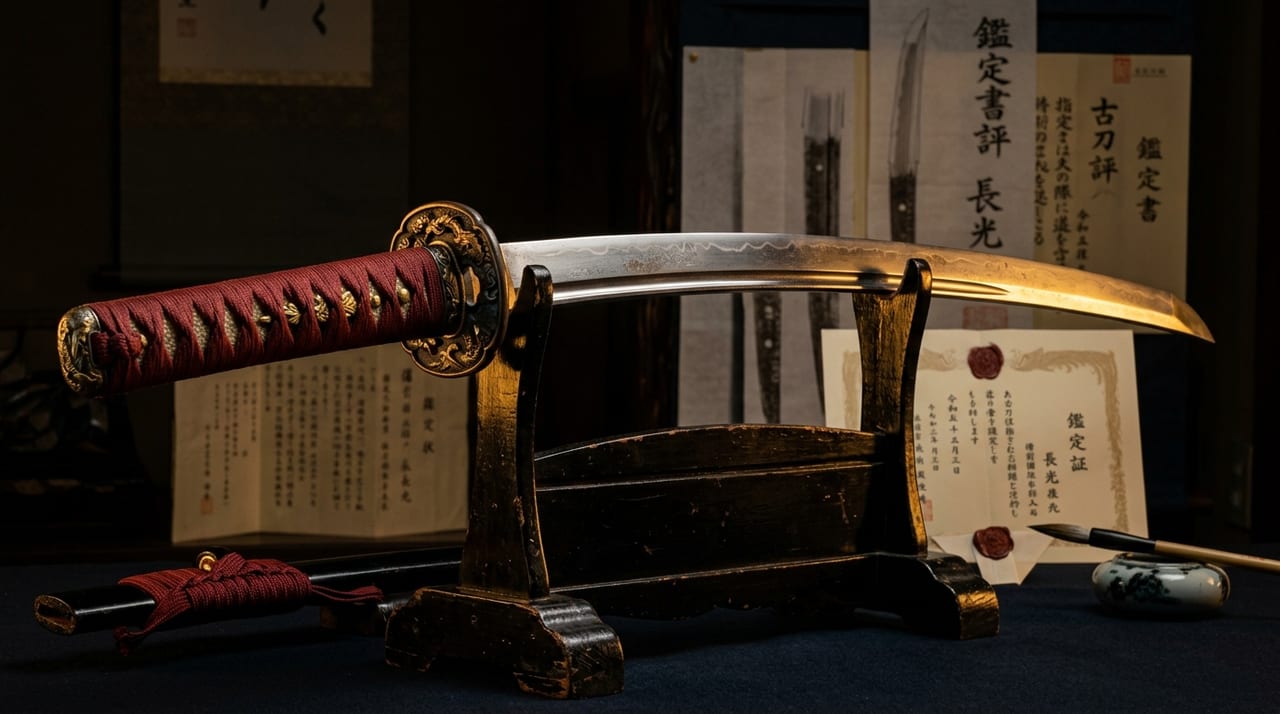
When appreciating a sword, the first step is to use the signature carved on the tang as a clue, or if unsigned, the kiwame (attribution) recorded in paper documentation or appraisal certificates, to confirm which tradition or regional lineage the work belongs to. Following that, examining the steel appearance — whether itame or masame grain, whether the blade is straight or irregular, and whether nie or nioi predominates — in light of the characteristics of each production region accumulated since Rikkoku Gohon times, deepens one's understanding of the historical background the sword carries.
Rikkoku Gohon transcends a mere historical classification; it provided an epistemological framework for how to interpret the aesthetic value of Japanese swords, and thus constitutes a fundamental concept of sword culture. At TOUKENZA's online catalog, you can search for swords with reference to this classification by production region and tradition.