Ōkanehira (大包平)—The Masterpiece of Bizen Ancient Blades, a National Treasure Sword Embodying the Technical Peak of the Late Heian Period
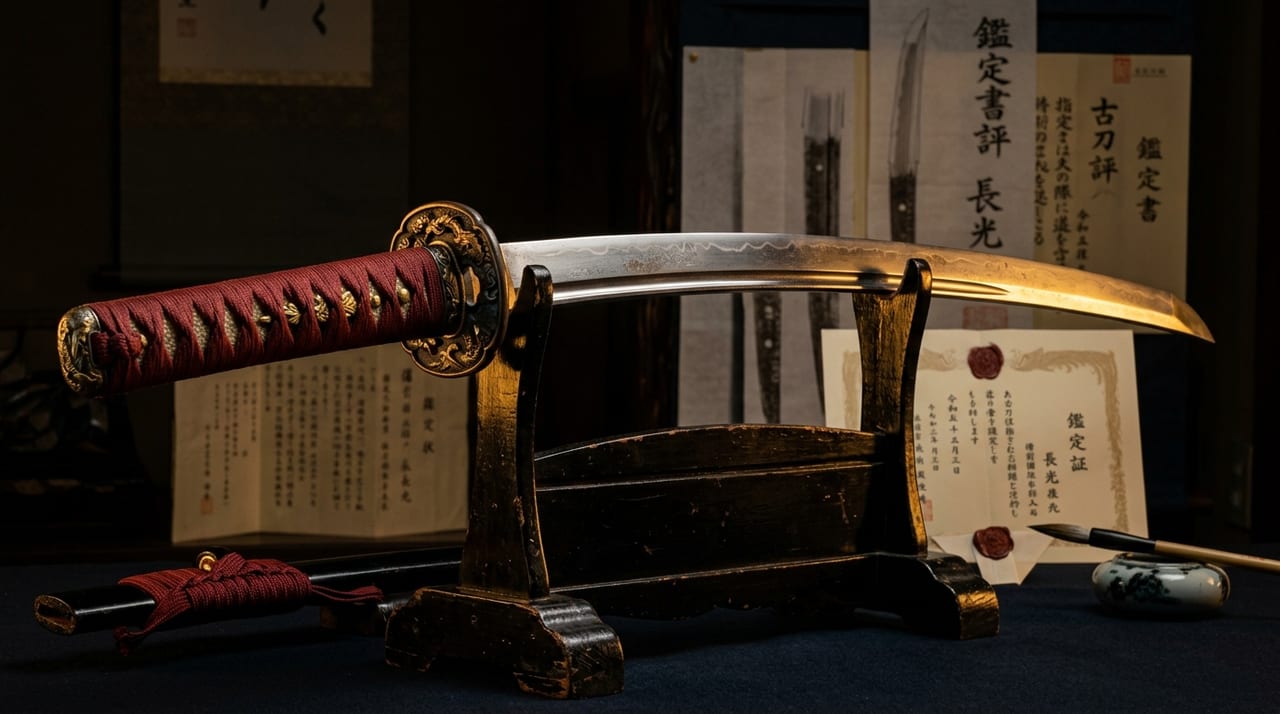 * Image is for illustrative purposes only.
Table of Contents
What is Ōkanehira?
Ōkanehira is a national treasure sword known as one of the greatest masterpieces in the history of Japanese swords. It is believed to have been made in the late Heian period (around the 11th-12th centuries) by the swordsmith Kanehira of Bizen Province (present-day Okayama Prefecture). Its name comes from the smith's name "Kanehira" with "Ō" (great) added, indicating that it is the largest and finest work among Kanehira's creations.
Its most distinctive feature is its exceptionally large size. The blade length of 89.2 centimeters is exceptionally large compared to other surviving Heian-period tachi, which is why it bears the name "Ō" (great). Given that typical Heian tachi have blade lengths of around 70-80 centimeters, Ōkanehira is an exceptionally oversized blade at more than 10 centimeters longer. However, beyond mere size, its forging technique, hamon, and jihada are of incomparable excellence, leading later experts to evaluate it as "the supreme sword in the realm" and "the pinnacle of Japanese swords."
The Swordsmith Kanehira
Kanehira was a swordsmith of Bizen Province in the late Heian period and one of the master craftsmen representing the Ko-Bizen school. His birth and death dates are unknown, though he is believed to have been active around the 12th century, with few reliable records surviving.
The Ko-Bizen school was the earliest group of Bizen swordsmiths, centered in what is now the southeastern Okayama Prefecture and the Asahi River basin, predating later schools such as the Osafune and Ichimonji schools. The characteristic features of Ko-Bizen swords are the excellence and refinement of their jihada and their restrained beauty. Unlike the brilliant choji midare seen in later Bizen swords, Ko-Bizen swords typically feature orderly hamon composed primarily of suguha or small midare.
The works of Tomonari and Masatsune, regarded as the twin peaks of Ko-Bizen alongside Kanehira, also survive in small numbers, and research into Heian-period Bizen swords relies on precise analysis of the few extant masterpieces. Few works by Kanehira survive, including Ōkanehira, and all are extremely rare cultural properties at the level of national treasures or important cultural properties. This rarity further elevates the value of Ōkanehira.
Sword Form and Structure
The current appearance of Ōkanehira (based on records from the Tokyo National Museum) is as follows.
- Blade length: 89.2 cm
- Curve: 3.4 cm (relatively deep curvature at the hilt)
- Width at base: 3.5 cm
- Width at point: 2.7 cm
- Construction: Shinogi-zukuri with iori-mune ridge
- Hamon: Small midare interspersed with small choji with ashi
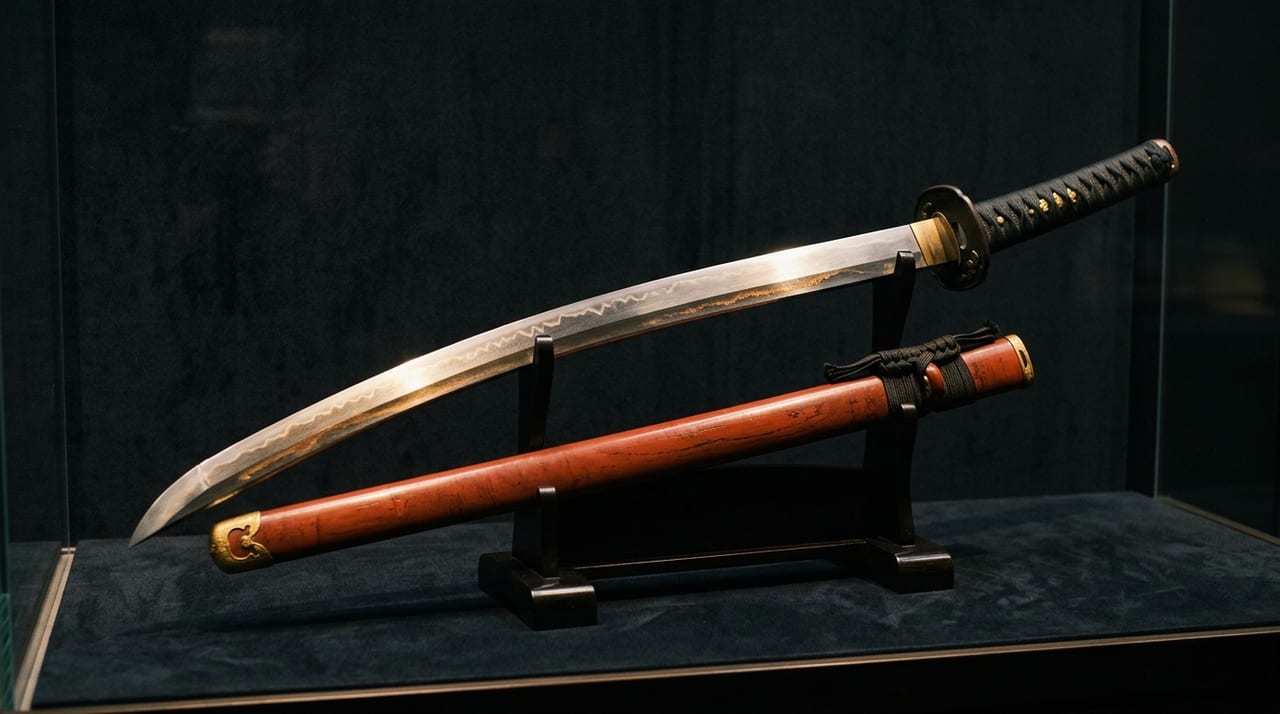
The jihada features dense itame interspersed with mokume, and the clear jihada near milky white is described as "shirake" (whitish radiance). The hamon is primarily composed of small midare, with small choji mixed throughout in an orderly arrangement. Within the hamon are elements called "ashi" (feet) that flow from the edge toward the point, introducing variation.
The kissaki (point) is a chu-kissaki (medium point) with good proportions, and the boushi (point pattern) is a ko-marukaeri (small rounded return). The nakago (tang) has not been heavily shortened (suriage), but remains in nearly original condition. It is extremely rare for a Heian tachi to have its tang preserved in such excellent condition.
The estimated weight is approximately 1.2-1.5 kilograms, and given the blade length of 89.2 centimeters, it achieves a well-balanced, manageable weight. This too demonstrates the high technical skill of its maker, Kanehira.
Points of Appreciation——Reading Kanehira's Technique from Jihada, Hamon, and Nakago
When you have the opportunity to actually appreciate Ōkanehira, where should you focus to best grasp its excellence? Below, I outline the key points of appreciation.
The "shirake" (whitish radiance) and density of the jihada: The most important characteristic expression of Ōkanehira's jihada is "shirake." This is a phenomenon in which the jihada glows with a faint milky or silvery-white radiance when viewed against light, appearing only in fine jihada where the carbon concentration in the steel has been uniformly balanced. This is because the characteristic "jinie" of the Bizen tradition spreads finely and uniformly across the entire jihada surface; when the particles are coarse, it becomes mere "gloss," but Kanehira's jihada displays an ethereal, haze-like whiteness.
The composure of the hamon and the flow of ashi: Within the orderly hamon primarily composed of small midare, small choji mixes throughout. While the overall effect is one of quiet refinement, viewing it closely reveals minute variations. Pay particular attention to where the "ashi" flows toward the point. This flow of ashi is not merely a pattern but a metallurgical phenomenon demonstrating that the carbon layer of the hagane (edge steel) changes in bundle-like formations toward the point, revealing the precision of Kanehira's quenching technique.
The preservation state and signature of the nakago: Ōkanehira's nakago remains in the rare condition of being nearly ubu (unchanged from its original form since creation). Many Heian tachi were later "suriage" (shortened) and remodeled into uchi-gatana by cutting the tang short, but Ōkanehira has been passed down without such modification. The signature "Kanehira" on the tang is traditionally believed to have been inscribed by the maker himself, and from its calligraphy, line thickness, and incision depth, one can directly read the characteristics of Heian-period signature-cutting.
Provenance——A Bizen Treasure Passed Down Through the Ikeda Family
The most reliable part of Ōkanehira's provenance is its transmission to the Ikeda family, lords of Okayama Domain. The Ikeda family was a daimyo house with Bizen Province as its domain and, from their position based in the largest center of Bizen sword production, actively collected fine Bizen swords.
There are various accounts of how the Ikeda family acquired Ōkanehira, but by the early 17th century (early Edo period), it is reliably recorded as a treasure of the Ikeda household. The Ikeda family treated Ōkanehira not merely as a weapon but as a family treasure and work of art, with each successive daimyo cherishing it as "the supreme sword in the realm." Throughout the Edo period, as Ōkanehira was guarded in the Ikeda family storehouse, it is said to have been a celebrated treasure desired to be seen by the shogun's household and many others, but the Ikeda family refrained from showing it to other houses, revealing it only on special occasions.
After the Meiji Restoration, the former daimyo Ikeda family became peerage, with the family treasures inherited as private property. In the 20th century, the Ministry of Education purchased Ōkanehira in 1967 (Showa 42), and it has been held by the Tokyo National Museum, where it is now preserved and displayed under state management. It was designated a National Treasure on June 9, 1951 (Showa 26) (after the Cultural Properties Protection Law went into effect). It is now regularly displayed in special exhibitions and other venues at the Tokyo National Museum.
The Origins of the "Supreme Sword in the Realm" Evaluation
The earliest record of Ōkanehira being evaluated as "the supreme sword in the realm" is found in Edo-period authentication records by the Honami family. The Honami family served as official appraisers to successive shogunal and daimyo houses, examining famous swords throughout Japan, and documents giving Ōkanehira the highest evaluation in their records still exist.
The Honami family's authentication was not merely aesthetic judgment but a comprehensive evaluation based on systematic analysis of creation period, school, and technical characteristics. Authentication documents (called "origami") were proof of the highest authority in sword transactions of that era, and blades bearing high-evaluation origami from the Honami family received dramatically elevated assessments based on the reliability of their content. It is said that the assessed value in the origami issued for Ōkanehira far surpassed all others in the sword market of that time.
Particularly in the records of Honami Kochu, words to the effect of "the supreme sword of Japan, none to compare" remain, establishing the highest evaluation by the authority on Edo-period sword authentication. These evaluations were passed down through successive generations, and the recognition that "Ōkanehira is the pinnacle of Japanese swords" has become the common understanding of the sword world to this day.
While Tenka Goken (Five Swords Under Heaven) refer to renowned swords from the Heian-Kamakura period representing "treasures of the realm," Ōkanehira holds the title of "supreme in the realm" as the pinnacle among the tachi sword type. This distinction indicates that Ōkanehira is regarded as special for embodying the technical pinnacle of the specific Ko-Bizen school.
Scientific Analysis Reveals Kanehira's Technique
In recent years, Ōkanehira has been subjected to non-destructive scientific analysis such as fluorescence X-ray analysis and neutron diffraction, and scientific data on its materials and manufacturing techniques have accumulated.
Analysis has revealed that Ōkanehira's iron material is exceptionally fine steel made from high-quality sand iron produced through tatara iron-smelting as its raw material, with carbon content homogenized through repeated folding and forging. This represents scientific evidence supporting that iron-smelting and forging techniques of the late Heian period had already reached a sophisticated level.
Furthermore, the martensite microstructure composing the hamon exhibits particularly high density and uniformity, confirming that the quenching technique was realized in an ideal form even from the perspective of modern metallurgy. The fact that the swordsmith Kanehira achieved forging approaching the optimal solution defined by modern science using only "empirical knowledge" demonstrates the reliability of the technical intuition of this Heian master craftsman.
Particularly noteworthy is the achievement of uniform quenching across a blade as long as 89.2 centimeters. The longer the blade, the more difficult it becomes to maintain uniformity in clay application, control heat distribution during quenching, and manage rapid cooling speeds. According to modern metallurgical knowledge, achieving uniform martensite microstructure across the full length of a blade nearly 90 centimeters long requires extremely precise control of the speed difference between heating and cooling. That Ōkanehira achieved this using only tools and experience from the Heian period testifies that the skill of the swordsmith Kanehira was at a level transcending his era.
Ōkanehira in Modern Times——Display and Preservation
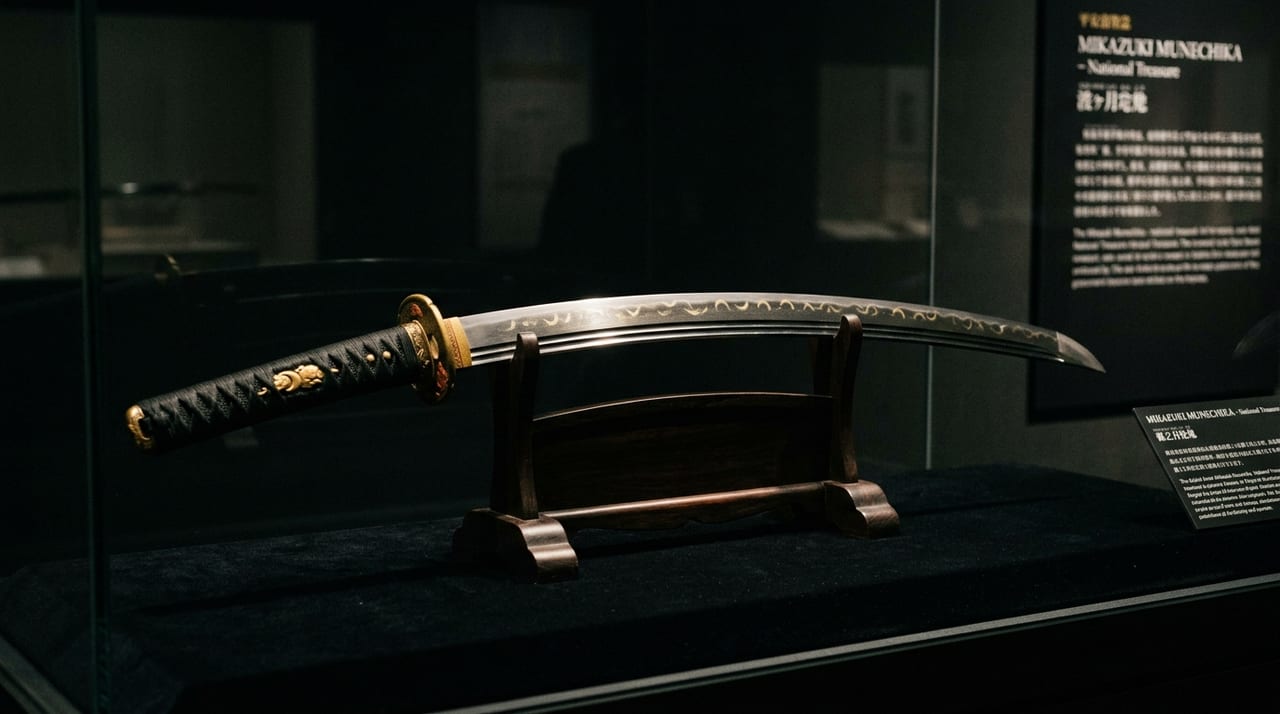
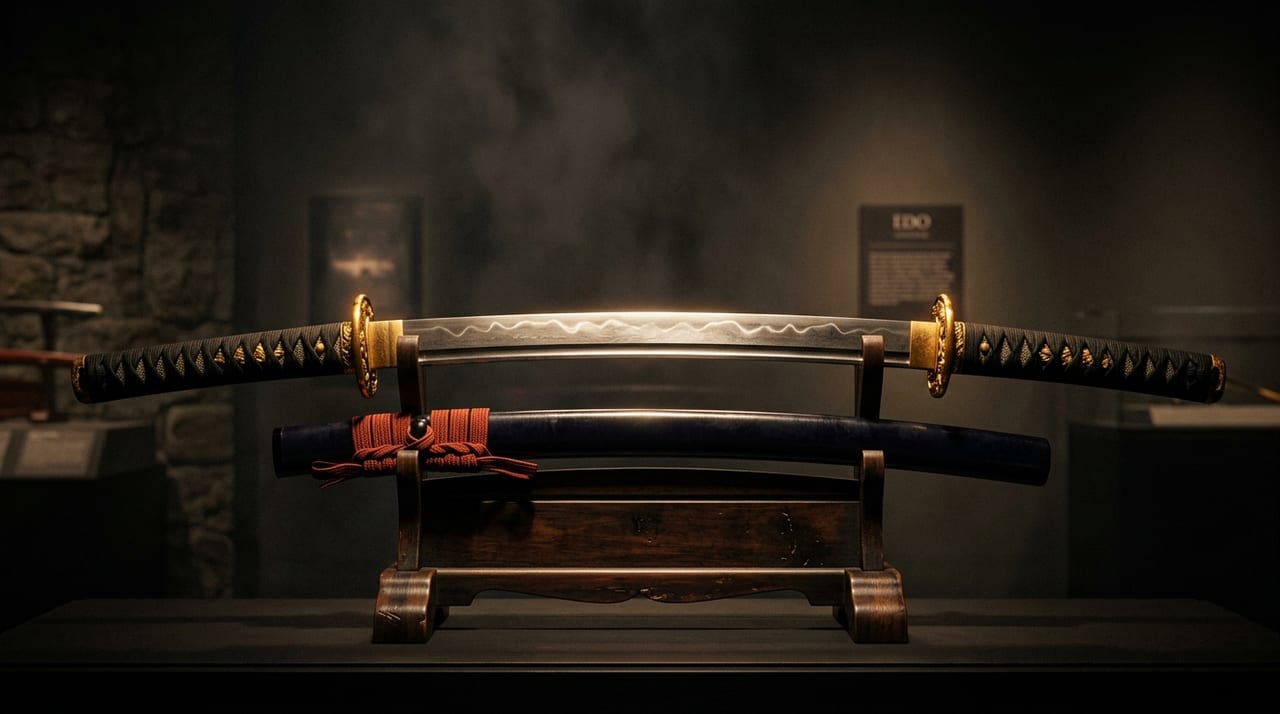
Ōkanehira is held in the collection of the Tokyo National Museum and is normally kept in strict secrecy and security. It is made public only a few times a year, primarily displayed behind glass cases in sword-specialty exhibitions and in the "Japanese Art" series exhibitions.
When displayed, lighting is carefully arranged so it can be viewed from multiple angles, and it is managed so that the jihada's shirake (whitish radiance), the ashi of the hamon, and the return of the boushi appear most beautifully. Opportunities for visitors to see Ōkanehira up close are extremely limited, so when public information is released, sword enthusiasts from across the nation gather.
Preservation involves rigorous temperature and humidity control, with display cases using nitrogen sealing to prevent blade oxidation. That iron from more than 900 years ago since the Heian period still retains its luster today is a result of continuous preservation efforts by successive owners and the current museum. The Tokyo National Museum maintains systems for minimizing deterioration through regular scientific analysis and oil treatment (maintenance), with preservation condition data for Ōkanehira continuously recorded.
Related columns: Ko-Bizen School——The Dawn of Bizen Swords Built by Tomonari and Masatsune | Scientific Authentication of Japanese Swords | How to View and Appreciate Jihada