The Swordsmith 'Mei Name Succession' System: Rules for Inheriting Workshop Names and Modern Lineage Traditions
 * Image is for illustrative purposes only.
Table of Contents
What is "Nidaime" (Second Generation)—The Meaning of Name Inheritance Among Sword Makers
In the world of Japanese swords, titles such as "Nidaime (Second Generation) ○○" and "Sandaime (Third Generation) ○○" carry meaning beyond mere succession of names. When a sword maker passes their mei to a student, it is an act of transmitting the entire technical skill, aesthetic sense, customer base, and philosophy of the school. This is a cultural practice essentially similar to the "myōseki (name and lineage) succession" found in Kabuki and Noh theater.
Sword makers who inherit a name carve out their own individuality while bearing their master's name. The ideal is held to be "maintaining the style of the First Generation ○○ while achieving unique development as the Second Generation."
Such succession is not a legal procedure like a registered name change, but rather an inheritance of "designation" within the sword-making society and schools. Therefore, even if sword makers bearing the same mei exist across multiple generations, works from each generation are treated as separate individual creations, and authentication and appraisal are conducted on a generation-by-generation basis—a point worth noting.
Conditions for Name Succession and the Master's Judgment
Name succession is not a legally stipulated system, but rather is conducted through agreement between master and student and industry custom. For a master to pass a name and lineage to a student, the following conditions are mainly required on an informal basis.
First is demonstration of years of training and technical skill. Generally, students who have completed a master-student relationship of ten years or more become candidates, with the prerequisite being the attainment of a technical level capable of embodying the master's style. In some cases, attainment of the "mukansha" (no-examination) class is a requirement.
Next is character and loyalty to the school. More than just the master's techniques, determination to inherit the philosophy, aesthetic sense, and attitude toward customer service is required. Only students whom the master judges to be trustworthy become candidates, as they will bear responsibility for maintaining the reputation of the school.
And then there is the master's retirement or death. There is "inter vivos succession" in which the master passes the name and lineage while still alive, but cases where students inherit the name after the master's death are also common. In the case of inter vivos succession, a form may be adopted in which "the First Generation remains involved in an advisory capacity after retirement."
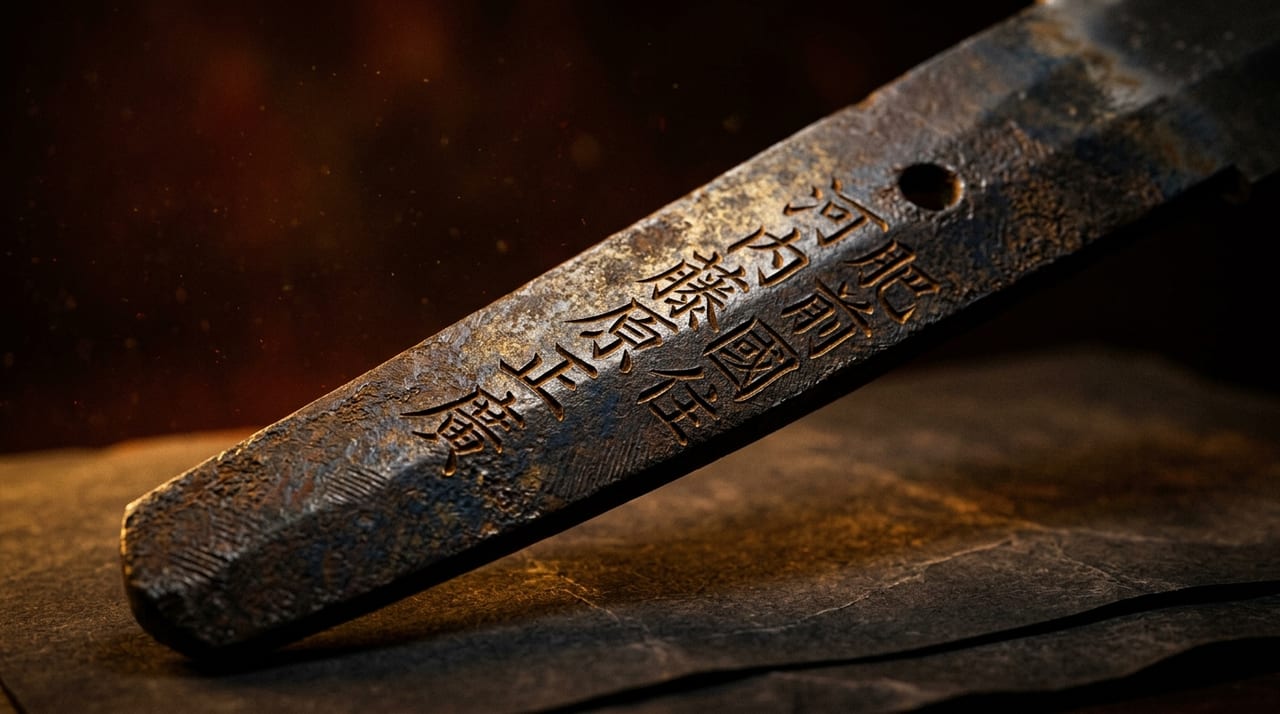
Note that inheriting a name and lineage does not necessarily mean the cutting style (character type and script) of the mei is identical to the master's. Examples can be seen in which characters such as "nidai" or "nidaime" are added to part of the mei, or the details of the kaou or cutting style are altered, so that those of the same period can identify the generation.
Forms of Succession—The Issue of Branch and Main Lines
When there are multiple students, who will inherit the mei can sometimes become a source of conflict after the master's death. Historically, the hierarchy between "hondeshi" (principal student) and "suedeshi" (junior student) and kinship (with blood children given priority) have been emphasized.
In modern times, there is a tendency to emphasize skill and intimacy between master and student over kinship, but when there is a blood child, it is not uncommon for that child to preferentially inherit the name and lineage. There is also a "bunke" (branch line) method in which the name and lineage are divided among multiple students, and examples exist in which they are distinguished by adding regional designations such as "○○ (East)" and "○○ (West)."
Industry organizations (such as the Japan Art Sword Preservation Society and various school associations) may mediate, but basically consensus formation among the parties is given top priority. When branch lines occur, each lineage independently takes students and nurtures successors for the next generation; therefore, cases in which multiple lineages continuing from a single mei extend in parallel to the present day are not uncommon.
Examples of Famous Name Succession
As a famous example of succession in history, the lineage of "Gassan Sadakazu" can be cited. The First Generation Gassan Sadakazu was a renowned craftsman of Osaka known as an imperial court artisan, and his grandson (a son of Gassan Sadakatsu) took his grandfather's name as Second Generation Gassan Sadakazu in 1966 (Tokyo National Research Institute for Cultural Properties, obituary record). It was Second Generation Gassan Sadakazu (recognized in 1971) who was designated as a Living National Treasure (Important Intangible Cultural Asset Bearer), not the First Generation. Furthermore, his third son inherited the modern Gassan school as Gassan Sadatoshi, and Second Generation Gassan Sadakazu and Gassan Sadatoshi are not the same person but are in a father-and-son relationship. The techniques of the Gassan school continue to this day, and the mei "Gassan" has become a symbol of the entire school, along with characteristics of its jigane (such as ayasugi hada).
The lineage of "Koyama Munetsugu" is also discussed as an example of succession, but in fact there are various theories regarding the continuity of the lineage, illustrating the complexity of name and lineage succession in the early modern period.
In modern times, there are increasing cases in which master-class sword makers who hold the mukansha certification formally designate and announce their successors while still alive. "Successor designation" through industry organizations is increasing transparency.
Choice Between Inherited and Independent Names
Whether a student inherits the master's name and lineage is not necessarily an obligation. Many sword makers choose to establish their own mei while receiving their master's influence. The most common motivation for choosing an independent mei is artistic autonomy—"wanting to establish one's own style while breaking free from the master's influence."
Even in this case, notes such as "student of [name]" or "[name] school" often appear in authentication documents and sword-maker registers, and the master-student relationship is recorded beyond the mei name. Even for sword makers who chose an independent mei, tracing their lineage often reveals a history of training under a renowned master, and this master-student relationship itself may be valued as background information for the work.
Confirmation Points to Keep in Mind When Purchasing
Most questions from readers considering the purchase of a sword with an inherited mei center on the point: "Are swords with the same mei handled differently depending on the generation?" In practice, confirming the following points deepens understanding.
- Confirm the notation of the artist's name and generation recorded in the authentication document. — Certification organizations such as NBTHK issue authentication documents after identifying the maker along with the reading of the mei inscription. Because works bearing the same mei but from the First, Second, or Third Generation are treated as creations of different individuals, confirming the contents recorded in the authentication document is fundamental.
- Observe the characteristics of the mei's script type and cutting style. — When measures are taken to alter the character type or supplementary characters of the mei at generational transitions, this can serve as a clue for distinguishing generations.
- Confirm the presence or absence of provenance (transmission) documentation. — Whether records such as former owner documentation or past authentication documents remain to substantiate provenance is helpful in understanding the background of the work.
- Confirm notation of master-student relationships and lineage. — Even for sword makers who bore an independent mei, the relationship with the master may be recorded in supplementary information in sword-maker registers or authentication documents, so it is advisable to confirm this as well.
In any case, it should be understood that the basic approach to authentication is to comprehensively evaluate not just the mei itself but the entire work, including jigane, hamon, and form, and confirming the generation of the mei is only part of this evaluation.
Challenges in Modern Name Succession
In the modern era of serious successor shortage, it is considered problematic that the hurdle for name succession is too high. The length of training years and the severity of technical requirements can also hinder the entry of motivated young people.
On the other hand, careless name and lineage succession carries the risk of damaging the reputation of the school. Historical examples exist in which a successor's skill fell far short of the master's, and it was said "the Second Generation besmirched the name and lineage." This "difficulty of succession" is an essential challenge common to Japanese traditional performing arts and crafts as a whole.
Technology succession and name and lineage succession are distinct, and while the industry as a whole recognizes the danger of conflating the two, it continues to seek appropriate forms of succession. The frameworks for successor development and approaches to information disclosure vary from school to school and organization to organization, but it is thought that the systematic official organization of information surrounding successors and its increased accessibility from outside will form the foundation for this system to maintain trust going forward.