The Tough Forging of Tamahagane — Techniques for Imparting Toughness During the Tanren Process and the Judgments of the Tōshō
 * Image is for illustrative purposes only.
Table of Contents
What Is Toughness? — The Essential Nature of "Stickiness" Required of a Japanese Sword
When discussing the performance of a Japanese sword, one property given as much weight as sharpness is "toughness (jinsei)." Toughness refers to the amount of energy a material can absorb before fracturing — put simply, it corresponds to resistance to breaking and bending. Making a blade sharply cutting requires hardening, yet the harder the steel, the greater its brittleness, and the more easily it breaks on impact. The heart of Japanese sword tanren technique lies in reconciling these two opposing properties — hardness and toughness — at a remarkably high level of balance.
Tamahagane is a high-carbon steel with a carbon content of roughly 0.6–1.5%, and in its pre-tanren state the carbon distribution is uneven, making it a material whose toughness is difficult to control. The orikaeshi tanren that a tōshō performs is not merely a step for removing impurities; it is also a process that imparts toughness itself by homogenizing the carbon and refining the steel's microstructure.
The phrase long used to express the ideal sword — "does not break, does not bend, cuts well" — has been invoked since ancient times. These three conditions contain mutual contradictions: pursuing sharpness increases hardness and makes the blade prone to breaking, while pursuing resistance to bending makes the blade harder to put an edge on. Attention to toughness is itself the eternal challenge facing every tōshō: how to reconcile these contradictory demands within a single sword.
Determinants of Toughness at the Stage of Tamahagane as a Raw Material
Multiple factors determine the toughness of tamahagane. First is carbon content. The higher the carbon content, the more easily the steel hardens, but toughness decreases accordingly. A tōshō selects higher-carbon portions for the kawagane and lower-carbon portions for the shingane, and this act of selection is itself the first control point for toughness.
Next, the content of impurities such as phosphorus, sulfur, and silicon affects toughness. These impurities precipitate within the steel microstructure, weakening grain boundaries and causing a decline in toughness. The expulsion of impurities through orikaeshi tanren is an indispensable process not only for improving the appearance of the jigane but also from the standpoint of improving toughness.
Temperature control during tanren is likewise a critical factor. If the temperature is too high, crystal grains coarsen and toughness declines; if it is too low, work hardening proceeds too far and cracking occurs. When a tōshō watches the color of the furnace fire to judge the right moment to strike, this is precisely that temperature control being practiced through the body.
The determinants of toughness at the stage of tamahagane as a raw material can be organized as follows.
- Carbon content — the more there is, the easier the steel hardens, but toughness falls
- Impurities (phosphorus, sulfur, silicon, etc.) — weaken grain boundaries and lower toughness
- Tanren temperature — if too high, crystal grains coarsen; if too low, work hardening makes the steel prone to cracking
These factors do not exist independently; the difficulty of working tamahagane lies in the fact that they must all be managed simultaneously and in parallel throughout the actual tanren process.
The Process of Imparting Toughness During Orikaeshi Tanren
The relationship between the number of folds in orikaeshi tanren and toughness is studied even in modern metallurgical science, and roughly 8–15 folds are considered optimal from the standpoint of improving toughness. The more folds are applied, the further the homogenization of carbon and refinement of the microstructure advance, but at the same time the risk of excessive tanren causing carbon volatilization and decarburization increases, potentially resulting in the loss of the necessary hardness.
The technique craftsmen call "nebari tanne" (tough forging) often refers to a method of folding carefully while keeping the tanren temperature somewhat low (around 800–900°C). Forging in this temperature range is favorable for microstructural refinement, and a fine microstructure has many grain boundaries, which impedes crack propagation and thereby increases toughness. However, low-temperature tanren makes the work itself more difficult, requiring both advanced technique and physical stamina.
Orikaeshi tanren may appear to be a simple repetition of drawing out and folding the steel, but in practice it is a process in which the tōshō makes judgments about the heating temperature, the force of each blow, and the direction of folding at every step. Even when using the same tamahagane, the toughness of the finished jigane can vary depending on how these judgments accumulate. Herein lies the value of handwork that cannot be reproduced in mass production.
The Structural Design of Shingane and Kawagane and the Distribution of Toughness
The traditional structural design of a Japanese sword — encasing shingane (low-carbon steel that is soft and high in toughness) within kawagane (hard, high-carbon steel) — is a groundbreaking technique that spatially separates toughness and hardness. The outer surface of the sword bears responsibility for the sharpness of the edge and the beauty of the jigane, while the shingane inside provides resistance against breaking — a division of roles embedded in the structure itself.
The effect of this design has been confirmed experimentally; it is known that the composite shingane-kawagane structure is superior in impact absorption compared with a sword made from uniform steel alone. The judgment a tōshō makes in selecting the steel for the shingane incorporates not only simple flexibility but also a sophisticated calculation that takes in the bondability with the kawagane (the management of the carbon gradient).
Multiple styles of construction (zukuri) have been transmitted, but in any style the fundamental principle of "a hard exterior and a tough interior" is common. There is a great gap between understanding this principle intellectually and acquiring the technique to actually integrate shingane and kawagane as intended, and mastery of the latter is said to require many long years.
The "Feel of Toughness" That a Tōshō Judges Through Experiential Knowledge
The toughness that modern metallurgical science can express as a numerical value was grasped intuitively by tōshō of the Edo period and earlier. How the steel being forged responds to the hammer — whether it has a "yielding" feel or a "hard and bouncing" feel — was the cue indicating the condition of that steel. Experienced tōshō are said to have been able to judge whether toughness was sufficient from the movement and resonance of the steel.
"Steel with toughness has a slight resistance when struck, a feel as though the hammer sinks in. Conversely, when toughness is insufficient, the rebound at the moment of striking is strong, and there is a sound of splitting" — this survives in oral records of a gendaitō swordsmith. This embodied knowledge is difficult to record in writing and has been passed down only through direct experiential transmission between master and apprentice.
Such intuitive judgment is largely honed through the experience of failure. Only after experiencing many failures in the form of broken or cracked pieces does the correspondence between the sensation transmitted through the hammer and the internal condition of the steel become inscribed in the body. Behind the fact that a tōshō's period of apprenticeship is said to be long lies the reality that the acquisition of this kind of tacit knowledge takes time.
Collaboration Between Gendaitō Swordsmiths and Toughness Research
In the modern era, efforts have advanced for tōshō and materials scientists to work together in evaluating toughness numerically. Research has been reported that combines Charpy impact testing and Vickers hardness measurement to quantify how much differences in the tanren process affect toughness.
The fruits of such research are expected not only to provide scientific backing for traditional craft technique but also to find application in training programs for the next generation of tōshō. The possibility exists that transmission will become more reliable when a numerical yardstick is added to the master's words "learn with your eyes, your hands, and your ears." The effort to make visible the invisible property of toughness continues to hold important significance for the transmission of Japanese sword forging technique.
Points to Keep in Mind When Appreciating and Storing a Sword from the Perspective of Toughness
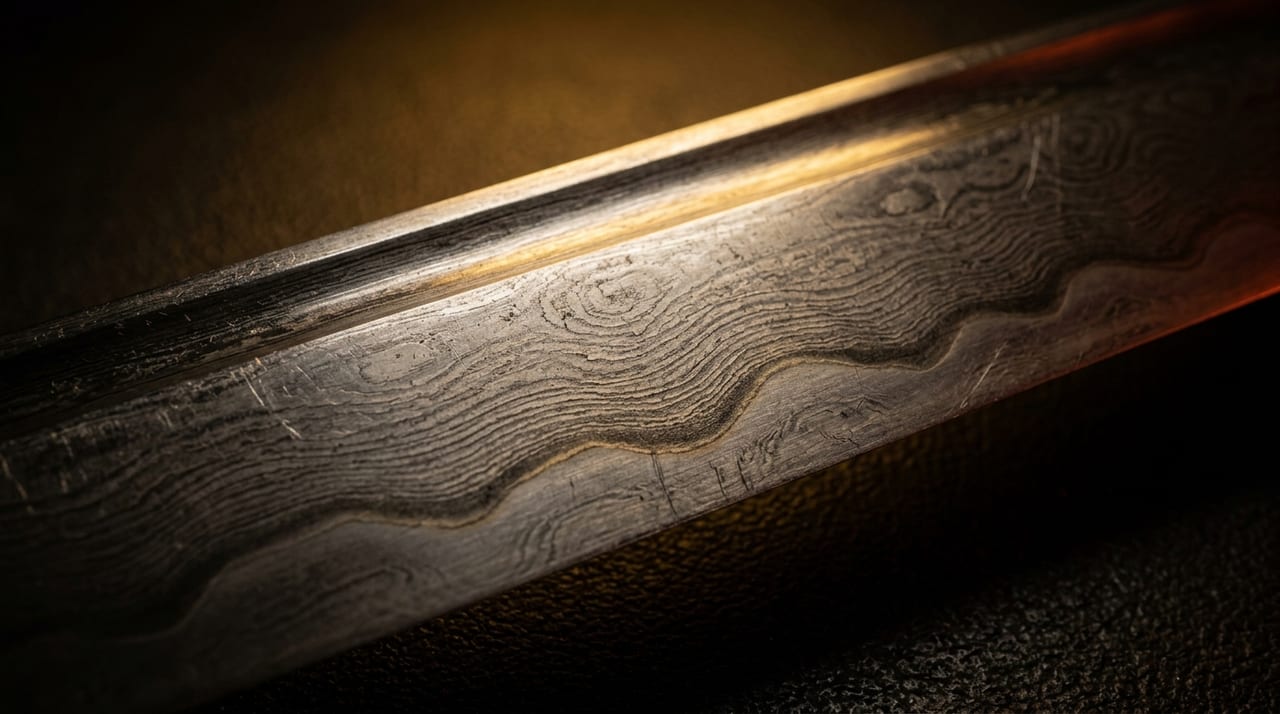
Toughness itself is not a property that can be measured in a finished sword without destroying it. For those who appreciate and collect existing swords, the realistic approach is therefore not to confirm toughness directly but rather to read, from the jigane and the hamon, the traces of the effort that was devoted to increasing it. The degree to which the jigane is compacted and the crispness of the hamon are considered among the cues that reflect the care taken in orikaeshi tanren and the construction of the blade.
From a storage perspective as well — though not directly related to toughness — sudden changes in temperature or humidity can place a burden on the steel, so stabilizing the storage environment ultimately contributes to preserving the condition of the sword over a long period. The unremarkable considerations of not applying undue force when appreciating a sword and handling it in accordance with basic etiquette can also be said to be fundamental attitudes that contribute to making the most of the toughness the material inherently possesses, for as long as possible.