Types and Functions of Sageo — School-Specific Customs of Materials, Colors, and Tying Methods, and Their Role in Carrying a Sword
 * Image is for illustrative purposes only.
Table of Contents
What Is Sageo — A Decorative Cord Developed as a Carrying Accessory for the Nihontō
Sageo is a braided or leather cord attached to the saya of a nihontō, threaded through a small protrusion located near the middle of the saya called the "kurikata." The name derives from "a cord (o) that hangs (sageru) down," referring to the excess cord that hangs at the lower portion of the saya when the sword is thrust through the obi.
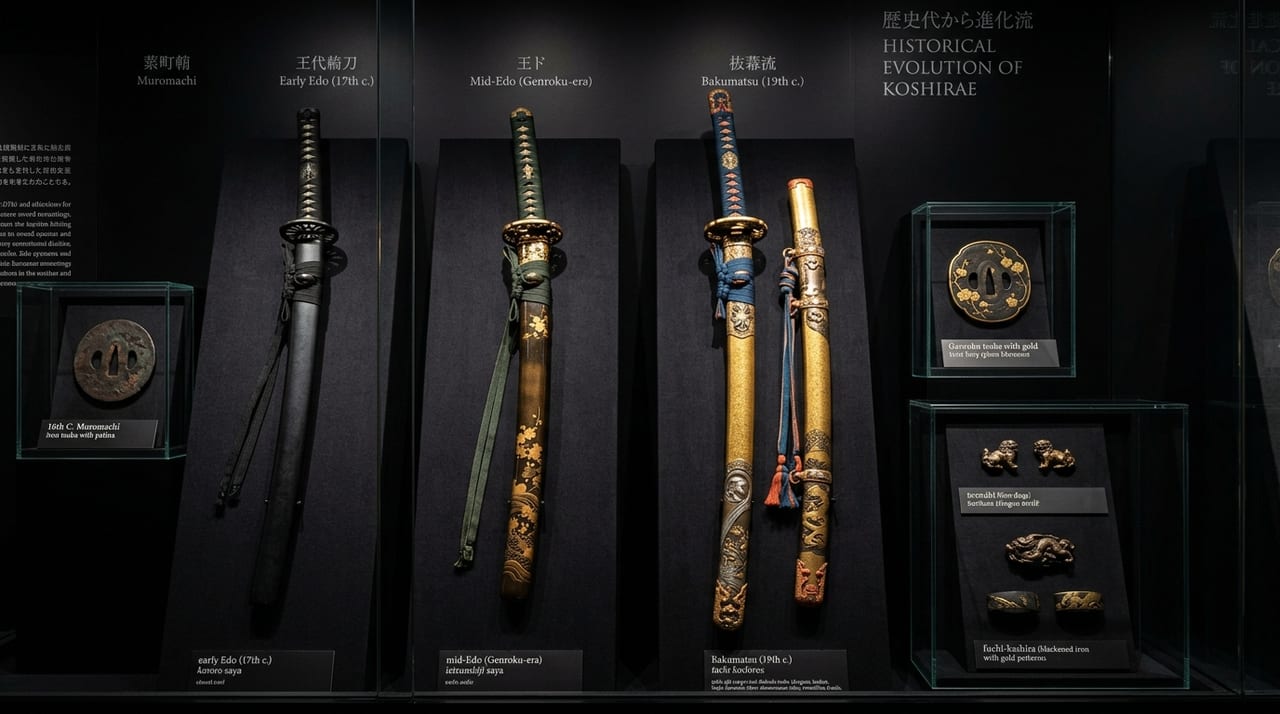
Sageo was not merely decorative; it served important functional roles in carrying, securing, and drawing the sword. The material, color, and tying method were also minutely prescribed according to a warrior's school, rank, and whether the occasion was a formal ceremony or the battlefield, and as part of the tōsōgu (koshirae) it has long been highly regarded for its aesthetic value as well.
A specific example of its use is the practice, when removing the sword from the waist to place it indoors or lean it against a wall in a tatami room with the saya still on, of wrapping the sageo around the saya to lightly secure the koiguchi and prevent inadvertent drawing. This is said to have carried meaning as a form of etiquette signaling that one bore no hostile intent toward the other party.
Materials and Types of Sageo
Sageo materials fall broadly into two categories: silk kumihimo (braided cord) and leather.
Silk kumihimo is considered the most prestigious material. Kumihimo hand-braided by craftsmen from pure silk requires uniform thickness, luster, and coloring, and demands a high level of skill to produce. During the Edo period, kumihimo makers in Kyoto supplied high-quality sageo to meet the demand of the warrior class. Depending on the braiding technique, there are various types — "marugumi," "hirautsugumi," "kakugumi," "Edo-uchi," and others — each used according to the occasion and the school.
Leather sageo, made by cutting deer hide or cowhide into thin strips, was considered highly durable and practical. It was used for battlefield purposes and paired with plain, rugged koshirae, possessing a simple yet functional appeal.
Hemp sageo, being a relatively inexpensive and easily obtainable material, was used for everyday wear by warrior households and on the swords of ashigaru and common troops.
These materials differ not only in visual formality but also in actual handling. Silk kumihimo is supple, easy to tie, and yields a beautiful result, but is weak against moisture and friction and prone to fading and fraying with extended use. Leather is resistant to wear and holds its shape well, but tends to harden over time and requires periodic maintenance. Hemp has a dry texture that makes it easy to handle and is considered suitable for everyday use such as practice.
Colors of Sageo and Their Meanings
The color of sageo functioned as an important marker of a warrior's social rank, school affiliation, and the formality of the occasion. Usage of color varied by school and era, but several representative customs have been passed down.
Navy (kon) was the most common color, widely used for everyday sword-wearing by warrior households. Its subdued tone was said to express a warrior's dignity. Brown (cha) and black (kuro) were also used for everyday wear, prized as understated yet refined combinations. White (shiro) was used for formal and ceremonial koshirae and was treated as a color symbolizing purity and cleanliness. Red (aka) was sometimes used on occasions of formal warrior dress or celebration, and some schools used their own distinctive colors as a means of identifying their disciples.
It should be noted, however, that these color conventions varied by era, region, and school and were not uniformly established across the warrior class as a whole. When using a particular color, it is advisable to confirm the customs of one's own school or household.
School-Specific Customs of Tying Methods
The tying method of sageo is variously prescribed by school, and it was said that "you can tell a swordsmanship school by how it ties the sageo."
The handling of sageo in iai is regarded with particular importance. In the sword-drawing techniques of iai, the key point is how swiftly one can draw from the sheathed position, and specific tying methods are prescribed so that the sageo does not impede the draw. In major iai schools (Musō Shinden-ryū, Musō Jikiden Eishin-ryū, Tamiya-ryū, and others), the method of managing the sageo during practice is prescribed in detail and constitutes one of the items transmitted to disciples.
In the use of sageo among bujutsu schools, techniques for employing sageo as a weapon have been transmitted in some schools. There existed a "sageo-jutsu" that combined a long sageo (approximately 3 to 4 shaku in length) with the sword, with applied techniques such as ensnaring an opponent, disarming them, or binding them in an emergency.
In practice, if the sageo is tied improperly, the cord hanging from the saya during drawing or resheathing motions may become tangled around the feet or the hand holding the sword, risking interference with the movement. Furthermore, in seated techniques (suwariwaza) involving a draw from seiza, it is considered important to carefully manage the sageo beforehand so that it does not become trapped beneath the body on the tatami or get stepped on. For this reason, tying the sageo is not merely a formality but also has the aspect of a practical skill that supports safe practice.
Care and Storage of Sageo
Since sageo has the aspect of a consumable item that is regularly retied on the saya, proper care and storage are the key to making it last.
- After use, rather than leaving the sageo with knot creases set in for an extended period, untying it to the extent possible before storing helps prevent it from losing its shape.
- Since silk sageo are prone to discoloration and fading when exposed to direct sunlight, it is advisable to choose a location away from light when storing them.
- Storing in a damp place can lead to mold and insect damage, so maintaining a dry environment is considered fundamental.
- Leather sageo tend to harden with repeated use and require care appropriate to their condition.
These are basic considerations that require no special tools, but the accumulation of daily care is what sustains the appearance and function of sageo over time.
Selecting Sageo Today and Its Cultural Significance
For today's nihontō enthusiasts, iai practitioners, and sword collectors, the choice of sageo is an important factor that determines the aesthetic completeness of the tōsōgu. Selecting a sageo suited to the period, school, and intended use is indispensable for achieving the overall "caliber" of the sword as a whole.
High-quality kumihimo sageo are still produced today by traditional kumihimo craftsmen, with specialist kumihimo shops operating mainly in Kyoto and Tokyo. Both pure silk and synthetic fiber materials are used, and prices range widely from a few thousand yen to tens of thousands of yen.
When selecting sageo, in addition to the overall sense of unity achieved through color coordination with the saya and tsuka-ito, the intended use is also an important consideration. When the primary purpose is display in a tokonoma or similar setting, the beauty and luster of the material tends to be prioritized; when used regularly in iai practice, ease of tying and durability may be given precedence. If the school or dojo to which one belongs specifies or recommends particular colors or tying methods, it is reassuring to confirm with one's instructor before purchasing.
Sageo is a detail often overlooked within nihontō culture, but the combination of its material, color, and tying method serves as an eloquent clue to the cultural context of the sword as a whole. When appreciating and studying the nihontō not merely as a bladed weapon but as a comprehensive cultural artifact, we hope that attention to sageo will also be added to your perspective.