Yaki-ire and Martensitic Transformation: The Science of Microstructural Changes That Harden the Nihontō
 * Image is for illustrative purposes only.
Table of Contents
What Is Yaki-ire: The Final Process That Transforms a Sword into "Living Steel"
Yaki-ire is the most dramatic process in nihontō manufacture. The blade, to which tsuchioki has been applied, is heated in a furnace, and the moment the optimal temperature is reached, it is plunged all at once into a water tank. In those few seconds, a violent microstructural transformation occurs inside the steel, and the steel that was previously soft is transformed into a hard blade. At the same time, the beautiful hamon (temper line) appears, and the "face" of the sword is complete.
Yaki-ire is also a process of irreversible final decision. If temperature, timing, or water temperature is off by even a small amount, the sword becomes a failure. Failure takes one of the following forms.
- The thin edge cracks, unable to withstand the thermal stress during rapid cooling
- It ends in yaki-busoku (insufficient quenching), in which adequate hardness is not achieved
A blade that has been finished through more than a hundred processes can become scrap in this single instant — it is the moment when the skill and mental fortitude of the kaji (smith) is most put to the test.
From Austenite to Martensite: The Mechanism by Which Steel Hardens
The reason steel hardens through yaki-ire lies in a change to the crystal structure of iron. Carbon steel at room temperature is a mixed microstructure of "ferrite," which has a body-centered cubic lattice (BCC) structure, and cementite (iron carbide: Fe₃C), but when heated to the A1 transformation point (eutectoid temperature: approximately 727°C), transformation to austenite begins. In hypoeutectoid steel with low carbon content, complete austenite is only achieved upon further heating to the higher-temperature A3 point (in hypereutectoid steel, above the Acm point). Austenite has a high solid-solution capacity for carbon (up to approximately 2.14%), and enters a state in which all the carbon that had precipitated out at the ferrite stage is dissolved into it.
When rapidly cooled from this austenitic state, there is no time for carbon to escape, and a "frozen" structure is formed in which the transformation from FCC structure to BCC structure is left incomplete. This is the steel microstructure called martensite, which has a distorted lattice structure known as a body-centered tetragonal lattice (BCT). This lattice distortion is the source of hardness; because the dissolved carbon distorts the lattice, the structure resists deformation, and hardness can reach 60 or above on the Rockwell hardness scale (HRC).
In the nihontō, high-carbon steel containing 0.6 to 1.5% carbon is used for the edge portion (hagane), and high-hardness martensite is formed through yaki-ire. Meanwhile, the mune (back of the blade) side protected by tsuchioki and the shingane (core steel) with its moderate carbon content cool more slowly, and therefore transform into soft, tough microstructures called pearlite and bainite. This dual-hardness structure is the fundamental reason the nihontō achieves the seemingly contradictory combination of being "hard yet unbreakable."
Determining the Yaki-ire Temperature: The Color of the Flame Read by the Tōshō's Eye
The appropriate heating temperature for yaki-ire varies with the carbon content of the steel, but the range of approximately 760 to 820°C is generally considered the optimal range for typical nihontō carbon steel. Below this temperature, the austenite transformation is incomplete and sufficient hardness cannot be achieved. Conversely, if the temperature is too high, grain coarsening and decarburization progress, and the risk of yaki-ware (quench cracking) increases.
In modern industrial quenching, precise thermometers and furnace temperature controls are used, but traditional nihontō yaki-ire is still performed almost entirely by "visual judgment." The color of the light emitted by the blade inside the furnace functions as an accurate thermometer to the eye of the tōkō.
The approximate correspondence between steel color and temperature is as follows.
| Steel color (approximate temperature) | Condition |
|---|---|
| Dark red (approximately 700–750°C) | Insufficient for yaki-ire |
| Bright red (approximately 780–820°C) | Optimal range for yaki-ire |
| Orange (approximately 900°C or above) | Overheated |
Because this judgment is greatly influenced by the working environment (natural light, lighting), many tōkō perform yaki-ire in the dim early morning before sunrise. This is wisdom grounded in experience, aimed at eliminating visual disturbances.
Some tōshō use as an auxiliary method bringing a magnet close to the heated blade to confirm "the moment it loses its magnetism." Since iron loses its ferromagnetism above the A2 transformation point (Curie temperature: approximately 770°C), the temperature at which the magnet no longer adheres becomes a guide to the yaki-ire temperature range.
The Ms Point and Mf Point: The Beginning and End of Martensitic Transformation
Martensitic transformation has a clearly defined start temperature and end temperature. The "Ms point (martensite start point)" is the temperature at which martensite begins to form during cooling; the "Mf point (martensite finish point)" is the temperature at which transformation is complete.
The higher the carbon content, the more the Ms point and Mf point shift toward lower temperatures. In steel with 1% carbon, the Ms point drops to approximately 230°C, and the Mf point can fall below room temperature. This means that even when high-carbon steel is cooled to room temperature, transformation may not be fully complete, and untransformed austenite (retained austenite) can remain.
The structural design of the "tsukuri-komi" in nihontō forging — combining high-carbon hagane with medium-carbon shingane — also cleverly exploits this difference in Ms and Mf points. The high-carbon steel of the edge forms high-hardness martensite through yaki-ire, while the medium-carbon steel of the shingane, also aided by its slower cooling rate, becomes a tough pearlite-bainite microstructure. Traditional tōkō did not understand this phenomenon scientifically, but the fact that they had established the optimal material design and processes through more than a thousand years of trial and error astonishes even modern materials scientists.
Tempering (Yaki-modoshi): Adjusting the Balance Between Hardness and Toughness
A sword that has just undergone yaki-ire is in a state of high hardness but also high brittleness. Because the lattice distortion of the martensite is too great, internal cracks tend to form even from slight impact. To resolve this problem, "tempering" is performed.
Tempering is a process of reheating the blade after yaki-ire at low temperature (typically approximately 150 to 250°C). In this temperature range, some of the carbon precipitates out of the martensite to form carbides, and the lattice distortion is relieved. As a result, hardness decreases slightly, but toughness (resistance to impact) improves substantially.
In traditional nihontō manufacture, the operation of removing the blade from the water after yaki-ire and allowing it to air-cool for a short time is effectively equivalent to tempering. In the process by which the internal heat generated during yaki-ire travels from the core of the blade to the surface, the surface is moderately reheated. This effect of "self-tempering" is considered to be one factor in maintaining the toughness of the nihontō, and it is knowledge that also connects to modern high-speed tool steel quenching technology.
The Hamon: The Face of the Nihontō Created by Yaki-ire
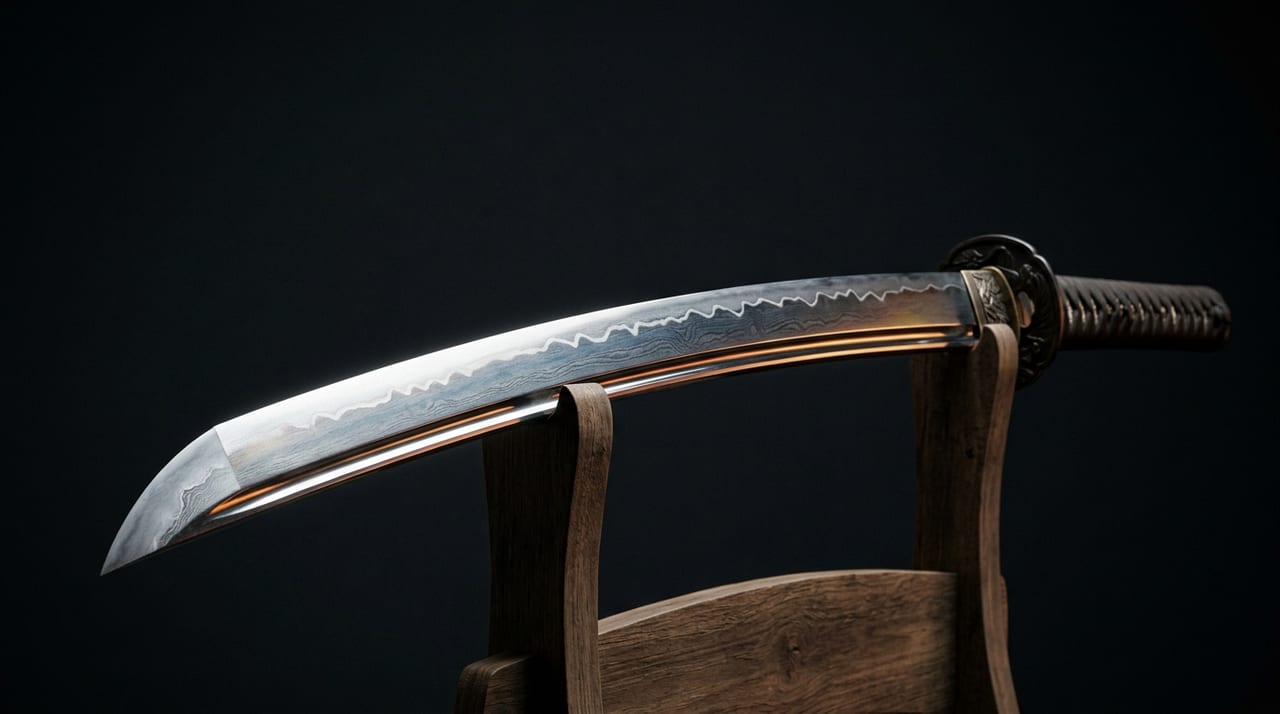
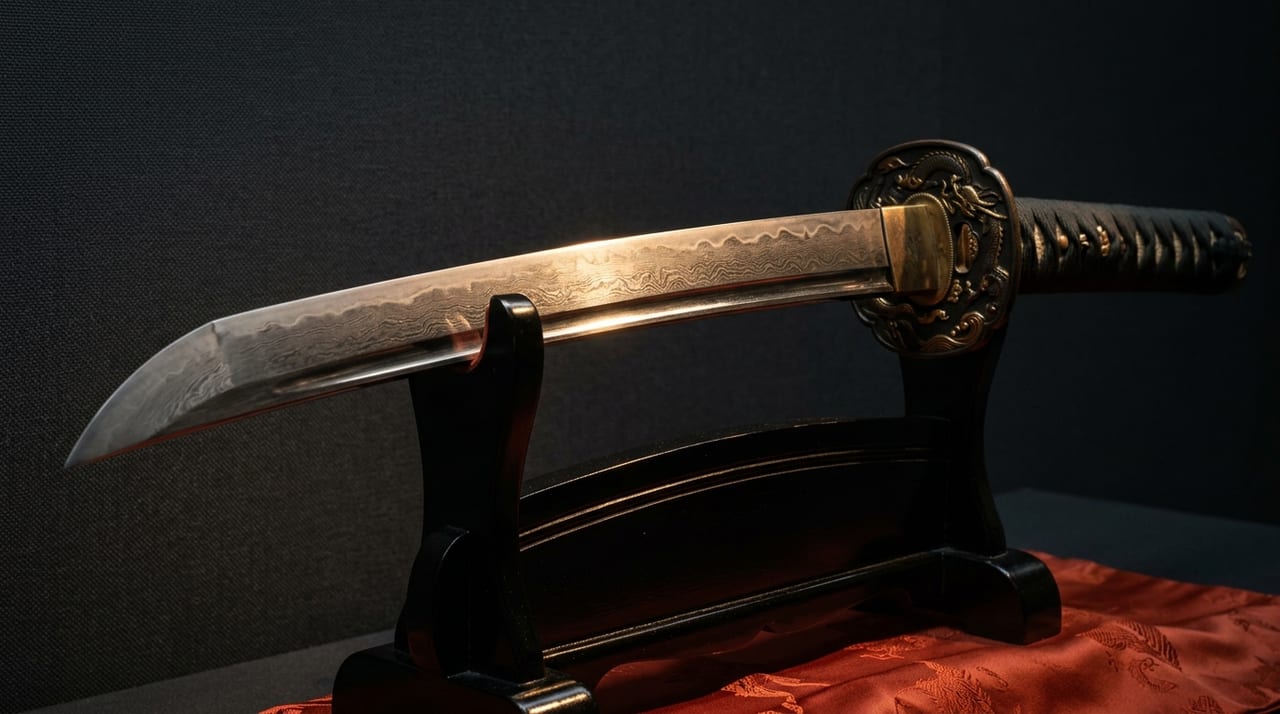
The visual product of the yaki-ire process is the hamon (temper line). This brilliantly white pattern that appears after polishing reflects the boundary between the martensite microstructure (hardened zone) and the pearlite-bainite microstructure (softened zone) as a difference in light reflection. Martensite diffuses light and therefore appears white, while pearlite reflects light uniformly and therefore appears gray to black.
The shape of the hamon is determined by the shape of the tsuchioki, and each school produces its own distinctive patterns (suguha, notare, chōji, gunome, and others). The hamon is therefore not mere decoration; it is scientific evidence of a successful yaki-ire process and a "fingerprint in steel" that bears the skill and individuality of the tōkō. The ultimate criterion for judging whether yaki-ire has succeeded or not is whether this hamon has appeared beautifully as intended, and it is here that the tōkō learns for the first time the outcome of a single sword.