Nie and Nioi: The Metallurgical Science Behind the Glittering Hamon
 * Image is for illustrative purposes only.
Table of Contents
The True Identity of Hamon's Radiance—The Difference Between Nie and Nioi
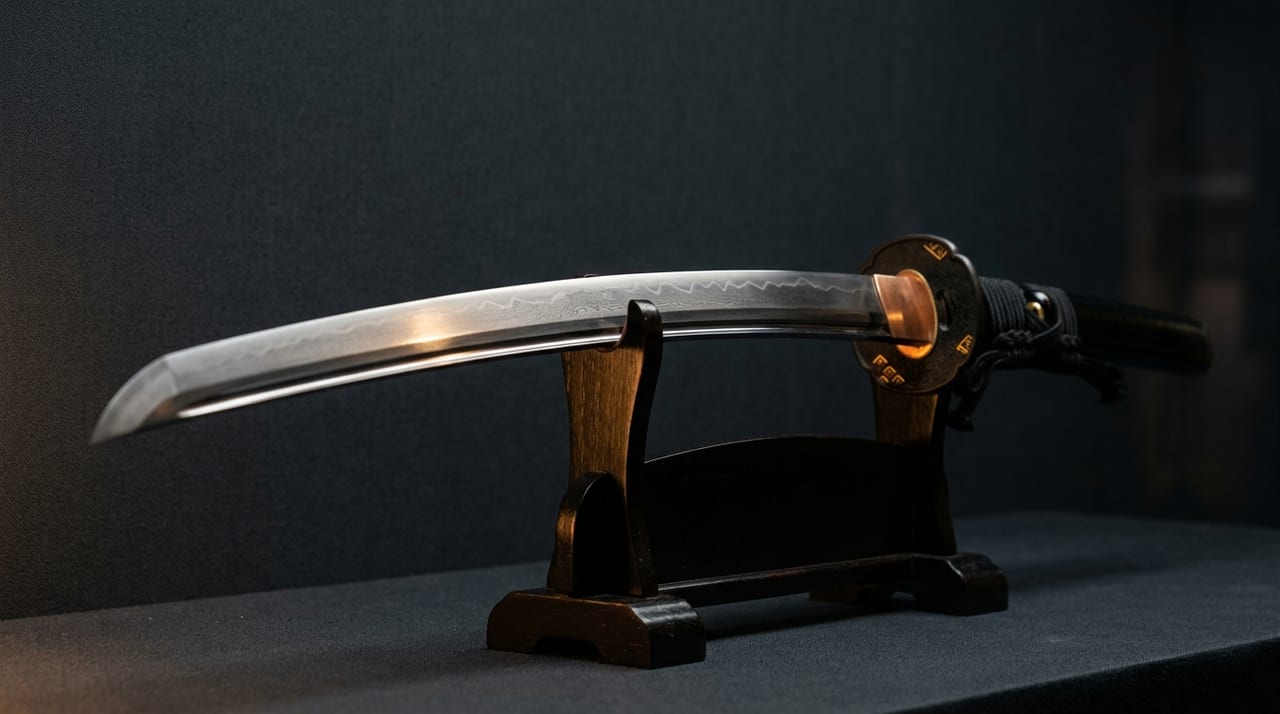
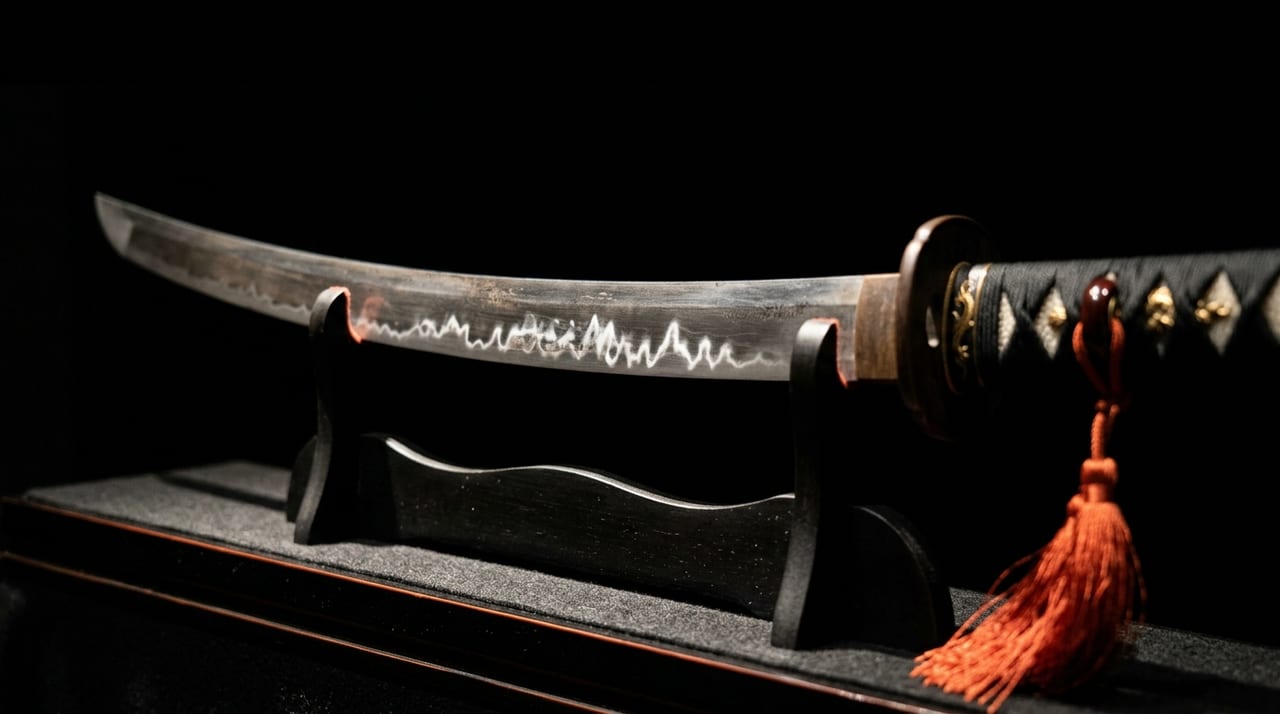
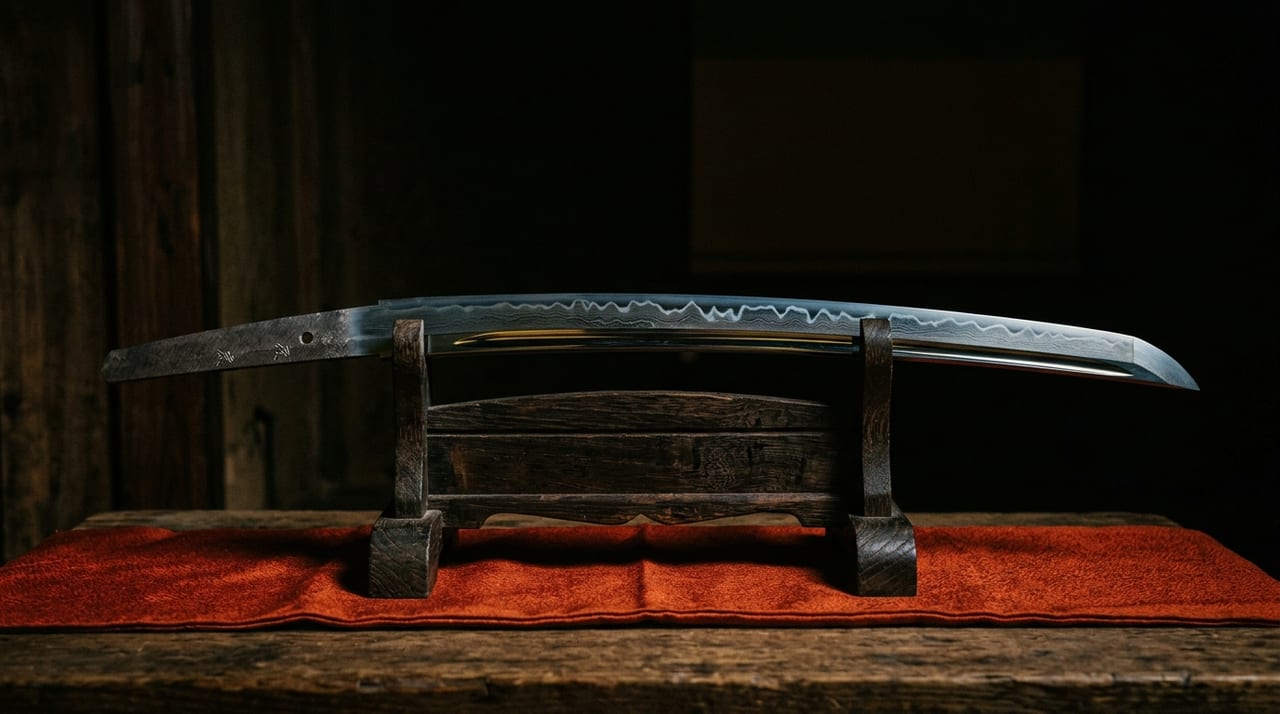
Observing the hamon of a Japanese sword closely, you will see fine particles glowing along the yakiba-sakai, or white bands like mist. These are "nie" and "nioi." They appear similar, but their essence is distinctly different.
Nie: A state where bright particles recognizable to the naked eye scatter near the yakiba-sakai. Particles glowing like a starry sky are called "nie-tsubu," and a hamon abundant in them is called "nie-deki." When viewed in sunlight at changing angles, the particles sparkle, creating a visual impact like scattered gold dust.
Nioi: A state where finer particles than nie cluster densely, appearing as a band like mist or white smoke. Individual particles cannot be distinguished by the naked eye, but the white band itself is recognizable. A hamon abundant in it is called "nioi-deki." The hamon of nioi-deki is soft, possessing an ethereal beauty like mist settling in.
In actual hamon, nie and nioi often coexist, and their ratio, distribution, and density determine the individual character of the hamon.
The Metallurgical Identity—Martensite Particle Size
According to modern metallurgy, nie and nioi are composed of the same crystalline phase of steel called "martensite," but their particle sizes are fundamentally different.
Martensite: An extremely hard crystalline phase formed when steel is rapidly cooled (quenched) from high temperature (austenite state). It has a special crystalline structure called body-centered tetragonal (BCT), with a volume larger than typical steel crystals. This volume expansion is one of the main factors in the sori or curvature of the blade. It also has the property of simultaneously increasing hardness and brittleness by forcibly confining carbon atoms within the crystal lattice.
Nie (large martensite particles): When the heating temperature before quenching is relatively high, austenite crystal grains enlarge, and the martensite particles formed after quenching become larger. Individual particles from several micrometers to tens of micrometers can be distinguished with the naked eye, glowing as points when struck by light. Nie particles develop more easily when the clay on the edge side is thin, allowing rapid cooling.
Nioi (fine martensite): When the heating temperature before quenching is slightly lower, austenite crystal grains remain small, resulting in fine martensite particles after quenching. Though individual particles cannot be seen, they appear as a white band when viewed collectively. Compared to nie, it provides more uniform hardness distribution, tending to increase the durability of the cutting edge.
The heating temperature is the primary factor determining whether the result is nie-deki or nioi-deki, but the carbon distribution of the jigane and the pattern of clay placement also have complex effects.
Clay Placement and Quenching—The Manufacturing Process That Creates Nie and Nioi
The difference between nie and nioi is determined by the properties of the jigane after forging and the subsequent processes of "tsuchi-oki" (clay placement) and "yaki-ire" (quenching).
Tsuchi-oki (clay placement): The process of applying "yakiba-tsuchi" (quenching clay), a mixture of clay, charcoal powder, and whetstone powder, to the blade. The shape of the hamon is determined by this clay placement pattern. Thinly applied areas (the edge side) cool quickly, while thickly applied areas (the spine side) cool slowly. This difference in cooling speed affects the quality and quantity of nie and nioi. Thin clay on the edge side promotes nie development, while thicker application at the yakiba tends to produce abundant nioi.
Yaki-ire (quenching): The blade is heated to approximately 800°C over charcoal and quickly submerged in water. This rapid cooling creates martensite. Water temperature, water volume, immersion angle, speed, and timing—all of these affect how nie and nioi appear. The swordsmith uses years of experience and intuition to judge the color in the furnace (flame color) and determine the optimal temperature. The moment of quenching is final; there are no second chances—it is truly a do-or-die moment.
Trends in Nie and Nioi by Production Region and School
Whether a blade exhibits nie-deki or nioi-deki is closely tied to the techniques of the tradition and school to which the swordsmith belongs.
| Tradition / School | Typical Characteristics |
|---|---|
| Soshu-den (Masamune, Sadamune, etc.) | Nie-deki abundant in large nie particles. The vigorous spread of nie creates a grand, magnificent beauty. |
| Yamashiro-den (Awataguchi, Raiha, etc.) | Nioi-deki with fine nioi as the primary element. Clear and precise hamon is characteristic. |
| Bizen-den (Ichimonji, Osafune, etc.) | Nioi-deki as the foundation with nie mixed in. The yakiba is clear and brilliant. |
| Yamato-den (Senjuin, Tegai, etc.) | Abundant nioi-deki, with restrained nie. Simple and powerful. |
| Mino-den (Kanemoto, Kanesada, etc.) | Nioi-deki and nie-deki coexist. The hamon is refined as a practical blade. |
The Soshu-den in particular is said to have been established by Masamune, who deliberately engineered jigane and clay placement to promote nie, establishing a grand hamon style. Conversely, the Awataguchi school of Yamashiro-den pursued fine nioi, embodying subtle but profound beauty.
Evaluation Criteria for Nie and Nioi and Special Phenomena
In Japanese sword appraisal, nie and nioi are evaluated from the following perspectives.
Evaluation Points for Nie:
- Uniformity of particle size (greater uniformity indicates higher skill)
- Clarity of radiance (absence of dullness or rust)
- Regularity of distribution (does it line up orderly along the yakiba-sakai)
- Density (the extension of nie into the blade body, called "ashi")
Evaluation Points for Nioi:
- Uniformity of width (is the width uniform along the yakiba-sakai)
- Depth (does the "nioi-guchi" extend deeply into the blade body)
- Transparency (does it have the clear whiteness of mist, or does it appear cloudy)
Special Phenomena of Nie and Nioi:
- Sunagashi (sand-stream): A phenomenon where fine streaks of light flow along the yakiba-sakai. Nie particles lined up in a linear pattern.
- Kinsuji (gold thread): A fine golden glowing line running along the yakiba-sakai. Rare and highly valued.
- Inazuma (lightning): A bright line of light running in a lightning-like pattern.
- Tobiyaki (flying fire): Isolated hardened sections on the jigane separate from the hamon.
- Uchinoke: A phenomenon where a separate white arc appears above the yakiba-sakai.
These arise accidentally through the complex interactions of heat convection and conduction during quenching. Though often considered hallmarks of famous blades, deliberately creating them is extremely difficult for the swordsmith.
Light and Angle Necessary for Appreciation
To properly observe nie and nioi, appropriate lighting and observation methods are essential.
A point light source is recommended—using incandescent bulbs or high color-rendering LED lights (color rendering index Ra90 or higher), adjust the angle while directing light at the hamon. Nioi appears as a white band when light is directed at a slightly frontal angle to the blade, while nie particles sparkle when slanted light is used. Fluorescent lights and diffuse light make it difficult to see the details of nie and nioi and are not well-suited for observation.
Holding the blade horizontally and shifting its angle by 5 to 10 degrees at a time while keeping the light source fixed will cause nie particles to sparkle one after another as if lighting up. This visual experience in this moment is one of the greatest pleasures of appreciating a Japanese sword.
Conclusion—The Hamon is a Collaborative Creation of Swordsmith and Nature
The beauty of nie and nioi is not something the swordsmith can fully control. The technique of clay placement, the judgment in quenching, the carbon distribution of the steel, the temperature of the water—countless variables intertwine in complex ways and appear as a result. Even for a master swordsmith, reproducing the exact same hamon each time is nearly impossible.
This is why the hamon of famous blades is called "ichigo ichie" (one time, one meeting). Scientifically, it is merely a difference in the particle size of the crystalline phase, but the creator's intention, technique, and the chance of nature converge to create a beauty that is utterly unique. Understanding nie and nioi deeply is directly connected to cultivating an eye that sees the Japanese sword not merely as a weapon, but as a craft in which science, art, and spirituality are fused.