Kawari-Gata Tsuba: The World of Unusually Shaped Japanese Sword Guards
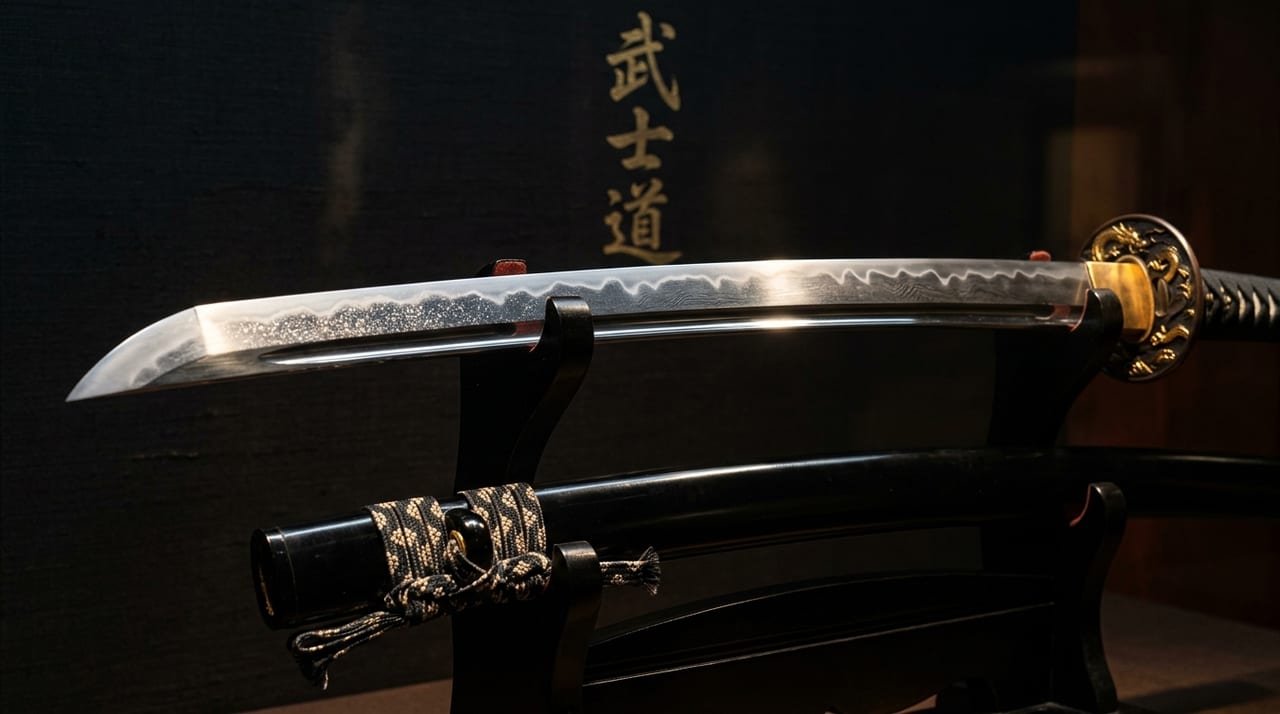 * Image is for illustrative purposes only.
Table of Contents
Definition and Appeal of "Variant Forms"
Tsuba shapes are broadly divided into "standard forms" (jougata) and "variant forms" (kawarigata). Standard forms refer to widely prevalent basic shapes such as circular, mokkō-gata (melon-shaped), and angular forms, while variant forms are a collective term for all other non-standard shapes.
The appeal of variant-form tsuba lies in the fact that the shape itself is already a message. When a warlord wore a sword, the tsuba's shape was visible as part of one's attire to others' eyes. Selecting a tsuba of a special shape was also a means of displaying one's aesthetic sense, beliefs, family status, and tastes to those around. When the Azuchi-Momoyama period gave way to the Edo period and warfare subsided, samurai began to view the sword less as a practical tool for battle and more as a "statement of status and aesthetic sense." This shift greatly accelerated the diversification of variant-form tsuba.
Historical Background of Variant-Form Tsuba
Variant-form tsuba began to be produced in large numbers primarily during the Azuchi-Momoyama period through the early Edo period. During this era, foreign cultures flowed in through nanban (Southern Barbarian) trade, bringing new ideas to the design of sword fittings. Moreover, with the flourishing of chanoyu (tea ceremony), the spirit of mitate (aesthetic appropriation) and wabi-sabi came to be demanded in martial equipment as well, and tsuba makers pursued sculptural forms unbound by conventional standard forms.
Among tsuba makers, the Umetada school, based in Kyoto, became especially renowned for the production of variant-form tsuba. The refinement of metalwork combined with a challenge to free-form shapes can be seen commonly in the work of artisans such as Umetada Myōju. Furthermore, the Gotou family, primarily known for their metalwork, also produced tsuba of distinctive shapes from workshops under their influence. By the middle of the Edo period, tsuba makers throughout various domains competed in original designs, and the production of variant-form tsuba became increasingly vigorous.
Types and Meanings of Major Variant-Form Tsuba
- Fan-shaped tsuba (ougi-gata tsuba): The fan shape is deeply rooted in Japanese culture as an auspicious motif of "expanding toward the end," and was treasured as a form bringing good fortune. During the Edo period, it was favored by wealthy warrior families and culturally sophisticated individuals familiar with chanoyu, and many refined examples remain with scenes from Noh theatre or seasonal flowers carved into the ground metal.
- Hollyhock-shaped tsuba (aoi-gata tsuba): A tsuba modeled on hollyhock leaves. Since the hollyhock crest is widely known as the family crest of the Tokugawa clan, a hollyhock-shaped tsuba sometimes indicated a connection with the Tokugawa retainer corps. However, many examples were chosen purely as a plant motif, so it is premature to connect all of them with the Tokugawa. Finely executed examples with leaf veins carefully expressed through openwork carving show particularly high completion as tsuba for appreciation.
- Cross-shaped tsuba (juuji-gata tsuba): One of the shapes most directly reflecting contact with nanban culture. Often conscious of the Christian cross, examples related to Christian daimyo such as Konishi Yukinaga and Takayama Ukon are transmitted in records. However, since cross-like structures existed before nanban trade in forms such as "sword-shape openwork," caution is needed as not all cross-shaped tsuba necessarily connect to Christianity.
- Gourd-shaped tsuba (hyoutan-gata tsuba): From the image of Toyotomi Hideyoshi's standard, the "Sennari-byōtan" (thousand-fruiting gourd), it became popular as an auspicious object imbued with the warrior's yearning and wishes for victory. The gourd shape particularly stands out for the beauty of its curves, and even iron-ground examples with minimal decoration radiate a strong presence through the shape itself.
- Half-moon-shaped tsuba (hangetsu-gata tsuba): A semi-circular tsuba. The moon is a poetic motif of great importance in Japanese culture, and a shape evoking the "ariake moon" or "crescent moon" carries a subtle beauty consonant with the spirit of chanoyu. Many examples remain combining the scene of moon-viewing with pines or reeds depicted, which possess high painterly completion.
- Sword/blade-shaped tsuba (ken-gata tsuba): A tsuba formed in the external shape of a sword or blade. The shape itself embodies a weapon, becoming a powerful statement of martial will. Many such tsuba were used on practical swords of the Muromachi and Sengoku periods, and examples with carvings imitating blade patterns are also found.
Production Techniques—Materials and Processing That Bring Out Form
The choice of material and technique is of significant importance in bringing out the individuality of variant-form tsuba to their fullest.
Iron-ground variant-form tsuba create a rustic and vibrant expression through the interplay of the ground-iron's surface pattern (hada)—the fine surface markings born from repeated forging—and the shape's contours. The powerful character of iron, exemplified by the Higo tsuba with its rejection of unnecessary ornamentation, harmonizes exquisitely with the individual character of variant forms.
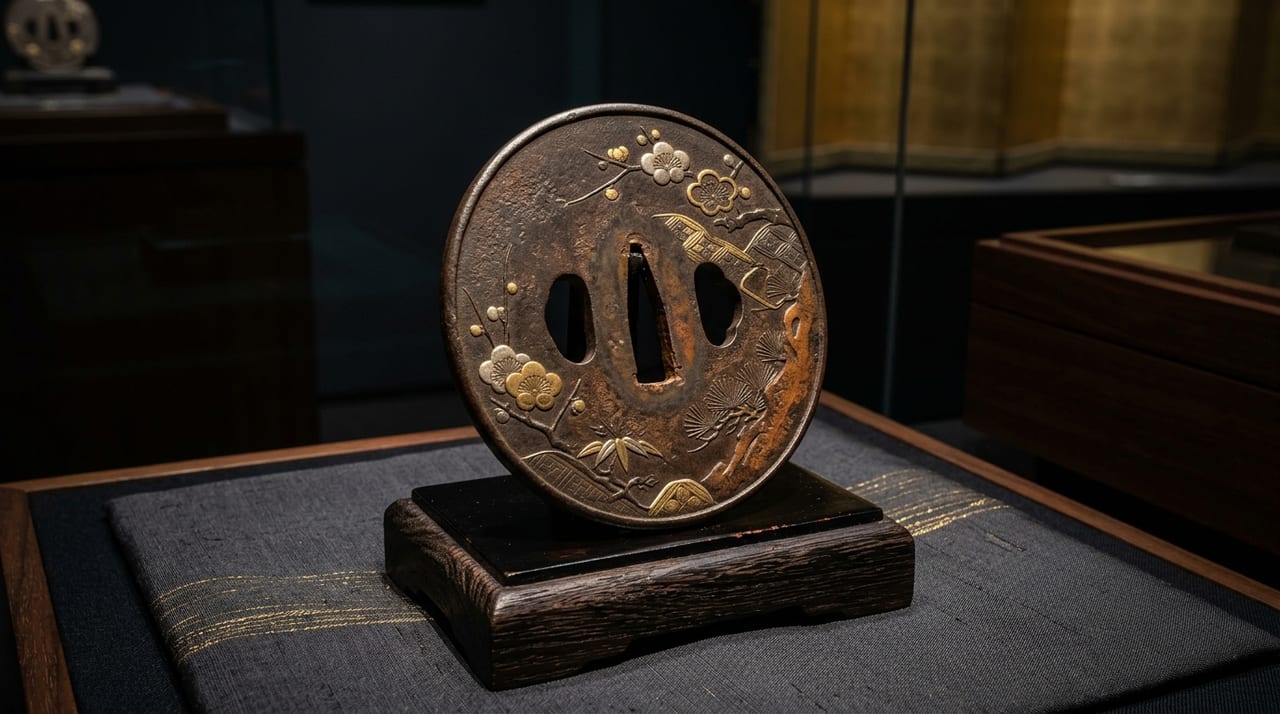
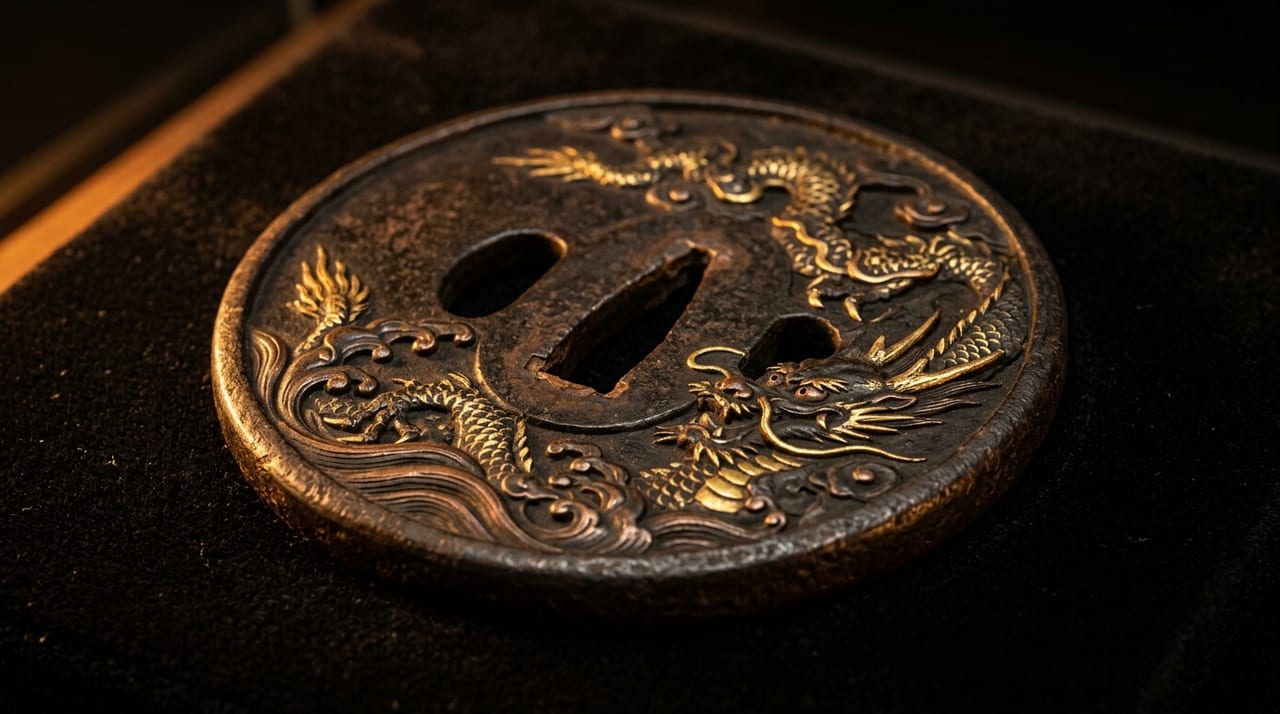
In variant-form tsuba with metal decoration, nunome zogan (cloth-pattern inlay) and takabori (high relief) were favored. Nunome zogan is a technique of making fine cloth-like marks on the ground metal and hammering gold and silver into them, creating depth on the surface of variant-form tsuba with complex outlines.
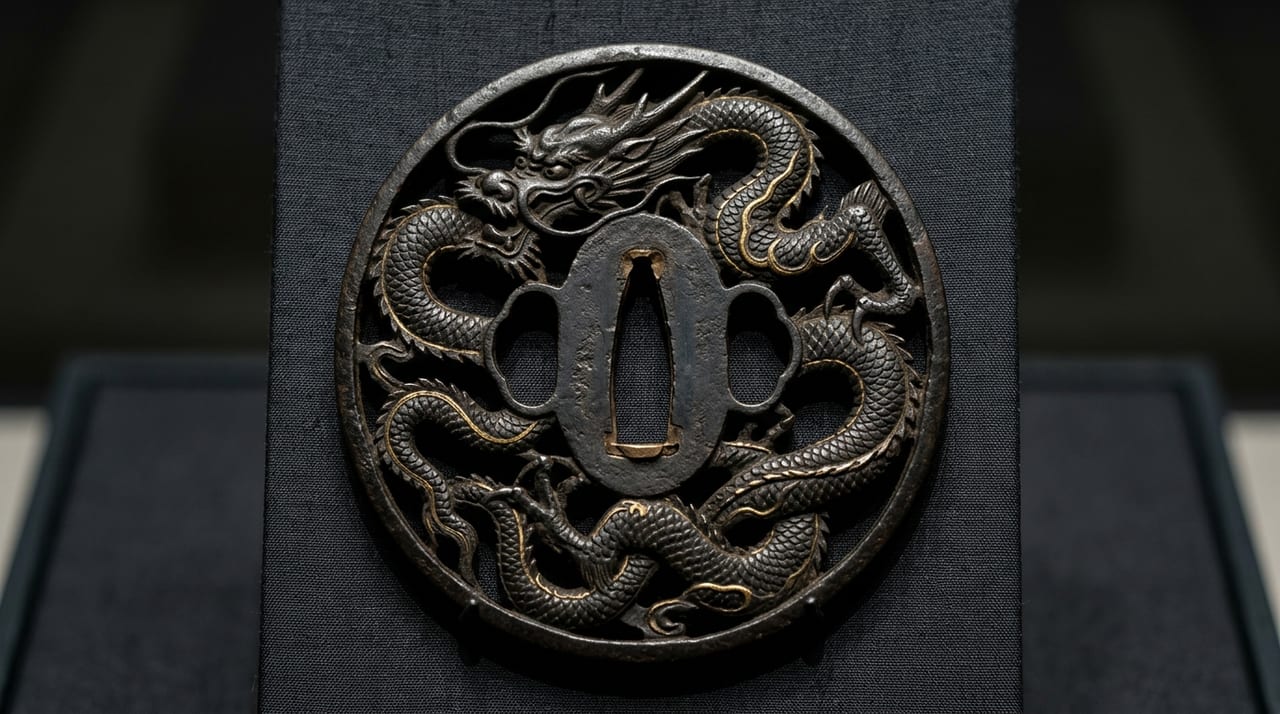
Furthermore, the sukashi (openwork) technique—cutting through metal to create patterns—shows particularly good compatibility with variant-form tsuba. Through the combination of the shape's outer edge and interior openwork patterns, works emerge that present completely different expressions depending on how light strikes them. Examples designed so that the sukashi's outline corresponds with the tsuba's outer shape demonstrate the high compositional skill of the craftsperson.
Appreciation and Collection of Variant-Form Tsuba
Collecting variant-form tsuba offers a unique enjoyment in the variety of forms. Since the shape differs from piece to piece, the visual rhythm created when displayed together is interesting, and the diversity of meanings embedded in each form deepens the appreciation.
In appreciation, it is important to observe how the shape harmonizes with the entire sword mounting (handle, sheath, and ornaments). Variant-form tsuba are beautiful even individually, but examples transmitted as complete sets of koshirae (sword mounting) are rare, and the ability to confirm the overall unity of the sword mounting gives them special value. A koshirae where shape, material, technique, and design function as an integrated whole is also the most faithful record of the aesthetic sense of the time of its making.
In determining authenticity, comprehensive judgment is required based on the regularity of the shape (distinguishing intentional asymmetry from later deformation), the period characteristics of the ground metal, and the presence or absence and style of any signature (mei). When acquiring such pieces, it is desirable to consult explanations from sword dealers or specialists and, if possible, to verify records together with the pairing koshirae.
Conclusion—Japanese Aesthetic Sense Dwelling in Form-Breaking
Variant-form tsuba are sculptural heritages that convey to the present day the individuality of the craftsmen who pursued free-thinking in form and meaning beyond the bounds of standard forms, and the collectors who selected them. The fan's good fortune, the hollyhock's authority, the cross's foreign exoticism, the gourd's martial valor—each shape is not merely a sculptural departure but rather a crystallization of the era's thought, faith, and aesthetic sensibility.
As the apex of the diversity of sword fittings, variant-form tsuba offer an interest distinct from standard-form tsuba. The joy of deciphering the story embedded in each shape—this is the true delight of variant-form tsuba appreciation.