Inlay (Zōgan) Techniques on Tsuba: The Principles and Aesthetics of Kome-zōgan, Nunome-zōgan, and Kirikane-zōgan
 * Image is for illustrative purposes only.
Table of Contents
What Is Zōgan: The Beauty Born from the Fusion of Different Materials
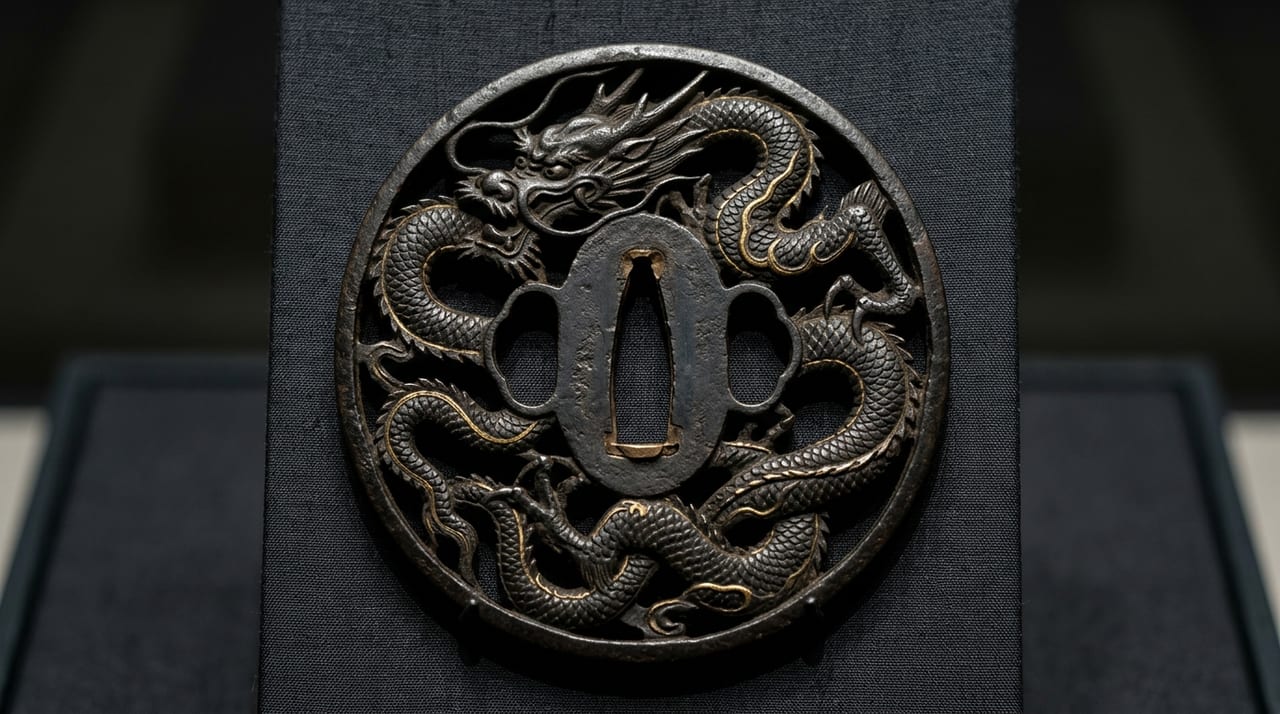
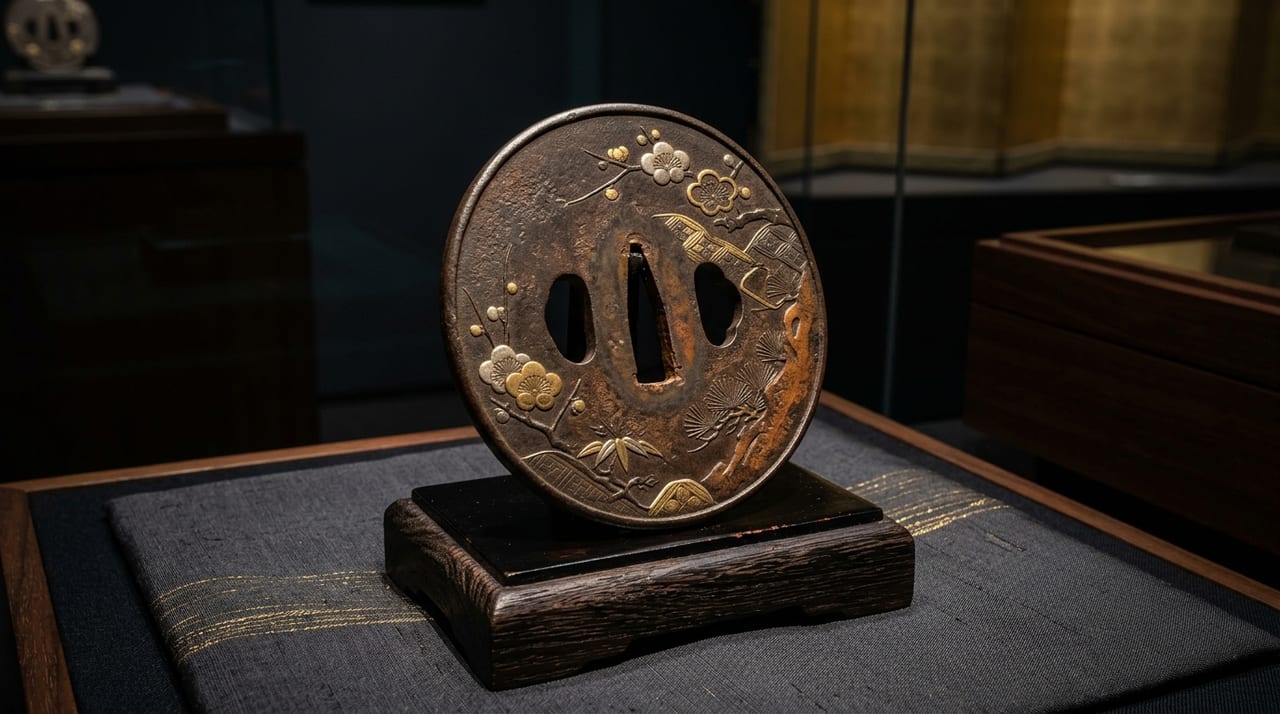
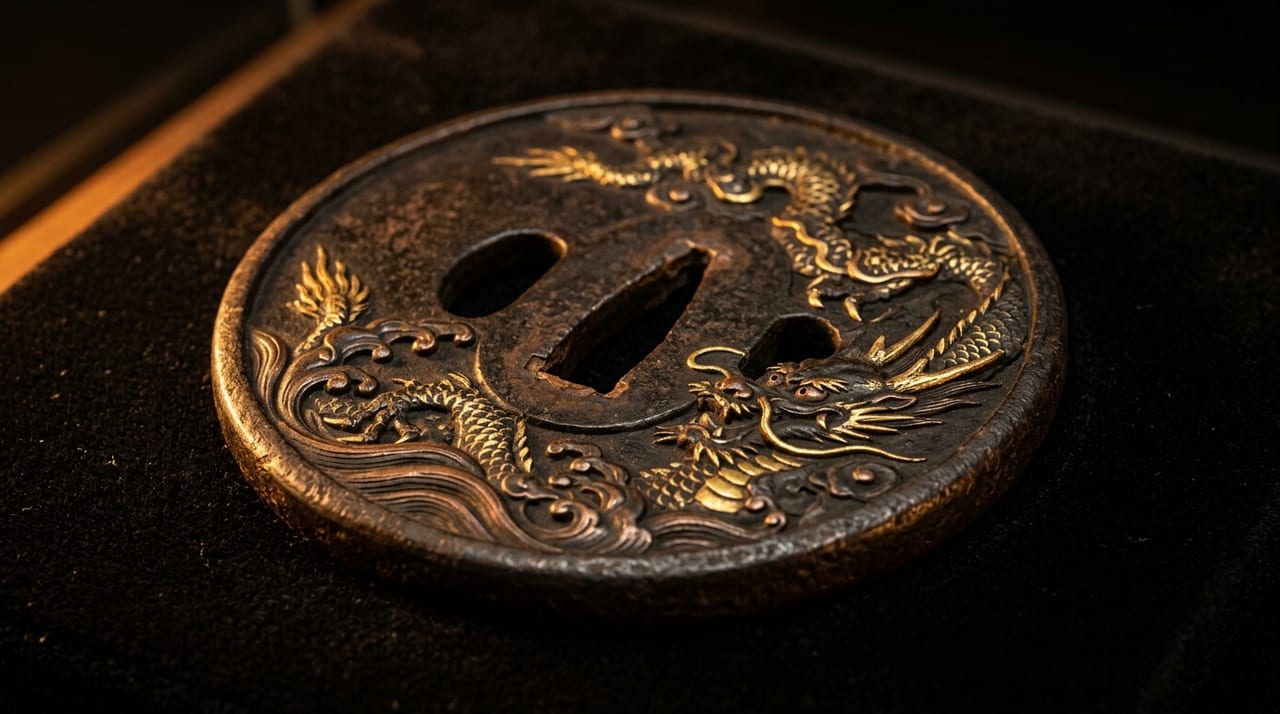
Zōgan is a general term for techniques in which different materials — gold, silver, shakudō, shibuichi, and others — are inlaid into a metal ground to create decoration. The contrast in color, luster, and texture between the ground and the inlaid materials generates visual effects, bringing depth and richness to what would otherwise be a flat metal surface.
Zōgan has a long history — various forms of inlay developed in ancient Egypt, Persia, and China as well — but in Japan it was refined to a singular height alongside the development of tōsōgu. The inlay techniques refined by metalworkers of the Edo period in particular are recognized as a remarkable achievement in the history of metalwork worldwide. As schools such as the Goto family, the Umetada family, the Nara school, and the Yokoya school competed with one another, zōgan transcended mere "embedding" and acquired an expressive power comparable to painting.
The role of zōgan on tsuba can be organized into three broad functions.
- Imparting color — composing an image by combining the colors inherent to each material: the black of iron, the deep brown of shakudō, the brilliance of gold, and the whiteness of silver.
- Refining the design — using zōgan to supplement fine details — eyes, claws, lines of feathers — that are difficult to express through carving alone.
- Diversifying texture — the contrast in sheen, luster, and grain that arises when different materials are placed side by side.
Kome-zōgan: The Most Fundamental Technique
Kome-zōgan is the most fundamental inlay technique, in which grooves or holes are carved into the base metal and a different material is hammered in to secure it. "Kome" carries the meaning of "to pack in," and the essence of this technique lies in its fixation by physical compression.
The procedural steps of the technique are as follows.
- Grooves or holes in the shape of the design are carved into the base metal (iron, shakudō, etc.). The cross-section is often cut in a dovetail (arimizo) shape — wider on the inside — creating a structure that prevents the inlaid material from pulling out.
- The material to be inlaid (gold, silver, etc.) is cut slightly larger than the groove or hole.
- The material is placed against the groove or hole and hammered in gradually with a chisel (tagane) and mallet (tsuchi).
- The surface is ground flat and finished with whetstones and files.
What determines the quality of kome-zōgan is the balance between the precision of the groove and the hardness of the inlaid material. If the groove is too shallow, the inlaid material tends to fall out; if too deep, the structural integrity of the base metal is compromised. The kome-zōgan of a master craftsman fits so tightly that the join is invisible to the naked eye, and the boundary line can only be confirmed under a loupe. Even today, kome-zōgan technique is indispensable in the restoration of period koshirae, and although it is the foundational technique, the level of its execution is a direct reflection of the craftsman's mastery.
Nunome-zōgan: Hammering Gold into a Fine Lattice
Nunome-zōgan is a technique in which fine crosshatched scratches (nunome) are made on the surface of the base metal, and gold or silver foil or fine wire is then rubbed in over them to secure it. The lattice scratches, resembling the weave of cloth, "catch" the metal and hold it in place — the principle being that friction and mechanical hooking anchor the thin metal layer to the base.
A dedicated nunome chisel is used to work the nunome pattern. Parallel lines are struck both vertically and horizontally to create the lattice of scratches, whose ridges serve as minute barbs that catch the gold or silver foil. If the density of the nunome is too coarse, the metal peels away easily; if too fine, the work becomes difficult to execute — an experienced craftsman adjusts the coarseness of the nunome to suit the piece's purpose, materials, and design.
Among the principal applications of nunome-zōgan, "kin-nunome-ji" (gold nunome ground) merits special mention. This is a technique in which nunome is applied across the entire surface of the base metal; gold or silver is then rubbed in to prepare a gold or silver background, over which the main subject is carved in high relief (takabori) or hair-line engraving (kebori). It is prominently seen in works of the Umetada school and Nara metalworkers. Tsuba with a kin-nunome-ji ground have a pictorial richness in which the carving stands out against a golden background, and they were especially prized in the warrior society of the mid-Edo period. In works that combine a silver nunome-ji ground with kome-zōgan in shakudō, the cool metallic luster of the silver sets off the warm deep brown of the shakudō, producing a distinctive refinement.
Kirikane-zōgan: The Precise Technique of Cutting Metal Sheet
Kirikane-zōgan is a technique in which thin sheets of gold, silver, shakudō, or similar metals are cut into precise shapes and inlaid into the base metal. "Kirikane" literally means "cut metal," and what distinguishes it from kome-zōgan is the use of flat sheet material cut in advance to a predetermined outline.
The greatest strength of this technique is its freedom of form. Whereas kome-zōgan is constrained by the shape of grooves and holes, in kirikane-zōgan the metal sheet can be cut with scissors or a chisel into any outline — birds, flowers, dragon scales, and so on. In the metalwork of the Goto family, highly sophisticated kirikane-zōgan is frequently seen in which precisely cut gold sheet is inlaid in complex shapes into a shakudō ground; Goto Jōshin and Goto Teijō in particular left masterworks expressing minute botanical designs in kirikane.
The technical difficulties lie in cutting the thin metal sheet and securing it to the base metal. If the edges distort when the sheet is cut, the fit with the base metal is compromised, so a step to flatten and reshape the cut sheet back to true is indispensable. For securing it, in addition to the same method used in kome-zōgan — hammering out the perimeter to bite into the base metal — a method of bonding with a small amount of low-melting alloy (a material close to silver solder containing tin or lead) was also used. The latter yields a higher level of visual finish, but carries the risk of the join flaking over time, and from the standpoint of appraisal and preservation the former is regarded more highly.
Iroe-zōgan: Pictorial Expression Woven from Multi-colored Materials
Iroe-zōgan is an advanced inlay technique that combines multiple metal materials of different colors and textures to achieve richly varied expression akin to painting. It brings together kome-zōgan, nunome-zōgan, and kirikane-zōgan, each working in a single material, and uses the colors inherent to each material as "pigments."
The role of each material's color is broadly established.
| Material | Color / Luster | Subject |
|---|---|---|
| Gold | Yellow / strong luster | The sun, flames, the golden gleam of arms |
| Silver | White / moderate luster | The moon, snow, the reflection of water surfaces |
| Shakudō | Jet black / depth | Night, shadow, the deep sea |
| Shibuichi | Grayish blue / subdued luster | The sky, haze, distant scenery |
| Iron | Black / rugged | Earth, rock, arms themselves |
Yokoya Sōmin is celebrated as the metalworker who carried iroe-zōgan to its ultimate expression. In his representative works, he used shakudō as the main ground and combined kebori in gold, kome-zōgan in silver, and kirikane in shibuichi to compose characteristically Japanese subjects — hawks, pine trees, rough waves — as three-dimensional paintings. After the Yokoya school, the designs on tsuba established their reputation not as "accessories to arms" but as "independent metal paintings," and they became status objects that daimyo and wealthy merchants competed to commission.
Points for Appreciating Inlaid Tsuba and Their Preservation
The first thing to confirm when appreciating an inlaid tsuba is the tightness of the joins. One should examine with a low-magnification loupe whether the boundary between the inlaid material and the base metal is perfectly closed, and whether there are any signs of gaps, lifting, or flaking. A piece in which the joins are uniformly tight all the way around directly attests to the high standard of technique at the time of its making.
Next, one examines the color development of the materials and their state of preservation. Gold and silver are relatively resistant to oxidation, but shakudō and shibuichi change in color over time. Shakudō is intentionally brought to a jet-black color by a treatment called "iro-age (color raising)" using a copper sulfate solution, after which further use and storage cause it to change to an even deeper brownish black. This layered color change is highly valued as "jidai-iro" (period patina). Discoloration due to rust or corrosion, however, is deterioration, and distinguishing between the two requires specialist knowledge.
Finally, one evaluates the degree of integration between zōgan and carving as a whole. In a superior inlaid tsuba, the individual techniques do not exist independently; rather, the contour lines of the carving naturally take over the material boundaries of the inlay, binding three-dimensional relief and flat color expression together organically. In the works of a master craftsman, the "completeness as a picture" when viewed from several tens of centimeters away and the "precision as a craft" when examined up close with a loupe are achieved simultaneously — and it is precisely that duality which is the greatest attraction of the inlaid tsuba.
Conclusion: The Richness of Tsuba Born from a Dialogue Between Different Materials
Kome-zōgan, nunome-zōgan, and kirikane-zōgan each possess their own principles and characteristics, yet in the hands of a master craftsman they are combined freely, condensing painting, sculpture, and craft into a single tsuba. Zōgan is not mere "ornamentation" — the brilliance of gold, the purity of silver, the depth of shakudō, the ruggedness of iron: it is a craft as dialogue, in which different materials each assert their own inherent beauty while harmonizing as one work.
When appreciating a nihontō, one's gaze tends to be drawn to the hamon (temper line) and the jigane (steel of the blade surface), but the thought and technique that a metalworker has poured into the zōgan of a tsuba are likewise part of the quintessence that Japanese metalwork offers to the world.