Hair-Pin-Shaped Large Swords——The Unique Sword Form of the Heian Period and Extant Cultural Properties
 * Image is for illustrative purposes only.
Table of Contents
Kenuki-gata Tachi: One of Japanese Sword History's Most Distinctive Forms
The "kenuki-gata tachi" (毛抜き形太刀) is one of the most unusual swords among those created during the Heian period (794–1185). While typical Japanese swords are made by separately crafting the blade (the metal portion) and the hilt (the handle made of wood, fabric, and metal fittings) and then joining them together, the kenuki-gata tachi has the blade and hilt forged as a single, integrated iron piece—fundamentally different from the standard structure of Japanese swords.
The name derives from the shape of the openwork (sukashibori) carved into the hilt (tsuka). Viewed from the side, the hilt features an oval-shaped openwork hole that resembles the upper half of a "kenuki"—a tweezer-like small tool—giving this sword type its name "kenuki-gata." This openwork is not merely decorative; it is believed to have served the functional purpose of reducing the weight of the one-piece iron hilt. The aesthetic and practical aspirations of Heian craftsmanship are concentrated in this small opening.
Structural Uniqueness: Why a One-Piece Design?
The hilt of a typical Japanese sword is constructed by inserting the nakago (the root portion of the blade) into a wooden tsuka-ki (hilt wood), then securing it with a mekugi (peg). In contrast, the kenuki-gata tachi consists of the blade, nakago, and hilt as a continuous, single-forged iron piece, using no wooden hilt wood at all.
The one-piece structure demands considerable skill from a forging perspective. In ordinary Japanese sword making, the craftsman focuses on forging the blade shape; however, with the kenuki-gata tachi, the entire piece—including the length, shape, and position of the openwork holes in the grip portion—must be forged at once. Additionally, the finishing requires precise openwork carving, making these surviving pieces evidence of the high level of technical skill possessed by Heian-period iron workers.
Various theories exist regarding the practical significance of this one-piece structure.
- One theory: The design was intended to eliminate the risk of the hilt separating from the blade during combat. Wooden hilt wood is susceptible to cracking and loosening due to moisture and impact, and there was danger of the hilt flying off entirely during intense sword strikes. A one-piece design eliminates this risk entirely.
- Another interpretation: Some scholars argue that this was a design for ceremonial or ritual swords used by Heian nobility, prioritizing external simplicity and elegance. A solid iron hilt that showcases the luster of the metal possesses a unique dignity different from the typical hilt wrapped in cloth or leather.
Regardless, this form was unique to the Heian period and rapidly became obsolete after the Kamakura period. In the practical swords of samurai, the wooden hilt structure became the mainstream due to considerations of usability and ease of repair, and the kenuki-gata technique disappeared without being transmitted to later generations. This is why this structure is not seen in modern Japanese swords.
Scientific analysis of existing examples suggests the possibility that the carbon content of the iron was deliberately varied between the hilt section and the blade section. If the grip portion was made from malleable low-carbon iron while the cutting portion was made from hardness-enhanced steel, with each section purposefully crafted to have different properties within a single one-piece forging, it would indicate that Heian-period iron workers possessed metallurgical control beyond mere shaping.
Historical Positioning: The Intersection of Continental Culture and Japanese Originality
The Heian period, when kenuki-gata tachi were made, was an era in which Japanese culture was gradually moving away from the direct influence of continental (Tang) culture and developing Japan's unique "kokufu bunka" (national style culture). In swords as well, this period coincided with a transition from the straight blades of the continent to Japan's distinctive curved tachi (sword).
The kenuki-gata tachi structure finds no clear counterparts in continental swordcraft and can be said to represent a purely Japanese invention. At the same time, it reflects the lineage of decorative swords from the Nara period such as "kuro-urushi no tachi" (black-lacquered swords) and "kazari no tachi" (ornamental swords), representing a stage in the refinement of sword culture as ritual and ceremonial dress within Heian aristocratic society.
The Heian period was also the age of "sekkan politics" (the rule of the imperial regents). The upper aristocracy, centered on the Fujiwara clan, regarded swords more as symbols of authority and status than as military implements. This cultural background provided fertile soil for the intricate openwork carving of kenuki-gata tachi. This form, where aristocratic aesthetics and artisan skill intersected, stands as clear evidence that Heian sword culture occupied the boundary between its continental past and its Japanese future, making it of immense historical significance.
Existing Representative Examples: Masterpieces Protected as National Treasures and Important Cultural Properties
Kenuki-gata tachi exist in extremely limited numbers, and nearly all surviving examples have been designated as either National Treasures or Important Cultural Properties. Due to their rarity, each existing blade serves as primary source material in Japanese sword research.
The most widely known representative example is the "Tsuru-maru Kuninaga" (鶴丸国永). This tachi, held by the Imperial Household Agency, is said to have been made by Kuninaga, a swordsmith of the Gojo school. The Gojo school, distinct from the Sanjo school (Munenaka), represents a lineage of master craftsmen representative of the old sword period. The Tsuru-maru Kuninaga is a rare surviving example in which the openwork carving of the kenuki-gata hilt remains completely intact, and the overall form, steel, and blade pattern are all highly regarded as representing the pinnacle of Heian-period sword aesthetics. Though public viewing is limited due to Imperial Household Agency stewardship, its elegant form can be confirmed through photographs and illustrated catalogs.
Other existing examples are preserved in several locations, including shrines and temples such as Kasuga Taisha in Nara and Shitennoji in Osaka. As long-enshrined votive offerings to deities and Buddhas, many of these blades have been preserved to the present day, having escaped the turmoil of warfare and destruction by fire that affected the secular world. The unique preservation environment of shrines and temples has been the primary factor enabling the survival of kenuki-gata tachi to modern times.
A kenuki-gata tachi is also known to be preserved at the Atsuta Shrine treasure museum in Aichi, where it is recognized as an example with intricate patterning carved not only in the openwork of the hilt but also on the nakago. This specific example demonstrates that the sword served as both a practical weapon and a work of craftsmanship appealing to the aesthetic sensibilities of Heian aristocracy. Additionally, some scholars suggest that this openwork design influenced later sword fittings—the tsuba (handguard) and menuki (grip ornaments)—and a perspective has emerged positioning the kenuki-gata tachi not as an isolated exotic form but as a primary source of Japanese sword decoration culture.
Points of Appreciation: Key Elements to Observe in Original Works and Photographic Materials
The opportunity to view kenuki-gata tachi in person is so rare in Japan that it occurs only a few times per year at best, but by understanding the key points to observe in museum exhibitions and photographic materials, one can deepen the appreciation of these swords.
- The shape and precision of the hilt openwork: The smoothness and bilateral symmetry of the outline of the kenuki-gata opening serve as a direct indicator of the craftsman's technical level. The ability to achieve such precise openwork while forged as one iron piece exemplifies the high technical skill of Heian-period iron workers. Examples finished cleanly without rough edges or distortion in the opening are considered superior works.
- The curve and kissaki (point) of the blade: As Heian-period tachi, most examples display either koshi-zori (curvature at the grip) or uchi-zori (inward curve), possessing a unique "sugata" (form) different from the central and forward curvature that became mainstream after the Kamakura period. The kissaki frequently takes the form called "ko-kissaki," a small, rounded shape, which is also a typical characteristic of Heian-period tachi.
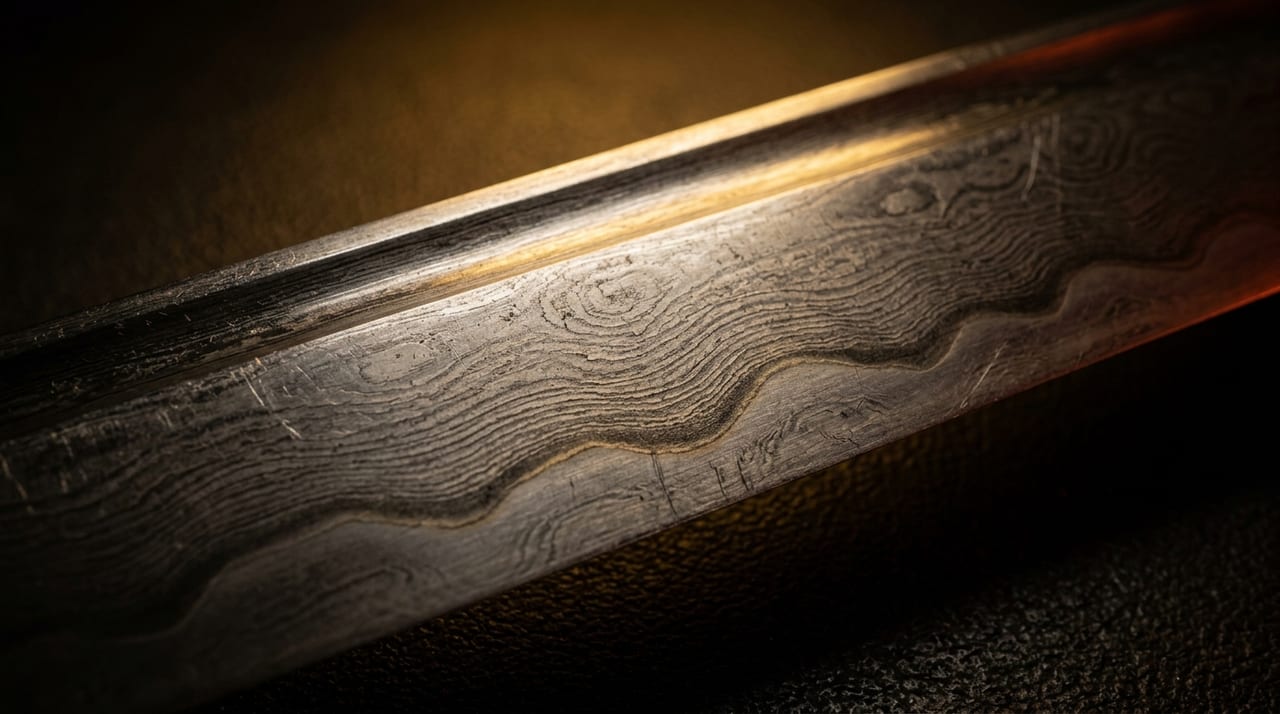
- Jigane (steel pattern) and hamon (blade pattern): Many surviving examples are difficult to observe due to rust and repeated polishing from prolonged storage; however, well-preserved examples may reveal the settled, small ko-itame-hada (fine grain pattern) steel characteristic of the old sword period and fine straight-edge or small irregular hamon patterns.
Conclusion: A Form That Existed Only in the Heian Period and Was Never Born Again
The kenuki-gata tachi represents a "singularity" in Japanese sword history. Never mass-produced, without successors, it remains a closed and unique form existing only in the Heian period. That this style was not transmitted after the Kamakura period, when samurai rose to prominence and practical swords were demanded, was a historical inevitability.
Yet the few surviving examples are irreplaceable witnesses to understanding the origins and diversity of Japanese swords. When given the opportunity to encounter original kenuki-gata tachi such as the Tsuru-maru Kuninaga, one should appreciate not only the beauty of the sword itself but also hold in one's heart the question of what Heian craftsmen sought to imbue in their blades. Beyond those openwork holes, the spirit of an age when martial prowess and beauty remained undifferentiated still dwells.