Ferrite, Pearlite, Martensite: An Introduction to Steel Microstructure for Understanding Nihontō
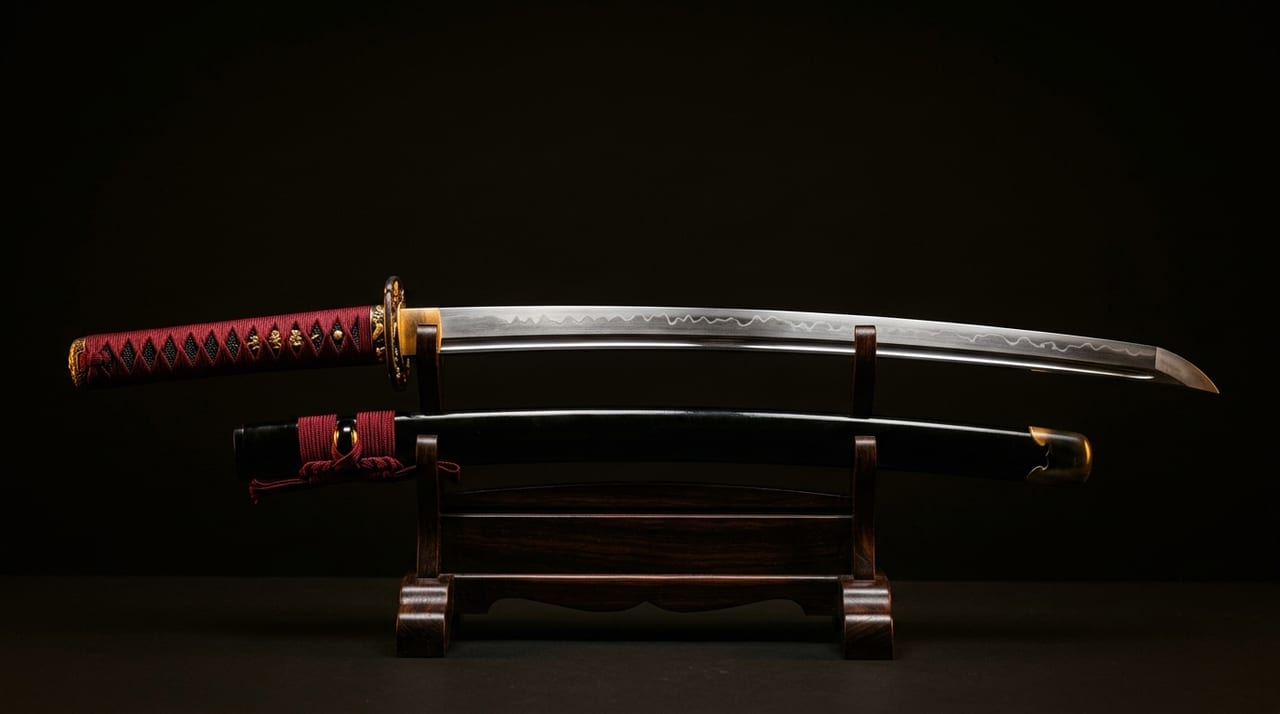 * Image is for illustrative purposes only.
Table of Contents
Why Metallurgy Is Essential for Understanding Nihontō
The characteristic of nihontō as being "hard yet unbreakable" has long been described as a "mysterious craft skill," but its essence can be explained by the science of steel microstructure changes. Having a basic understanding of metallurgy makes the meaning of traditional techniques such as orikaeshi tanren, yaki-ire, and tsuchioki far clearer, and adds a new perspective to the appreciation and appraisal of swords.
In the world of steel, two variables determine the microstructure: "carbon content" and "the speed of heating and cooling." The forging of nihontō is a tradition built on accumulated experience, yet it is in fact a systematic process for precisely controlling these two variables. This article takes the three basic microstructures — ferrite, pearlite, and martensite — as its framework and explains in turn the metallurgical significance of each stage in nihontō production.
Ferrite: The Basic Soft and Tough Microstructure of Iron
Ferrite is a microstructure close to pure iron containing almost no carbon, with a body-centered cubic (BCC) lattice structure. It is the stable basic phase of iron at room temperature and is soft with excellent ductility (ease of extension) and toughness (resistance to fracture).
In nihontō terms, the shingane (core steel) is relatively close to a low-carbon steel dominated by ferrite. Since the shingane, which forms the interior of the blade, requires the toughness to resist breaking, a low-carbon, high-ferrite microstructure is appropriate. This is the metallurgical basis for the uchigatana's resistance to breaking.
The role of wrapping the shingane belongs to the kawagane (jacket steel), which has a higher carbon content. The cross-section of a nihontō frequently has a structure in which the soft and tough shingane is enclosed within the hard kawagane, and this is considered a device for achieving both outer hardness and inner toughness within a single blade. The concept of a "hard exterior, tough interior" is a design philosophy common not only to steel materials but to composite materials in general.
Pearlite: The Microstructure of Intermediate Carbon Steel
Pearlite is a composite microstructure in which ferrite and iron carbide (cementite: Fe₃C) are arranged alternately in layers. When the carbon content is approximately 0.8% (the eutectoid composition), pure pearlite is formed; it is harder and stronger than ferrite, but softer than pure martensite.
When steel is classified by carbon content, the compositions are as follows.
| Classification | Carbon Content | Composition |
|---|---|---|
| Hypoeutectoid steel | C<0.8% | Ferrite + pearlite |
| Eutectoid steel | C=0.8% | All pearlite |
| Hypereutectoid steel | C>0.8% | Pearlite + cementite |
Because tamahagane varies in carbon content over a range of roughly 0.5% to 1.5%, it is necessary to obtain material with a carbon content suited to its intended use through "homogenization" in the ō-kaji process.
Martensite: The "Hardness of Nihontō" Born from Yaki-ire
Martensite is a microstructure formed by yaki-ire (quenching) of steel and has a body-centered tetragonal (BCT) lattice structure. The formation mechanism is a diffusionless transformation in which iron in the face-centered cubic lattice structure (austenite), which is stable at high temperatures, undergoes a lattice transformation upon rapid quenching without time for carbon atoms to diffuse and escape.
Martensite is one of the hardest microstructures in steel, but it is simultaneously brittle (prone to cracking). The cutting edge (ha) of a nihontō requires a hard microstructure dominated by martensite, while the mune (back of the blade) side requires a tough microstructure dominated by ferrite and pearlite — this "coexistence of hardness and toughness" is the fundamental challenge of nihontō. The sori and deformation around the machi that arise in the blade during this rapid quenching process are covered in Hamachi and Munemachi Finishing Techniques.
The Metallurgical Reason Sori Occurs
The sori (curvature) that characterizes the shape of nihontō is also considered deeply related to changes in steel microstructure. Martensite has a slightly larger crystal lattice volume than ferrite or pearlite, and when the cutting edge transforms to martensite through yaki-ire, that portion expands slightly. It is widely understood that the difference between the expansion at the cutting edge and the relative contraction on the mune side acts as a force that curves the blade toward the mune.
Of course, the size and shape of the sori are not determined solely by the transformation of steel microstructure; they are the result of multiple overlapping factors.
- What shape the tōkō forges the blade into during the sunobe and hizukuri stages before yaki-ire
- The thickness of the tsuchioki
- The quality of the steel
Nevertheless, metallurgy provides a fundamental clue to the question of why yaki-ire causes the blade to curve.
The Metallurgy of Tsuchioki and Hamon
Tsuchioki — the technique of applying clay to the blade before yaki-ire — is a precise technical operation for controlling the cooling rate and creating different microstructures in the cutting edge and mune sections.
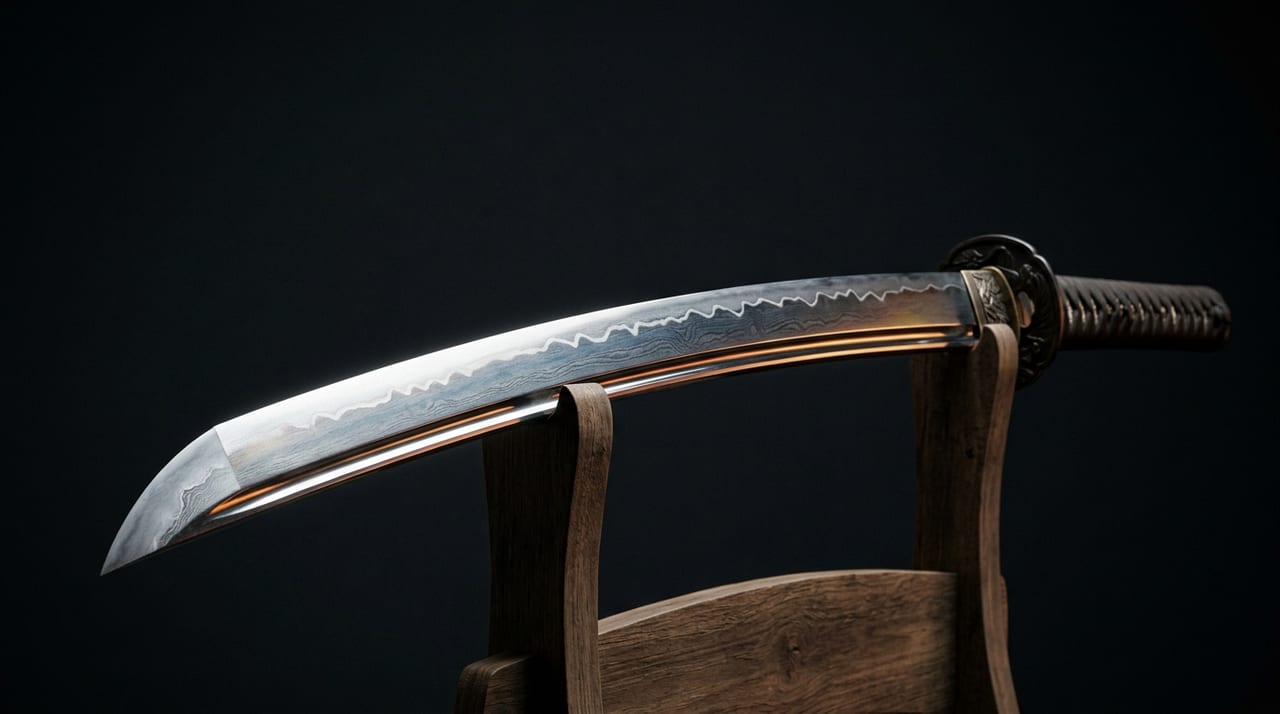
Sections coated with a thick layer of clay (the mune side) cool slowly, and a mixed microstructure of ferrite and pearlite is preserved. The cutting edge, coated thinly or left uncoated, is rapidly quenched and transforms to martensite. This boundary region appears as the band of brilliance observed as the hamon (temper line).
Nie in the hamon refers to the state in which coarse martensite particles are visible as grains, while nioi refers to the state in which fine martensite is distributed in a haze-like manner. Whether the hamon is nie-deki or nioi-deki is the composite result of the method of clay application, cooling rate, and carbon content of the steel, and is a part where the tōkō's skill and experience are expressed.
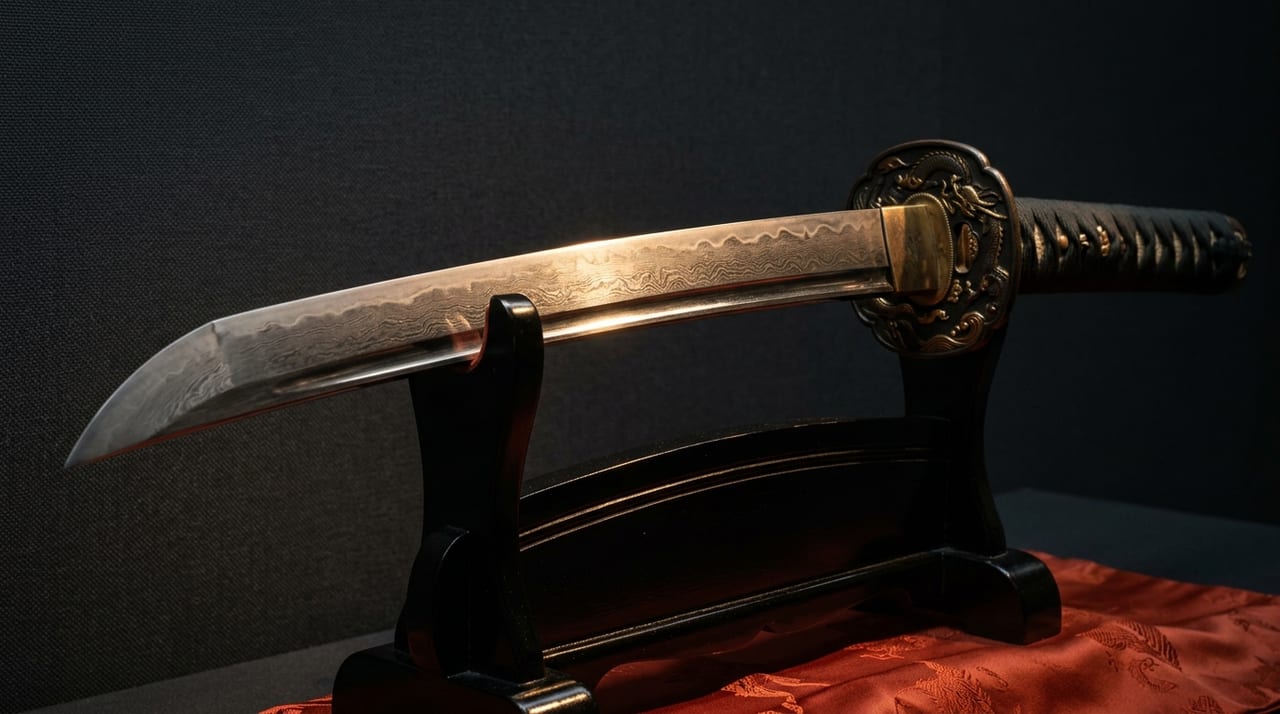
The hamon can be observed with the naked eye as a band resembling a white haze; viewing the blade while changing the angle of the light makes the differences in how nie and nioi shine more easily discernible. Paying attention to the shape and brilliance of the hamon during appreciation is not merely the appreciation of a design feature, but also a clue for inferring what kind of yaki-ire process the sword has undergone.
The Metallurgy of Orikaeshi Tanren: Homogenization and Inclusion Removal
The scientific significance of orikaeshi tanren's contribution to blade quality lies in "the removal of inclusions (slag) and the homogenization of the steel microstructure." Slag from the iron-making process (oxides, sulfides, etc.) remains as impurities within tamahagane. Repeated heating and hammering through orikaeshi tanren forces the slag out, causing it to rise to the surface and be removed.
Furthermore, repeated folding homogenizes the distribution of carbon and contributes to refinement of the microstructure. However, excessive folding carries the risk that carbon is consumed by combustion, causing the carbon content to fall lower than necessary. Modern metallurgists interpret the way craftsmen empirically found the optimal number of folding repetitions as evidence that they were intuitively grasping this "boundary between homogenization and decarburization."
How to Apply Knowledge of Steel Microstructure to Appreciation and Purchase
When selecting a nihontō, the appearance of the hamon and jihada (grain pattern of the steel) serves as one indicator that reflects how microstructures — ferrite, pearlite, and martensite — are distributed. A sword whose cutting edge has a clear brilliance and whose boundary between ha and ji is well-defined suggests that the tsuchioki and yaki-ire processes were carried out with care.
Kanteisho (appraisal certificates) often contain assessments of the quality of the hamon and the condition of the jigane (steel of the blade surface), and having a basic understanding of metallurgy allows one to read such assessments with a more concrete mental image of their meaning. Even when something feels off about the texture or brilliance of a blade, one becomes able to ask a tōshō or appraiser from the perspective of "what kind of microstructural change should have occurred at which stage."
Metallurgy of steel microstructures is the foundation for cultivating an "eye" for nihontō, and when combined with specialized appraisal knowledge, it greatly enhances the resolution of one's sword selection. The perspective of steel microstructure science does not "dismantle" the mystery of nihontō; rather, it is an auxiliary tool for reaffirming how scientifically rational the experiential knowledge of craftsmen was. The skill of tōshō and metal science are not in opposition — they speak the same truth in different languages.